Show notesShow notes
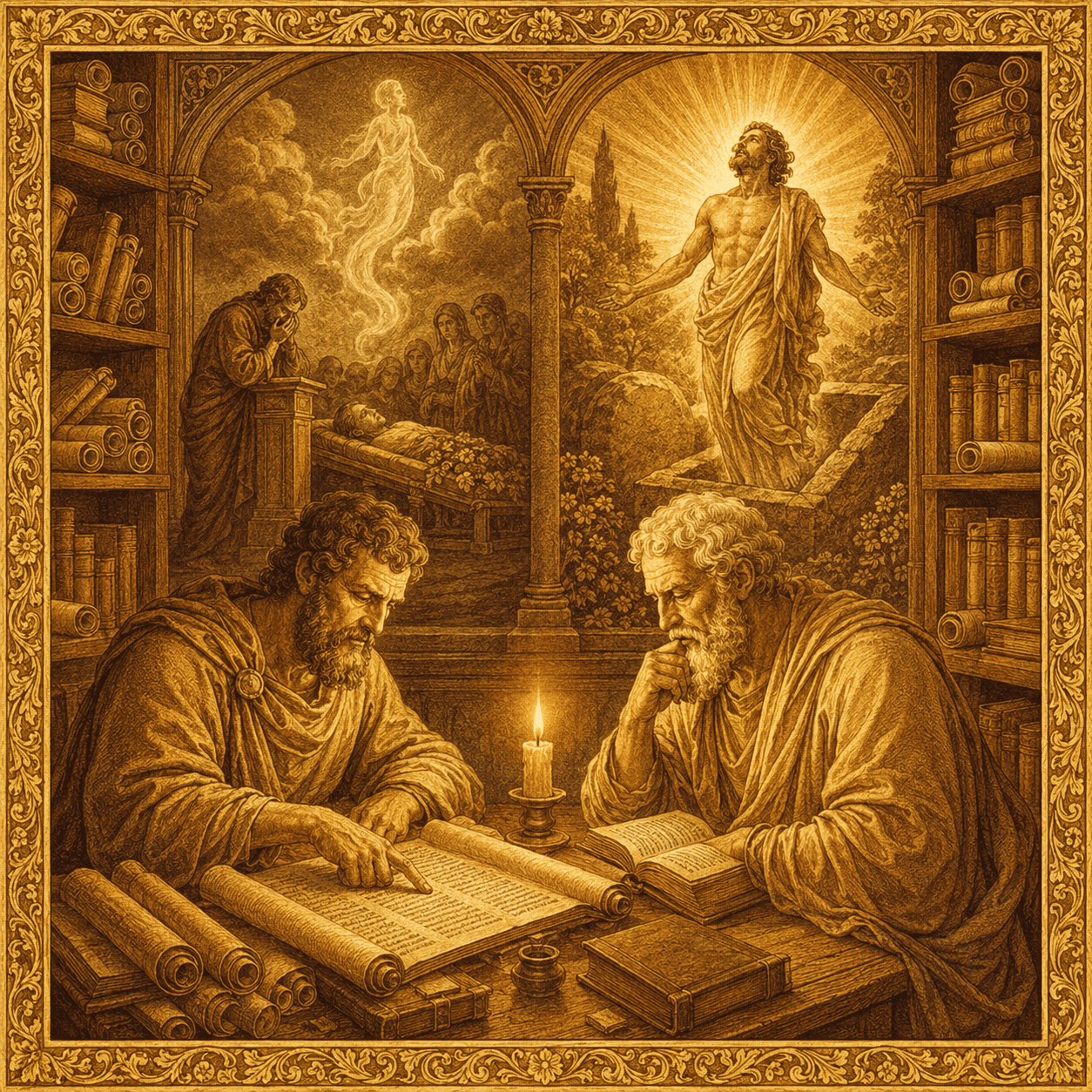
At the funeral, someone says it: they've gone to a better place, free of this broken world. It is the most familiar comfort in the West, and the first followers of Jesus would not have recognized it. Two hosts trace where it came from: Plato's split between a decaying world and a perfect one, with the body as the soul's prison and death as the way out.
Then they go back to what resurrection meant in first-century Judea: a body given back, born in the Maccabean martyrs' defiance and denied by the Sadducees who ran the temple. They weigh the historical case for the empty tomb, follow Paul's firstfruits to Revelation's city coming down, and ask what the escape story costs a world that God means to renew.
In this episode
- 4:19 Hellenization and Plato's two realms
- 10:17 Soma psychikon, soma pneumatikon: what Paul meant by a spiritual body
- 12:46 The Sadducees: power and the grave
- 15:23 The Maccabean martyrs
- 24:22 The case for the empty tomb, in four clues
- 33:30 Firstfruits and the split timeline
- 38:05 The cost of the escape story
The full argument is in the companion study: You Were Never Meant to Float Away.
Read the transcriptHide the transcript
Transcript edited for the page.
[0:00]
So picture this. You're sitting in a dimly lit room. Okay. The air is just heavy. Like you can smell the lilies everywhere. Oh yeah. That classic funeral home smell. Right. And there's this quiet, collective sorrow just sort of settling over all the rows of chairs.
It's a heavy feeling. It really is. And someone who deeply loved the person who just passed away steps up to the podium. Yeah. They look out at the grieving family. And with this genuine, profound tenderness, they offer those familiar words of comfort. The ones we've all heard a million times. Exactly. They say their loved one has gone to a better place. Right. That they're finally free of this broken world. That they're, you know, looking down from the clouds.
Which is an incredibly comforting image when you're dealing with the raw pain of grief. It really is. When you're sitting in that chair, staring at a casket, that image of the soul escaping the pain of a physical body, it's the exact lifeline most of us reach for. Yeah, we need to know they're okay. And escaping to heaven is basically the default setting for how Western culture processes stuff. But here is the massive historical reality we really need to unpack today. Okay, lay it on me. That beautiful, comforting image of a soul escaping a broken physical world to just float away to heaven,
it is not the original Christian story wait really not at all in fact if you were to present that exact framework to the first century writers of the New Testament yeah they wouldn't even recognize it they would look at you completely confused wow which forces us to ask the core question we're going to answer today I mean for anyone listening right now who has built their entire theology or even just their personal comfort on that idea right if the ultimate goal isn't our souls floating away to heaven, what actually is the Christian hope for life after death? Welcome back to Babel Report, and that question is exactly what we're going to unravel today. So glad to be back. Because here on Babel Report, our mission is to make deep Bible scholarship easy to follow. We take what scholars know about the ancient world, the original languages, the historical texts, and we try to make it land. No jargon, just the good stuff. Exactly. We want to look closely at the dirt, the history, and the reality of the text itself. Because when you strip away the assumptions we've gathered over, you know, a couple of thousand years of Western history, the original texts almost always say something entirely different than what we expect. Precisely. And to start this deep dive off, we really have to talk about the central figure of the text.
[2:51]
Right. Right off the bat. When the early followers of Jesus, or Yahusha, the name his friends in Galilee actually used. Yeah, that's such a great historical detail. Right.
When they stood in the streets of Jerusalem and later places like Rome and Athens, they made a highly specific, very physical claim. Okay. What was it? They declared that Yahuwah had raised Jesus from the dead. Raised him from the dead? Yes. And they did not mean his soul had survived the cross to live on in some spiritual realm. But I want to push back on that right away, because surviving as a spirit is exactly what most people today assume the Bible teaches. Oh, for sure. The general consensus in modern culture, even inside most churches, I'd say, is that the physical body is temporary. Yeah, just a shell. Exactly. It's a shell. And the ultimate victory is leaving the shell behind to exist as a free spirit.
[3:39]
It's the uninvited guest in Christian thought. The uninvited guest. That idea of escaping the physical body is a concept that snuck into the theology centuries ago. But it doesn't come from the Bible.
Where does it come from then? It actually comes directly from ancient Greece, specifically from the philosopher Plato. Wait, hold on. Are you saying the dominant view of the afterlife in modern Christianity was essentially copy-pasted from a Greek philosopher? That's exactly what I'm saying. But how does a Greek philosophical concept override a Judean religious movement? Did the early Christians just, like, sit down and read Plato's Republic? Not exactly. It's a matter of massive cultural osmosis.
[4:19]
You really have to look at the mechanics of the ancient world here. Okay, set the scene. So 300 years before Jesus, Alexander the Great conquers the known world. Right, huge empire. And when he did, he didn't just bring Greek armies. He brought Greek culture, Greek language, and Greek philosophy. Hellenization. Exactly, Hellenization. So by the time of the first century, the entire Mediterranean basin was breathing Greek thought the way a fish breathes water.
So it wasn't that a fisherman in Galilee was reading ancient philosophy textbooks. It was just the air they breathed. It was the assumed reality of the culture. And Plato's view of human existence was incredibly dominant in that cultural air. So what was Plato's view exactly, in plain words? To a Platonist, the universe is divided into two distinct realms. Okay, two realms? Right. You have the material world, which is flawed, changing, and decaying. That's us? Yeah, the physical stuff. And then you have the spiritual world of forms, which is perfect, eternal, and unchanging. So where does humanity fit into that split? Well, in that framework, the physical human body is essentially a prison. A prison? Yeah. The soul is the real you. It's this immortal, divine spark that somehow tragically fell from the perfect spiritual realm and became temporarily trapped. Encased in flesh and bone? Encased in it. So to a Platonist, the physical world is at best a pale shadow of what is actually real. And at worst? At worst, it's a heavy trap holding you down. Meaning the ultimate goal, like the highest possible good a human could hope for, is to finally escape the physical trap. You nailed it. You die, the soul is liberated from its flesh prison, and you ascend as pure light or pure spirit back to the eternal realm.
[6:12]
Yes. The good news for Platonists is evacuation. Evacuation. That's a great word for it. And as the early Jesus movement spread out of Judea and into the broader Greco-Roman world, that Greek idea began filtering into Christian circles. I see. So it just sort of blended in. Right. Early church thinkers who were trained in Greek rhetoric, people trying to explain the faith to a Roman audience, they started borrowing Platonist language to make it palatable. Because that's what the audience understood. Exactly. And over the centuries, it dressed itself up in biblical-sounding vocabulary and just passed itself off as the original message. Wow. But when you actually read the New Testament from one end to the other, it never once promises an evacuation. It promises transformation. That is a stark contrast for anyone listening who has been told their whole life to prepare for an evacuation.
Evacuation versus transformation. The Creator does not abandon His creation. He redeems it.
[7:08]
Let's anchor this with a picture. Okay, I love a good metaphor. Think of it like a house. Platonism treats the human body and the physical earth like a condemned rental property. Oh man, a condemned rental. Yeah. The roof is leaking, the foundation is cracked, the plumbing is completely ruined. You are just living in it, counting down the days until the lease is up. Right. You cannot wait to move out, hand over the keys, and leave it behind to be demolished by a bulldozer. That is the escape narrative. And in that scenario, you don't care if the drywall is rotting. You aren't going to spend a dime fixing the plumbing because you want nothing to do with the property anymore. Right. Why polish the brass on a sinking ship? Exactly. But the biblical view is the exact opposite. In the biblical view, God bought the house to do a full down-to-the-studs renovation. Ooh, I like that. Down-to-the-studs. He isn't tearing it down to leave an empty dirt lot. He is restoring the foundation, replacing the wiring, fixing the roof, and making it structurally perfect. Why go through all that trouble, though? Because he intends to move in. He reclaims the property.
[8:16]
But I have to play devil's advocate here. Do it. If you read the letters of the Apostle Paul, particularly in the New Testament, he talks all the time about the flesh being opposed to the spirit. He does. He explicitly uses the phrase spiritual body in his first letter to the Corinthians.
Doesn't that prove the Platonists were right? A spiritual body sounds like an oxymoron. It sounds like a ghost. That exact confusion you just voiced is precisely why Paul was so profoundly alarmed when he wrote his first letter to the Corinthians. He was alarmed. Specifically in chapter 15. Yeah.
Let's look at the dirt and history of Corinth. Corinth was a Roman colony in Greece. Okay. It was a bustling, upwardly mobile seaport, heavily influenced by Greek philosophy, and obsessed with intellectual status. So they were steeped in that Platonist mindset we just talked about. Deeply steeped in it. Okay. So when the Christians in Corinth heard Paul talking about the future, their cultural filters kicked in. Right. Some of them started actively arguing that there was no future resurrection of the physical body. Because to them, getting your physical body back sounded like a punishment. Yeah, why would you want to go back to the prison cell you just escaped? Exactly. They heard Paul use the word spiritual and immediately concluded that the future life would be a disembodied, ethereal, ghostly existence. Which makes total sense if your entire cultural background tells you that the physical world is dirty and the spirit world is pristine. They probably thought they were agreeing with Paul. They probably thought they were being highly advanced, enlightened Christians. They thought they had graduated to a higher level of spirituality.
but Paul wasn't just slightly annoyed by a minor misunderstanding. No. He was terrified they were losing the entire plot of the universe. He wrote an enormous, sustained argument in 1 Corinthians 15 to correct them. Wow. And to understand his argument, we have to look at the original Greek language he used, which gets completely lost in our English translations.
[10:17]
Okay, lay the Greek on me. Break down this spiritual body oxymoron. Paul contrasts two Greek phrases. soma psychikon and soma pneumatikon.
Okay, soma meaning body. Right. English Bibles translate this as a natural body and a spiritual body. But in ancient Greek, adjectives ending in -ikon don't describe what a thing is made of. They don't. What do they describe? They describe what a thing is animated by. Give me an example of how that works. Think of a steam engine versus an electric engine. Okay. If I say steam engine, I don't mean the engine is literally made out of steam. I mean the metal engine is powered by steam. Right. It's made of iron or steel. Exactly. And if I say electric engine, I don't mean it's an invisible block of electricity. It's a physical metal engine driven by electric power. Ah, okay. So the adjective points to the power source, not the material. Exactly. So when Paul says soma psychikon, a natural body, He means a physical body animated by the normal frailty, decay, and eventual death of regular human life. What we experience right now. Yes. When he says soma pneumatikon, a spiritual body, he is not talking about a ghost made of spirit. He's talking about the power source. He is talking about a physical, tangible body that is now animated by the imperishable, indestructible power of God's spirit. The exact same power that raised Jesus from the dead. So it's still a body. It is still a body. It still eats. It still has weight. But it is no longer subject to decay. It is imperishable. So what you're saying is God's plan isn't to rescue our souls from the physical world, but to permanently heal the physical world itself. That is the core of it. The Creator loves the physical world too much to let death have the final word over it.
That is huge.
[12:16]
But to understand the sheer seismic shock of that claim, we really have to travel back and look at the world Jesus actually lived in. Right, back to Judea. We have to set the ancient scene in Judea.
Because first century Judaism was deeply, sometimes violently, divided on what happened after death. So it wasn't a single unified belief system where everyone just nodded along to the same eschatology. Not even close. It was a theological battleground.
[12:46]
Let's look at the two major power groups of the first century. First, you have the Sadducees. The Sadducees? Mm-hmm. We hear that name a lot. If you grew up in Sunday school, you know the name. But we often miss who they actually were. They controlled the temple establishment. So they were the elite. They were the aristocratic, wealthy elite. The high priests, like Caiaphas, were generally Sadducees. and they completely, utterly denied the resurrection of the dead.
Completely denied it. They believed that when you died, you went to the grave, and that was the absolute end of your story. But wait, I have to stop you there. Go ahead. Why would the top religious establishment in the country completely deny the idea of resurrection? Usually, religious leaders are the ones selling the afterlife. That's a very modern way of thinking about religion. Right, but why do they want death to be the final period at the end of the sentence? To understand that, you have to follow the money and the power. The Sadducees only accepted the first five books of Moses, the Torah, as authoritative. Okay, Genesis through Deuteronomy. Right. They argued that resurrection isn't explicitly detailed in the Torah, so they rejected it. But the deeper unstated motive is political. Because theology is rarely just about theology. It's usually about power. Precisely.
[14:03]
Resurrection is, at its core, a deeply revolutionary doctrine. How so? Think about what it actually promises to a listener in the first century. It promises divine justice for the oppressed. Right. It promises that the people who were crushed by the systems of this world, the poor who were starved, the innocents who were executed by corrupt courts. They'll be brought back. They will be raised up, vindicated and given their physical lives back by God himself while the corrupt rulers are judged.
Oh, I see. If you are sitting at the top of the social ladder, a theology that insists the present arrangement is not the final word is incredibly threatening. It is terrifying to them. The Sadducees were very comfortable. They collaborated with the Roman Empire to maintain the Pax Romana, the Peace of Rome. They had a good thing going. They ran the temple, which basically acted as a central bank. They were wealthy beyond measure. People in power rarely want God to upend the present arrangement. Right. If the current world works perfectly for you, you do not want a theology that says God is going to drastically intervene, overturn the tables and resurrect the poor. So for the Sadducees, denying the resurrection wasn't just a textual debate. It was a way to protect their socioeconomic monopoly. Like this life is all there is. So you better respect our authority right now. You hit the nail on the head.
[15:23]
Now contrast the Sadducees with the Pharisees and the everyday working class Judean people of the first century. OK. What did they believe? They believed fiercely in a future bodily resurrection.
And to understand why it meant so much to them, you can't look at abstract philosophy. You have to look at their bloody history. Bloody history. Specifically the story of the Maccabean martyrs in the second century BC. Okay, so this is roughly 150 years before Jesus steps onto the scene. What happened? Israel was being ruled by the Seleucid Empire, specifically an oppressive pagan king named Antiochus IV Epiphanes. Okay. He decided to forcibly wipe out the Judean religion.
He outlawed reading the Torah, he banned circumcision, and he notoriously sacrificed a pig on the altar in the Judean temple. Oh, wow. That is a total cultural and religious genocide. Yes. It was a time of horrific state-sponsored terror.
And during this persecution, a specific story was recorded in ancient texts like the Second Book of Maccabees that burned itself into the Judean consciousness. What was the story?
The authorities arrested a Judean family, seven brothers and their mother. The king's soldiers tortured them brutally, demanding they eat pork and abandon the law of Yahuwah. And if they complied? If they complied, they would live. If they refused, they would be dismembered and fried in massive pans over a fire.
That is unimaginably dark. What did they do? They refused. But it is what they said as they were dying that formed the bedrock of the resurrection hope. What did they say? As these young men were being executed,
the ancient sources record that they didn't look up to the sky and talk about their souls escaping to the clouds. Right. They looked their executioners right in the eye.
One brother held out his mangled hands, the hands the soldiers were about to chop off, and declared to the king that the creator of the universe gave him those hands. Wow. And because he was dying for the creator's laws, the creator would give him his physical hands back in the resurrection. That is intense. They are literally seconds from a torturous death and their comfort isn't my soul will fly away and escape you. It's God will reverse what you are doing to my body. Exactly. It wasn't poetry. It wasn't a comforting metaphor for spiritual peace. It was a defiant, concrete, politically charged demand for justice.
They were saying to the empire, you have the power to destroy this physical body right now, but the God who made the physical world is the supreme judge. Yes. He will recreate my body, he will vindicate me, and he will judge you for what you've done. So resurrection was born in the crucible of martyrdom. It was the only way to reconcile a just God with the horrific suffering of his faithful people in the present world.
[18:15]
Exactly. So fast forward to the first century. when everyday people in the streets of Jerusalem used the word resurrection. It had a very strict, highly specific definition born from that history. What was the strict definition? It meant you die, you wait in some interim state, maybe the grave, maybe Sheol. And then at the end of human history, God intervenes, history stops, and he gives you your physical body back to live in a renewed physical world. It never meant going to heaven when you die. Never. That definition had to be imported by the Platonists centuries later.
Resurrection meant a physical return to a physical but renewed earth as part of God's final justice. So what you're saying is to a first century person, resurrection wasn't a ghostly afterlife. It was a concrete demand for God's justice on earth. You nailed it. And this brings us to the twist in the historical record. The mutation that absolutely broke the entire theological framework of the ancient world.
The mutation. Yes. Before that Sunday morning, we now call Easter. No Judean person, not the Pharisees, not the Sadducees, not even the disciples who had been walking with Jesus for three years, expected resurrection to happen to a single isolated individual in the middle of continuing history. Because as you just established, resurrection was supposed to be a massive collective group event at the very end of time.
[19:40]
Yes. In the Judean eschatology of the time, time was divided into two eras. What were they? You had Olam haZeh, which means this present age, characterized by sin, death, and oppression. And Olam haBa, the age to come, characterized by peace, justice, and the presence of God. Right. The dividing line between those two ages was the general resurrection of the dead. It was the climax of the human story, grand finale. God brings history to a close, and everyone is raised at once.
[20:14]
Wait, I know people reading their Bibles will immediately ask, what about the Old Testament? Didn't the prophet Elijah raise a widow's son from the dead? He did. Didn't people come back to life before Jesus? How is this unprecedented? That is a great distinction to make. What Elijah did was resuscitation.
Resuscitation. He brought a boy back to normal mortal life. That boy grew old, his body decayed, and he died again. He was still firmly trapped in the present age of decay. Right. He wasn't immortal. No. The early Christians were not claiming Jesus had been resuscitated to eventually die again. They were claiming he had entered the resurrection, the glorified, imperishable end-of-time body. So when the disciples start running through the streets of Jerusalem claiming that Jesus has been bodily resurrected, they weren't just checking a theological box. Not at all. They were making a claim that didn't fit into any existing mental category. It must have sounded completely, utterly bizarre to their contemporaries. Think about it from a modern perspective. Okay. It would be like someone today claiming that the sun just went supernova, triggering the end of the solar system, but it only happened over their specific house. And the rest of the world is just going to work on Monday morning like everything is fine. Exactly. It breaks the understood rules of reality and timelines. It shattered their entire understanding of how history worked. They weren't fitting an event into their existing theological categories. Their categories were being annihilated by an event. That's a brilliant way to put it. The end of the world had somehow happened to one single person right in the middle of the world's ongoing story.
[21:47]
Exactly. But it is one thing to sit here and say that a group of first century people believe something entirely unprecedented. Right. People believe weird things all the time. Cults invent bizarre theology every day. It is a completely different thing to step back and ask the historical question, did it actually happen? Was there a physical empty tomb in reality? Or is this just a theological myth, a coping mechanism for grief that got wildly out of hand? That is the million-dollar question. Because if it didn't happen in the dirt, none of this theology matters. Hold that thought. It comes back in a big way. We have to look at the actual evidence they left behind, the footprints in history that secular historians have to wrestle with. But before we get to that, a quick word from our sponsors. Babel Lens is a scholarly Bible reading app that brings the kind of depth we talk about here on Babel Report into your own daily reading. When we dive into the Greek meanings behind words like spiritual body, this tool actually allows you to see those original nuances for yourself right on your screen. If you want to dig into the original Greek of Paul's letters or the historical accounts of the first century we're discussing today, this tool makes the ancient texts completely accessible. On iPhone, search Babel Lens in the App Store. On Android or your computer, use the web app at babellens.ai. Thread Apothecary brings the stories, symbols, and fascinating details of Scripture to life through creative apparel and everyday goods. From Bible-inspired t-shirts and hoodies to mugs and accessories, these designs are made to spark conversations, sometimes with a little biblical humor. You don't have to be a theology professor to appreciate a shirt that cleverly nods to the history we're unpacking today. They actually have some incredible designs that celebrate the renewed creation and the physical reality of the resurrection, which is exactly what we're uncovering today.
Explore the collection at threadapothecary.com. Okay, back to it. We lift off with a massive, pivotal question of whether any of this actually happened in the physical dirt of history. Right. Did a first century Judean man, who was publicly executed by the Roman state, physically walk out of his grave?
To answer this without just relying on blind faith, we are going to step into a first century courtroom. I like this approach. We need to examine the facts on the ground, the clues that history left behind, like detectives building a case. We aren't just taking theological assumptions at face value. We are looking at the historical record to see what actually holds up to scrutiny. Right. So let's open the file.
[24:22]
Clue one, the hostile witnesses. Okay. Hostile witnesses. In any courtroom, if a hostile witness, someone who actively wants to destroy your case, accidentally confirms a key piece of your evidence, that is incredibly compelling. Yeah, that's the holy grail of cross-examination. We look at the Judean authorities in Matthew's account. These are the people who wanted this Jesus movement dead and buried. They collaborated with Rome to execute the leader, specifically to scatter the followers and end the headache. But when the disciples started claiming Jesus was alive just a few days later, how did the authorities respond? They didn't just ignore it. No. They responded with a specific counter-narrative. According to Matthew, they claimed the disciples came in the night and stole the body while the guards were sleeping. Okay, but couldn't a skeptic just say, see, Matthew admits they stole it? Well, think about what that counter-story actually proves to a historian. What does it prove? Wait, let me ask you. You only accuse someone of grave robbery if the grave is undeniably, embarrassingly empty, right? Exactly. If the body is still in the tomb, you do not invent an elaborate story about fishermen overpowering Roman guards to steal a corpse. You just walk down to the tomb, roll the stone away, point to the decaying body, and the movement ends that afternoon. Oh, wow. The opponents of the early movement did not dispute the empty tomb. They didn't claim the Christians went to the wrong tomb. They just offered an alternative explanation for the emptiness. Exactly. And grave robbery was a massive issue in the ancient world. We actually have an artifact called the Nazareth Inscription. What's that? It's an edict from the Roman Emperor Claudius around this time period, making the robbing of tombs a capital offense punishable by death. Really? Yeah. That's intense. The authorities used a plausible excuse, grave robbery, to explain away a massive problem. It is a massive concession buried inside an accusation. The tomb was empty. That makes sense. What's next in the file? Wait, I think I'm jumping ahead. You're the guide here.
[26:19]
No, you're tracking perfectly. Clue two, the outside historians. One of the biggest critiques you hear is, well, of course the Bible says Jesus rose. It's a biased book. Right. People say that all the time. But we aren't just relying on Christian texts. We have non-Christian, outside voices who had absolutely zero reason to invent a myth to help the Christians. Okay, who are we talking about? Let's look at Flavius Josephus, a first century Judean historian writing for the Romans. He mentions the execution of James, identifying him specifically as the brother of the one called the Messiah. And he documents the existence of this Jesus movement. But I have to push back here because I've read that Josephus' writings were tampered with by later Christian monks who inserted glowing praise about Jesus. Can we actually trust Josephus as a source? That is a phenomenal point. You are talking about the Testimonium Flavianum. Right. Yes, the Greek copies of Josephus we have were embellished centuries later by Christian copyists, who made Josephus sound like a believer. So we throw it out? Not at all. Modern historians, even completely secular ones, agree that if you strip out the obvious Christian edits, there is an authentic core text underneath. Oh, really? We even found a 10th century Arabic translation of Josephus that lacks the glowing Christian edits, but still matter-of-factly records that Jesus was a wise teacher, was crucified by Pilate, and that his followers did not abandon him. So Josephus is just recording history. He isn't trying to convert anyone. Right. So the historical existence of the man, the crucifixion, and the stubborn continuation of the movement are verified by a Judean historian working for Rome. That's a solid piece of evidence. And then you have Tacitus, one of the greatest Roman historians, writing a bit later. He is recounting the great fire of Rome under Emperor Nero. Oh, I remember this. Nero blamed the Christians. He did. Tacitus notes that Nero blamed this fire on a group called Christians.
Tacitus explains that the movement took its name from Christus, who was executed by Pontius Pilate during the reign of Tiberius. Okay. And Tacitus notes with clear annoyance and disgust that this mischievous superstition was suppressed for a moment, but then stubbornly broke out again, spilling all the way from Judea into the capital of Rome itself.
Tacitus hates them. Despises them. Yeah, he calls it a mischievous superstition. He despises them. Yet he treats its expansion following a state execution as a stubborn factual reality that demands some account. It is hard to argue that the movement didn't exist or didn't explode in growth when top Roman historians are openly complaining about it.
[28:59]
Which brings us to clue three. And this is perhaps the most difficult piece of evidence for a skeptic to explain the way. Okay, what is it? The psychology of the disciples themselves.
Messianic movements were not uncommon in first-century Palestine. It was a pressure cooker of anti-Roman sentiment. Right, rebellions happening constantly. There were many charismatic leaders, men like Judas the Galilean or later Simon Bar Kokhba, who gathered thousands of followers, claimed God was going to use them to liberate Israel, and then promptly got themselves slaughtered by the Roman legions. And what happened to those other movements when the leader was killed? Did they start claiming their guy rose from the dead too? Never. They followed a very predictable, historically verifiable pattern. Which was? When the Romans crushed a messiah, the movement either completely dissolved, with everyone throwing away their weapons and going back in terror to their fishing nets and farms, or, if they still had fight in them, they rallied around a brother or a cousin of the deceased leader to take up the mantle. So they either quit or got a new leader. Exactly. What nobody ever did, across dozens of such movements over centuries, was claim that their executed leader had bodily risen from the dead and was now lord of all creation. Especially because, as we established earlier with the eschatology timeline,
claiming one guy resurrected mid-history wasn't what resurrection was supposed to look like anyway. It wasn't an available category. Right. And here is the kicker. The disciples had the perfect candidate to take over. They had James, the brother of Jesus. Oh, right. He was devout, highly respected in Jerusalem, and ready to lead. If they were just running a standard, cynical, messianic movement, They would have mourned Jesus, buried him, and made James the new Messiah to keep the political momentum going. That would have been the logical playbook. Instead, they insisted on a claim that made absolutely no sense in their own theological framework. And more importantly, a claim that made them immediate targets of both Roman and Judean power. I mean, if you are going to invent a lie, you invent a lie that gets you money, power, or, I don't know, safety. Yes. You don't invent a theological lie that guarantees you will be arrested, tortured, and crucified upside down. Why would a group of working-class fishermen court execution for a lie they completely made up? Human psychology doesn't work that way. People might die for a lie they mistakenly believe is true. We see that in cults today. Right. Brainwashing is real. But human beings do not willingly go to their execution for a fabrication they personally, consciously constructed, knowing it gives them absolutely zero earthly advantage. There's no motive for the crime. It requires more blind faith to believe they collectively hallucinated or lied their way to the executioner's block than to believe they actually saw something.
[31:42]
Exactly. And then we have clue four, which is a deeply overlooked detail in historical Jesus studies. All right. What's clue four? The missing shrine. What do you mean by the missing shrine? Ancient Judean culture had a very consistent, deep, centuries-old practice of venerating the graves of their prophets, martyrs, and heroes. We still see it today.
Like the tomb of the patriarchs. Yes, the tomb of the patriarchs in Hebron, Rachel's tomb near Bethlehem. When a holy man died, they built shrines. They offered prayers at the burial sites. They held annual commemorative gatherings. Because the physical location of the bones became highly sacred space. Because the bones were the connection to the person's legacy. But there is zero trace of this practice ever developing around the tomb of Jesus in the first century. Zero trace. Not a whisper of it in the historical record. The early Christians venerated the sites of other martyrs later on, but not the tomb of Jesus. Wow. In a culture that reliably honored its dead with shrines and pilgrimages, the complete deafening silence around what should have been the ultimate pilgrimage site points in only one logical direction. His followers didn't venerate the tomb. They didn't bring spices to it year after year because they knew there was nothing in it to visit. The bones were gone. Exactly. So what you have is a historically verifiable empty tomb, hostile witnesses offering excuses for it, Roman historians baffled by the movement's explosion, a psychological profile of disciples dying for an unprecedented claim, and a missing tomb cult. So what you're saying is the historical footprints point to something physically impossible actually happening, leaving us with a reality we have to deal with. And that reality is the foundation for everything else in the Christian worldview, because if it happened, it changed the entire structure of the universe. It forces us to rethink everything.
[33:30]
This brings us to the mutation that changed everything, the split timeline. How does one person rising from the dead split the timeline? Walk me through how they reconstructed their worldview after the shock wore off. Well, remember, resurrection was supposed to be the grand finale, right? The end of the world. The dividing line between the two ages. Right. But instead, the early Christians realized that the promised end time event had begun early. History had split into two overlapping phases. The new creation had launched right in the middle of the old creation. Oh, I see. The Apostle Paul uses a very specific agricultural term to explain this to his readers. He calls Jesus the firstfruits.
Firstfruits. That ties back to the Judean calendar, right? The book of Leviticus? Yes, the feast of firstfruits. In plain words, the first fruits are the very first small harvest you pull from the ground in the spring. Right. When a farmer sees the first sheaf of wheat come up, they don't say, well, that's it. Harvest is over. Let's go home. They'd be a pretty terrible farmer. Right. They say this first sheaf is the absolute undeniable proof that the massive harvest is coming later. And historically, the Judean feast of first fruits happened on the Sunday immediately following Passover. Wait, which is the exact day of the resurrection? Yes. The symbolism is inescapable. Jesus is the first fruit. His physical resurrection is the down payment, the proof that the massive worldwide renewal of all physical things is guaranteed to follow. So his resurrection wasn't the whole story. It was just the opening chapter of a much larger project. Exactly. And the direction of this story is crucial for answering our central question today.
[35:14]
The direction. Yeah. The climax of the Bible is not escaping to the clouds. The climax is in the book of Revelation. And when you read the closing chapters of Revelation, chapter 21, it is not a picture of souls escaping a burning doomed earth to go live in an ethereal, formless heaven. What is the actual picture John paints in Revelation then? John says, I saw the holy city, the new Jerusalem, coming down out of heaven from God.
And then a loud voice says, look, God's dwelling place is now among the people, and he will dwell with them. Oh, wow. It is a picture of a new heaven and a new earth coming together, overlapping perfectly. The direction is down and in, not up and away. Down and in. The creator comes to us. He brings heaven to earth.
And this shouldn't be a shock if we know our Hebrew roots. We can trace this unbroken thread all the way back to Genesis, right? Exactly.
Yahweh looked at the dirt, the water, the trees, the physical human bodies, and he called it very good. He is not a deity who views the physical material world as a regrettable mistake or a temporary testing ground. The physical world was the original project. It wasn't plan B. And he doesn't scrap his projects when they get damaged. Think about the prophet Ezekiel in the Old Testament, specifically his famous vision of the valley of dry bones. I love that passage.
Israel was in exile in Babylon. They were broken, enslaved, feeling utterly dead as a nation. When God wanted to give Ezekiel a vision of hope, he didn't give him a vision of souls floating up to a spiritual paradise. He gave him a vision of a graveyard coming back to life. He gave a vision of dry bones clattering together, sinews attaching, muscle and flesh wrapping over the bones, and breath filling their lungs. It's incredibly visceral. God promised intensely physical restoration. In the prophets, the future hope is always described in earthly terms. Planting vineyards, having children, rebuilding ruined cities, the desert blooming with water. And we usually spiritualize those passages. We say, oh, the blooming desert just means feeling peace in my heart.
We platonize them. We strip them of their dirt and grit. But to a Hebrew prophet, these weren't metaphors for going to a spiritual heaven. They were concrete promises about the physical world being put back to rights. So what you're saying is the Creator isn't scrapping his original project. He is actively reclaiming it. He is reclaiming it entirely. He bought the house back, and he is renovating it.
And that massive theological shift reshapes our present reality. Which leads us to ask the ultimate, so what question? Exactly. Why does this matter right now?
[38:05]
Let's talk about the cost of the escape narrative. I think this is where a lot of listeners might feel some serious friction, because the escape narrative, the idea of going to a better place, leaving the pain of the body behind, brings people genuine, deeply felt comfort. It does. If my grandmother is dying of cancer, the idea of her soul floating away to peace is beautiful. Why does it matter if people want to believe they just float away when they die? Are we just being theological pedants? It is not about being pedantic. It matters desperately because of what that theology does to the world we are living in right now. How so? The macro-level cost of the escape narrative is devastating for human flourishing. Think about it logically. If you truly believe the physical world is just a waiting room, and the body is just a temporary disposable container, then nothing here has ultimate eternal value. It becomes a disposable reality. Like a paper plate. Use it and throw it away. Right. And if the earth is a paper plate, then fighting for systemic justice, caring for the poor, healing communities, protecting the environment, fixing broken political systems, all of that is just passing time until the evacuation ship arrives. It's pointless. Why polish the brass on the Titanic?
That actually sounds a lot like the critique Karl Marx leveled against Christianity in the 19th century. It is exactly what Marx was critiquing. Karl Marx, living through the brutal exploitation of the Industrial Revolution, famously called religion the opiate of the masses. Right. It's a quote everyone knows. But he made that critique for exactly this reason. He looked at a version of European Christianity that had fully absorbed Platonism, and he saw a religion that convinced oppressed, starving, suffering people to just quietly endure their present misery instead of working to transform their conditions. Wow. The church was essentially telling them, don't revolt against the factory owners, keep your head down, because you'll get your pie in the sky when you die. Marx was identifying a real highly toxic phenomenon. If your theology tells you the world is a sinking ship, you don't bother trying to fix the engine or fight the captain. You just quietly look for a lifeboat and let the ship burn. Exactly. The Platonized version of Christianity absolutely acts as a tranquilizer. But the actual biblical story, the radical alternative of the cross, rejects that completely.
[40:24]
It pushes back against the tranquilizer. Yes. The cross wasn't a mechanism for God to rescue souls out of bodies. It was the creator plunging into the dirt,
taking the full weight, the absolute deepest brokenness of physical creation, injustice, empire, torture, death, into himself in order to overcome it from the inside out. That's powerful. The resurrection is the loud, undeniable announcement that the new creation has already started right here in the dirt on a Sunday morning. Which means the things we do in the dirt right now must matter. It isn't just a waiting room. It's the construction site of the new world. They matter eternally. Paul concludes that massive, dense chapter in 1 Corinthians 15 with a single, deeply practical application. What's the application? After spending 50 verses proving the physical resurrection, he doesn't say, therefore, relax, look at the clouds, because you're leaving this doomed rock soon. He says, therefore, my dear brothers and sisters, stand firm, because you know that your labor in the Lord is not in vain. Not in vain, meaning it isn't wasted. It isn't going to just burn up in some apocalyptic fire. Right. And to understand how that works, look at the metaphor of the stonemason, which scholars like N.T. Wright often use to explain this concept of building for the kingdom. Okay, the stonemason.
Imagine a stonemason working in a dusty quarry in the Middle Ages. He is carefully chiseling and shaping a single heavy block of stone.
That mason doesn't have the master blueprints. He doesn't know exactly where his specific rock is going to fit into the grand cathedral being built over the hill. Exactly. He might not even live to see the cathedral finished. It might take three generations. He just knows his one piece of work, his daily grind. But the stone isn't wasted. When the architect finally brings the cathedral together, that specific stone is taken up, exactly as the mason shaped it and built into the final beautiful structure. Oh, that's a beautiful way to see it. Paul is saying that every act of justice you do, every meal given to the hungry, every piece of art created to capture beauty, every act of love done in the present physical world is like that stone. We don't know exactly how God will use it, but we know the architect knows where it goes. It is not left behind. It is taken up into God's future. So what you're saying is everything we do now in love and justice actually survives into God's future. Yes.
The Christian hope is not an escape plan to float away from a doomed world, but a concrete promise that the Creator is coming down to renew it. And He invites us to pick up our chisels and participate in that renewal right now. That completely reframes how you read the text. It changes from a theology of leaving to a theology of staying and working.
[43:16]
It reframes everything. So here is the one takeaway we want you to carry into your reading this week. When you open your Bible, stop looking for the exit strategy. Stop reading the text as a manual for how to evacuate the earth. Exactly.
Instead, start noticing how much Yahuwah deeply passionately cares about the dirt, the bodies, the communities, and the physical reality of the world he made. It is a fundamentally different story. It is so much bigger than just my soul going to a nice place when I die. It is the story of a God who intends to put everything right. And I want to leave you with one final thought to mull over, something we haven't even touched on yet. Okay. When Jesus appeared to his disciples in that resurrected, glorified, imperishable body, the text notes a very specific detail. He still had the scars.
Oh, right. Thomas touched them. He still had the holes in his hands and his side. The perfect, renewed physical body carried the marks of its earthly history. What does that mean for our traumas, our histories, and our stories?
What does it mean? It means the physical world's history isn't erased in eternity. It is redeemed and carried forward as a badge of victory. The dirt matters. That is something to chew on for a long time. Thank you for joining us for this conversation.