Psalm 22: From Abandonment to Vindication
Explore Psalm 22 meaning for Jesus's crucifixion, from the cry of abandonment to resurrection vindication, and why lament is legitimate prayer.
When Jesus (YHWShA) is dying on a Roman execution stake, in unimaginable pain, he spends some of his last breath quoting poetry. He reaches for a line from an old song, written a thousand years earlier by a king who had his own reasons to feel abandoned by God (Alohim). This is the heart of Psalm 22 meaning for Jesus's crucifixion, and most readers rush past it. They hear "My God, my God, why have you forsaken me?" and assume it is a cry of despair, full stop.
But ancient readers knew something about how quotation worked that we have mostly lost. When you quoted the first line of a known song, you were pointing at the whole song. Jesus, dying, was doing something far stranger and more deliberate than screaming into the dark. He was reaching for a script written centuries before, one with a specific shape, and that shape is the key to everything that follows.
When Quoting One Line Means Pointing at the Whole Song

We read in fragments. We pull a verse, frame it, put it on a coffee mug. First-century Judean listeners, trained from childhood in the synagogue to hear Scripture read aloud and memorized by repetition, heard a quotation as a doorway into everything around it.
Metalepsis: The Hebrew Habit of Citing a Fragment to Call Up the Whole
There's a technical term for this: metalepsis. It names a literary move where an author or speaker cites a small piece of a larger, well-known text, trusting the audience to supply the rest. This requires a shared library. You can only do this if your audience has the whole text memorized well enough that one line functions like a handle on a door, and pulling the handle opens the entire room.
Ordinary people talked this way. In an oral, Scripture-saturated culture, it came without thinking. A rabbi could quote half a verse from Yashayahu and expect his listeners to finish the sentence in their heads, then the paragraph, and sometimes the whole chapter. The habit assumed deep familiarity, the kind you get from hearing the Psalms sung at festivals and read in synagogue gatherings from the time you could talk.
Why "My God, My God" Was Never Going to Stay Isolated
So when Jesus cries out "Eli, Eli, lema sabachthani," the Aramaic rendering of Psalm 22's opening Hebrew line, he is handing his listeners a citation. Anyone standing at that cross who had grown up hearing the Psalms, which in first-century Judean life would have included most Judeans present, would have started tracking forward through the psalm in their mind.
The crowd's reaction in the Gospel accounts shows why. Some bystanders think he's calling for Elijah, a mishearing that shows at least some confusion about the exact words. But the author who's recording this scene, writing for a community that knew the Psalter, is counting on his readers to do what the confused crowd didn't: recognize the line, and keep reading past verse 1 in their heads.
A Test Case from Elsewhere in Scripture
This isn't a one-off literary move invented to explain away an awkward crucifixion detail. The pattern shows up elsewhere. When the author of Hebrews quotes a line from Psalm 8 about humanity being made "a little lower than the heavenly beings," he's pulling the reader into the psalm's larger meditation on human dignity and dominion, then showing how Jesus fulfills that trajectory.
Paul does something similar in Romans when he quotes a fragment of Habakkuk, "the righteous shall live by faith." That phrase, pulled from its context, becomes a thin slogan. Read against Habakkuk's full argument, a prophet wrestling with why God allows violence to go unanswered, the quotation carries enormous theological weight. The author expects you to bring the whole book with you. Jesus quoting Psalm 22's first line operates on exactly this logic. The line works like a map reference, and the territory around it is what he wants you to see.
The Architecture of Psalm 22: Two Movements Built as One Song
To understand what Jesus was invoking, you have to read the psalm, not merely its famous opening line. The psalm is built, deliberately, as a two-act structure, with a hinge in the middle.
Verses 1-21: Sitting Inside the Darkness Without Rushing Past It
The first twenty-one verses do not let up. "My God, my God, why have you forsaken me? Why are you so far from saving me, so far from my cries of anguish?" The Hebrew word here for forsaken, azab, carries the sense of being left behind, abandoned on the road, deserted by someone who should have stayed. It's a strong word, the vocabulary of betrayal.
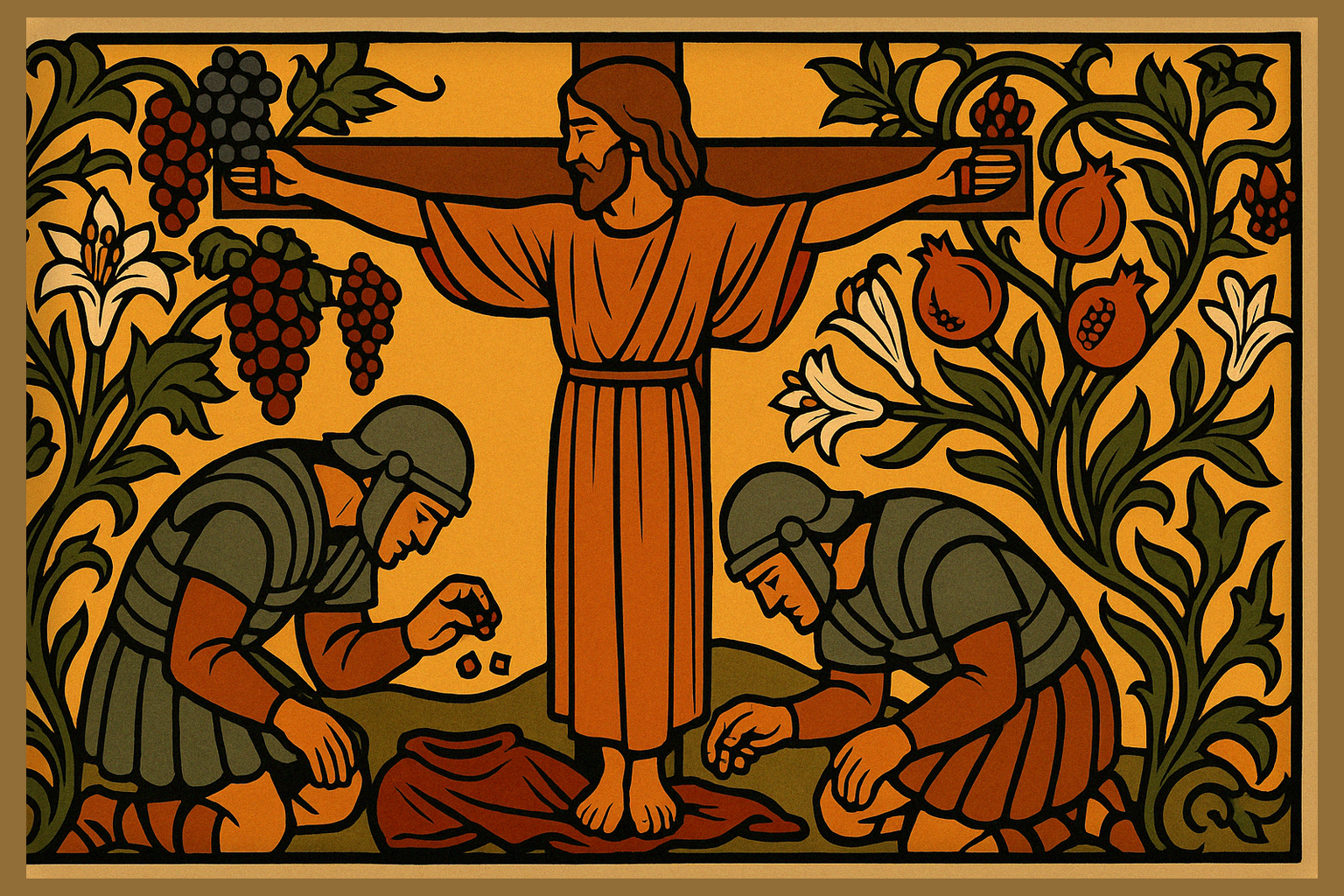
The psalmist goes further. He describes being mocked by onlookers who sneer, "He trusts in the Lord (YHWH), let the Lord rescue him." He describes his body failing: "I am poured out like water, and all my bones are out of joint. My heart has turned to wax." He names thirst: "my strength is dried up like a potsherd, and my tongue sticks to the roof of my mouth." He describes his hands and feet, his garments divided by lot, dogs surrounding him. This is a body in collapse, narrated with unflinching physical detail, and the psalm refuses to look away from it for twenty-one straight verses.
Verses 22-31: The Hard Pivot into Praise and Cosmic Reach
Then, abruptly, at verse 22, everything turns. "I will declare your name to my people; in the assembly I will praise you." The sufferer who has spent two-thirds of the poem describing abandonment suddenly speaks as one who has been heard. "For he has not despised or scorned the suffering of the afflicted one; he has not hidden his face from him but has listened to his cry for help."
The pivot keeps expanding outward. It's no longer solely about the psalmist's personal rescue. "All the ends of the earth will remember and turn to the Lord, and all the families of the nations will bow down before him." The poem reaches forward in time too: "Posterity will serve him; future generations will be told about the Lord. They will proclaim his righteousness, declaring to a people yet unborn: He has done it!" The psalm that began in the narrowest possible space, one man's body in agony, ends with language that spans nations and generations not yet alive.
Why the Shape of the Psalm Matters More Than Any Single Verse
The design is deliberate. No later editor glued two psalms together here; the movement from abandonment to vindication is the argument. You cannot get the force of the ending without sitting through the horror of the beginning, and you cannot understand why the beginning doesn't collapse into despair without knowing the ending is coming.
This is a pattern we see throughout the Hebrew Bible: structure carries theology. The shape of a text argues something the content alone cannot. Psalm 22 is making a claim with its architecture: forsakenness is real, named without euphemism, and it is not the last word. Quoting the psalm's first line, for anyone who knew the whole song, was quoting this entire claim.
The Gospel Writers Were Reading Psalm 22 as a Script
The Gospel authors didn't merely have Jesus quote the psalm's opening line and leave it at that. They built the surrounding narrative scene out of the psalm's details, piece by piece.
Divided Garments, Mocking Crowds, and Bones Out of Joint
Look at what Mark, Matthew, and Yahuchanan all include. Soldiers divide Jesus's garments and cast lots for them, a detail that appears in all four Gospels, directly echoing Psalm 22:18: "They divide my clothes among them and cast lots for my garment." Bystanders at the cross hurl insults that mirror the psalm's mockers almost word for word: "He trusts in God. Let God rescue him now if he wants him." Compare that to the psalm's taunt: "He trusts in the Lord, let the Lord rescue him." The wording overlap is too close to be coincidence.
Matthew in particular seems to be writing with the psalm open on the table. He records the exact mocking language, the exact detail about garments, and places Jesus's cry of abandonment at the center of the scene. These aren't stray details the Gospel writers happened to notice. They are a deliberate constellation, built to show the crucifixion as the psalm's script playing out in real historical time.
A Parched Throat and a Request for Something to Drink
Yahuchanan adds one more thread. Near the end, Jesus says, "I am thirsty," and the Gospel notes this happened "so that Scripture would be fulfilled." The psalm had said, "my strength is dried up like a potsherd, and my tongue sticks to the roof of my mouth." Yahuchanan is tracking the same psalm, pulling forward a detail most readers skim past, and marking it as part of the pattern. The thirst isn't incidental physiology. It's another thread in the same woven scene.
What It Meant for Jesus to Perform This Psalm, Not Merely Fulfill It
The common move is to treat these parallels as prophecy fulfillment in a passive sense, as if ancient predictions simply came true and Jesus happened to match them, the way a weather forecast happens to be accurate. Yet Jesus is the one who chooses, with some of his last conscious breath, to voice the psalm's opening line out loud.
This is an act of interpretation: Jesus is actively invoking the text, pointing his listeners toward its full arc, at the exact moment when the Gospel writers are also constructing the scene's other details to mirror the same psalm. This is a pattern of deliberate reenactment, where the crucifixion becomes a kind of embodied commentary on Psalm 22's entire trajectory, from the depths of verse 1 to the global vindication of verse 31. Jesus is performing the poem's full claim with his own body, his own voice, his own death, and, the Gospel writers insist, his own resurrection.
Abandonment as Legitimate Prayer, Not Spiritual Failure
If Jesus is consciously invoking this particular psalm, he is making a theological claim about what honest prayer is allowed to sound like.
The Hebrew Bible's Long Tradition of Crying Out Against Silence
Psalm 22 isn't an outlier in Israel's prayer book. Roughly a third of the Psalms are laments, prayers that name grief, confusion, anger, and the felt absence of God without apologizing for it. Psalm 13 opens, "How long, Lord? Will you forget me forever?" Psalm 88 ends without resolution at all: "darkness is my closest friend." These prayers were sung publicly, collected into the temple's worship book, and used generation after generation.
This tells us something about what the biblical authors considered legitimate address to God. Lament wasn't treated as a failure of faith that needed to be confessed and corrected. It was treated as faith doing its most honest work: refusing to pretend, refusing to perform contentment that isn't there, and bringing the raw material of real pain directly into God's presence rather than managing it privately first.
Jesus Praying Someone Else's Pain as His Own
In his most human, most physically shattered moment, Jesus doesn't compose something new. He reaches for inherited words, a song written by someone else, centuries earlier, who had walked through his own abandonment. Jesus takes on David's ancient cry as his own cry.
This is a kind of solidarity that goes both directions. Jesus is praying the prayer of every person who has ever felt forsaken, and in doing so he's also saying that David's ancient grief was never fully his own private experience. It belonged to something larger, a pattern of suffering and crying out that reaches its full weight in Jesus. The sufferer in Psalm 22 and the sufferer on the cross are speaking the same words because they are caught up in the same story.
Why This Reframes What Honest Prayer Is Allowed to Sound Like
If this is where the gospel places its center, not at a moment of serene confidence but at a scream of abandonment, then lament cannot be treated as a spiritual problem to be solved quickly. It's placed at the structural center of the whole story. A person crying out "why have you forsaken me" isn't failing at faith. They're praying in exactly the voice the biblical authors gave us, the voice Jesus himself used.
This doesn't mean despair gets the final say. It means despair gets named honestly, without being rushed past, before any resolution arrives. That sequencing matters pastorally. Faith that skips lament to get to victory faster is a thinner version of biblical faith.
Resurrection as the Hinge That Makes the Psalm's Pivot Make Sense
At verse 22, the turn from abandonment to praise, the shape of the psalm and the shape of the gospel story line up closely.
Without Vindication, the Turn in the Psalm Is Merely Poetry
If nothing ever answers the cry of verses 1 through 21, the turn into praise in verse 22 is mere wishful writing. It would be a beautiful hope and nothing more. The psalm asserts that God "has not hidden his face" from the sufferer, that the cry was heard. For that assertion to carry weight rather than function as poetic consolation, something has to happen that demonstrates it.
This is exactly the claim the Gospel writers make about the resurrection. It is framed as the historical event that makes good on the psalm's assertion, not as a nice ending tacked onto a sad story. Jesus's abandonment on the cross was real, named without euphemism, the way the psalm names it. And then something happened that the earliest Judean community insisted was not metaphor: an empty tomb, appearances, a transformed and terrified group of followers suddenly willing to die proclaiming what they'd seen.
"All the Ends of the Earth Will Remember and Turn to the Lord"
The psalm's closing language reaches for scope that David himself never lived to see fulfilled in his lifetime: nations bowing down, families from every corner of the earth turning toward the Lord, future generations told about what happened. In David's own historical moment, this was aspirational language, poetry stretching toward a hope.
The resurrection, in the Gospel writers' telling, is what gives that stretch a historical anchor. Within a few generations, a movement proclaiming a crucified and risen Judean teacher as Lord had spread from a small group in Jerusalem out into Judean communities across the Mediterranean and then into Gentile cities far beyond. The psalm's claim that distant nations and future generations would hear and turn wasn't abstract anymore. It had a datable starting point and a traceable spread.
A Vindication Too Big to Belong to One Person
And this is the detail that keeps the psalm from being read small. Its ending doesn't merely promise relief for the original sufferer. It promises reach: future generations not yet born, families of nations not yet in existence when the psalm was written, people who will hear secondhand and still turn. The vindication was scaled to everyone who would later stand where the sufferer once stood and ask whether abandonment gets the last word.
So the resurrection does more than give one man's execution a happy ending. If Psalm 22's full arc is what Jesus was performing, then the resurrection isn't primarily about vindicating Jesus's personal suffering. It's about answering, on behalf of everyone who has ever prayed that opening line and meant it, whether the darkness is final. The psalm's own shape says it isn't. The empty tomb is the historical claim that makes that shape something more than literature.
What the Whole Arc Invites You Into
Psalm 22 meaning for the crucifixion of Jesus goes deeper than hunting down scattered proof-texts, matching divided garments here and a parched throat there, as if the cross were simply checking boxes off an ancient prediction list. Jesus took the psalm's entire trajectory, from the rawest possible abandonment to the widest possible vindication, and lived it, prayed it, and died inside it.
That means the next time you find yourself somewhere inside verses 1 through 21, in a season where God feels distant and silent and the mockers seem louder than any help, you're not outside the story. You're standing exactly where the psalm, and Jesus, stood first. The biblical authors built a faith where the cry gets prayed honestly, sits as long as it needs to sit, and then, not by magic but by resurrection, gets answered in a way big enough to reach the ends of the earth. That arc was always meant for whoever picks up the first line and means it.
A Close Reading
A close reading of the passage through Story, Symbol, and Praxis.
Want to read the passages behind this article in their original language?
Read the Greek and Hebrew behind this passage yourself, verse by verse, through the same scholarly lenses as Babel Report.
Explore Babel Lens →babellens.aiMore in salvation


Explore the full gallery of essays and meditations
Browse the Collection