Jesus and the Mikveh: Purity as Power
Mikveh ritual purity and Jesus's clean/unclean disputes reveal a fight over Temple access and religious authority, not legalism versus grace.
Walk into almost any first-century Judean town and you would trip over them. Carved stone pools, cut straight into the bedrock, fed by channels that caught rainwater and funneled it down. A low partition wall splits most of them in half, so a person could walk down one side ritually unclean and climb out the other side clean. Archaeologists have pulled more than eight hundred of these mikvaot out of the ground across Judea and Galilee, with the thickest concentration clustered right around the base of the Temple Mount. That is not decoration. That is infrastructure.
And once you see mikveh ritual purity as infrastructure, not as a quaint religious custom, Jesus's purity disputes stop looking like a referendum on legalism. Most of us were handed that framework early: rigid rule-keepers on one side, a grace-teacher cutting through red tape on the other. But that reading falls apart the moment you ask what the purity system was built to regulate. It was not regulating sin. It was regulating access. And access always raises the question of who controls the gate.
Stone Pools in the Ground: What Mikveh Archaeology Reveals
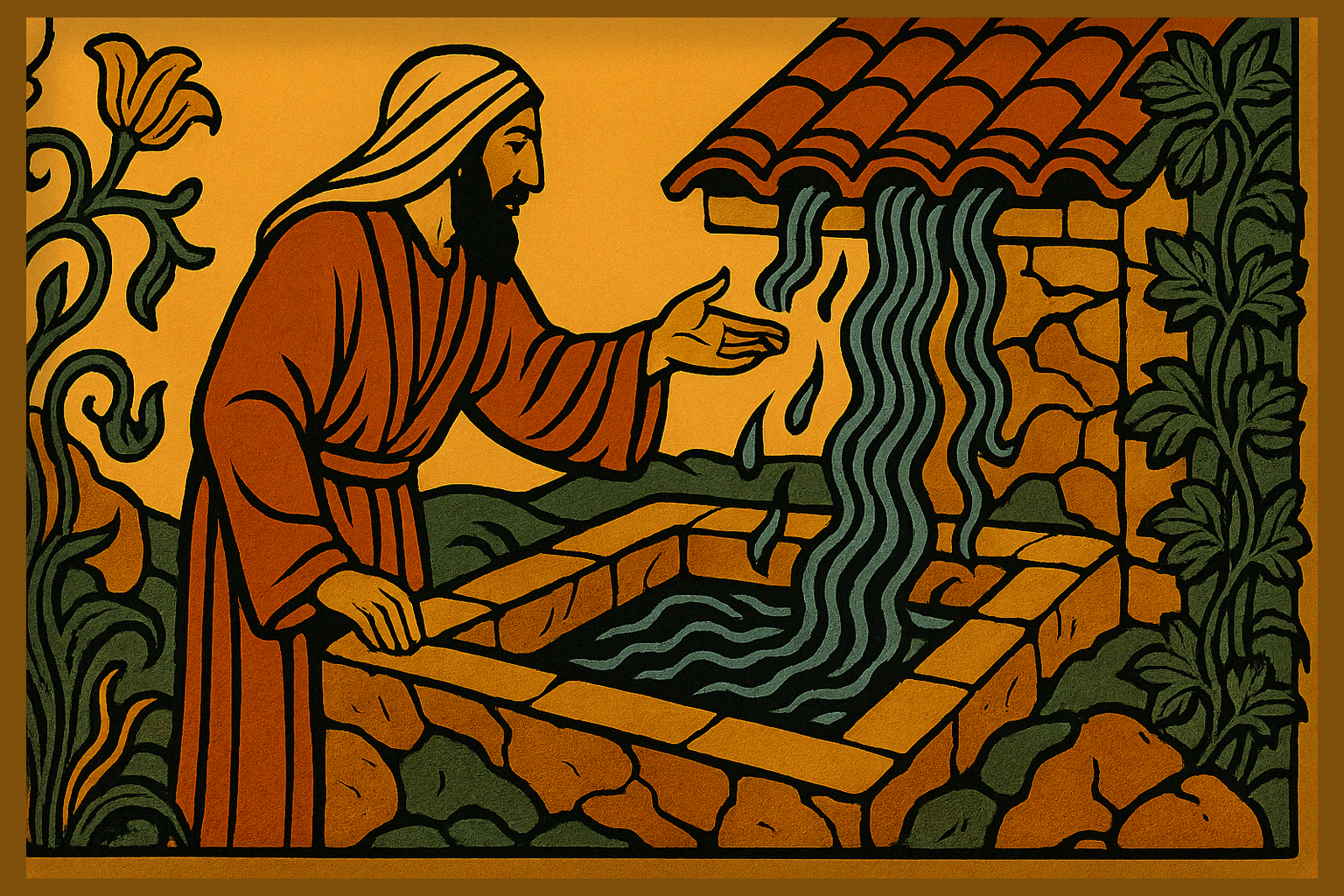
Before we get anywhere near Mark 7, we need to stand in front of the physical evidence, because the stones tell you something the English translations of your Bible never will.
Reading the Bedrock: How a Mikveh Was Built and Where They Cluster
A mikveh is a pool, usually rectangular, cut into natural rock or built into the ground, and filled at least partly with "living water," meaning water that collected naturally rather than being drawn and carried. Rainwater channeled from a roof or courtyard counted. Water hauled in buckets did not, at least not entirely. The design had to meet a minimum volume, roughly two hundred gallons by most reconstructions, so that a person could fully submerge.
Here's what's so interesting: these pools are not spread evenly across the land. Excavations at Qumran, Jericho, Sepphoris, and especially Jerusalem show dramatic clustering near sites tied to Temple worship and priestly life. Dozens have been found south and west of the Temple Mount, right along the routes pilgrims would have walked up toward the sanctuary. Some sit at the base of the monumental stairs leading to the southern entrances, positioned so a person could immerse immediately before ascending.
Notice what that placement is telling you. These are not scattered household conveniences. They are staged along the approach to sacred space, the way a modern security checkpoint sits right before the gate it protects. The builders were not guessing where people might want to wash. They were engineering the final step before entry into the Temple courts.
What Immersion Restored
So what did immersion accomplish? Leviticus is specific, and it is worth slowing down on the language. Leviticus 15 describes a man with a bodily discharge: he is tamei, unclean, and anyone who touches his bedding becomes unclean too, "until evening." The text prescribes washing clothes, bathing in water, and waiting. Leviticus 11 does something similar with contact involving certain carcasses. Numbers 19 lays out an entire ritual for anyone who has touched a corpse, requiring purification on the third day and the seventh day before the person is "clean" again.
Trace the pattern across these texts and you notice something: immersion never appears attached to language of forgiveness, confession, or atonement for wrongdoing. There is no sin offering tied to touching a dead body or giving birth or having a nocturnal emission. These are not moral failures. They are statuses, triggered by ordinary contact with death, disease, or bodily discharge, and immersion is the mechanism that reverses the status and restores eligibility to approach the sanctuary.
That word "restores" matters. The mikveh did not cleanse a stain on someone's character. It reset a person's standing relative to sacred space, the way a visitor badge gets reactivated after being suspended. You were not guilty. You were, for a time, not permitted to come near.
Contagious Status, Not Moral Failure: Untangling "Clean" and "Unclean"
This is where a word study pays off, because English has trained us to hear "clean" and "unclean" as hygiene or virtue, and Hebrew is not doing either.
The word tahor (clean, or ritually fit) and its opposite tamei (unclean, or ritually unfit) describe a condition that spreads through contact, almost like we'd describe exposure to a contagion today. Touch a corpse, you become tamei. Touch the person who touched the corpse, in certain cases, you become tamei too. The condition transmits. It is not earned through bad behavior and it does not require intent. A woman giving birth becomes tamei. A priest preparing a body for burial becomes tamei. Neither has sinned.
Think of it less like a courtroom verdict and more like a quarantine system. A quarantine does not pronounce you guilty of anything. It tracks exposure and manages who can safely enter a protected zone until the exposure clears. That is far closer to what tamei and tahor are doing in Leviticus and Numbers than anything resembling our modern category of sin.
This is a pattern worth holding onto, because almost every purity dispute in the Gospels gets misread the instant readers collapse tamei into "sinful" and tahor into "righteous." The text itself never makes that move. The biblical authors are inviting us to see purity as a system of contact and contagion, managed for the sake of protecting access to God's presence, not a scoreboard of moral standing.
The Temple at the Center: Purity Law as a Map of Access
Once you see purity as access rather than morality, the whole system starts to make structural sense, because everything in it radiates outward from one location.
Concentric Holiness: Courts, Walls, and Who Could Stand Where
The Temple complex in Jerusalem was not a single room you walked into. It was a series of nested zones, each one more restricted than the last. Outermost came the Court of the Gentiles, open to anyone. Inside that, a wall (the soreg) with inscribed warnings that any non-Judean crossing it risked death, a boundary Josephus and archaeological fragments of the actual warning inscriptions both confirm. Past that stood the Court of Women, then the Court of Israelite Men, then the Court of Priests, and finally the sanctuary itself, with the Holy of Holies at the center, entered by one man, the high priest, one day a year.
That is a built diagram. Walk from the outer wall to the center and you are walking through increasing requirements of purity and status. A Judean woman could go further than a Gentile. A Judean man could go further than a woman. A priest could go further than a layman. The high priest alone could cross the final threshold. Holiness was not a feeling radiating from the building. It was a measured gradient, and purity law was the mechanism that determined who occupied which zone on any given day.
Purity as Social Architecture Among Judeans
Here's what gets missed when people assume purity law was mainly about separating Judeans from outsiders: the sharpest boundary lines ran between Judeans themselves. A priest with a skin condition was barred from Temple service regardless of his lineage. A layman who had recently touched a corpse could not approach the inner courts no matter how devout he was. Menstrual impurity, seminal emission, childbirth, each of these temporarily repositioned a person on the map, Judean or not.
This means purity regulations were doing social work every single day, not marking off foreigners. They determined who stood where, who could approach whom, whose touch carried consequence for someone else's standing. Purity was status architecture for the whole community, and that architecture had real teeth, because standing closer to the center of the Temple correlated with standing closer to the center of religious and social authority in Jerusalem generally.
When Oral Tradition Meets Written Torah: The Pharisees' Innovation
This is the piece most readers skip past entirely, and it changes everything about how Mark 7 should be heard.
Handwashing Before Meals: Tracing the Command That Isn't There
Go read Mark 7:1-5 slowly. Pharisees and scribes from Jerusalem notice that some of Jesus's disciples are eating "with unclean hands, that is, unwashed." Mark, writing for a non-Judean audience, pauses to explain: "the Pharisees and all the Judeans do not eat unless they wash their hands, observing the tradition of the elders." Matthew's parallel in chapter 15 tells the same story.
Now go looking in the Torah for a commandment that ordinary Israelites must wash their hands before eating a regular meal. You will not find one. Leviticus requires washing for priests before Temple service and for specific impurity situations. It says nothing about bread at a kitchen table. The handwashing Mark describes is not Mosaic law. Mark says so outright, naming it "the tradition of the elders," a body of oral interpretation the Pharisees had developed and taught as binding, even though it was not written in Torah itself.
This distinction is the hinge the whole confrontation turns on. When the disciples skip handwashing, they are not violating a command from Moses. They are declining to follow an oral extension that a particular interpretive community, the Pharisees, had layered on top of Moses and was pressing as authoritative for all Judeans.
Extending the Temple's Holiness to the Kitchen Table
So why would anyone bother inventing a handwashing ritual with no Torah basis? Because the Pharisaic movement, as best we can reconstruct it from later rabbinic sources and from Josephus, was engaged in something like a holiness expansion project. Their conviction, as far as we can tell, was that the purity standards governing priests in the Temple should extend outward into ordinary life, into the home, into the dinner table, into the hands of the layperson eating bread on a Tuesday.
That is an ambitious theological claim. It says the boundary lines that once belonged to the sanctuary alone should now stretch into every household in Israel. And whoever gets to define those extended boundary lines, whoever decides what counts as sufficiently washed, sufficiently separated, sufficiently prepared, holds a form of religious authority that reaches into daily life far beyond what any Temple official could touch on his own. Pharisaic interpretation was not neutral commentary. It was a bid for interpretive jurisdiction over ordinary Judean practice.
Jesus's Counter-Teaching: Relocating the Source of Defilement
With that groundwork laid, Jesus's response in Mark 7:15 reads completely differently than the "legalism versus grace" version most of us grew up with.
"Nothing Outside a Person": What Jesus Claims and What He Doesn't
Jesus (YHWShA) says, "There is nothing outside a person that by going into him can defile him, but the things that come out of a person are what defile him." Read that claim carefully, because it is narrower than it sounds. He is not saying the Levitical purity system is void. He is not telling priests to stop observing corpse impurity or discharge regulations. He never tells anyone to skip the mikveh.
What he is doing is far more targeted: he is attacking the specific mechanism behind the handwashing tradition, the idea that food, or dirt on a hand, can travel into a person and contaminate them morally or spiritually. That mechanism, not the entire category of purity, is what he dismantles. Mark even adds an editorial note afterward, "and he declared all foods clean," which tells you the early Gospel writers understood this as addressing dietary contamination specifically, not canceling Leviticus wholesale.
From External Contact to Internal Disposition
Watch what happens next in the passage. Jesus pulls his disciples aside and explains that it is "from within, out of the heart," that evil intentions, theft, murder, and deceit emerge, and "these defile a person." He has not thrown out the category of defilement. He has relocated its source, from external contact, the Pharisaic concern with hands and food, to internal disposition, the condition of a person's heart.
This is still purity language. It still uses the vocabulary of defilement and cleanness. Jesus has not stepped outside the purity framework to critique it from some neutral moral high ground. He has stayed inside the framework and made a competing claim about where contamination originates. That is a theological move, but it is also, whether or not his hearers immediately registered it this way, a direct challenge to whoever had been claiming authority to police the external boundary in the first place.
Every Purity Ruling Was Also a Power Claim
Here is where the whole reading comes together, and where the stakes of these Gospel confrontations become visible.
Who Gets to Interpret: Pharisaic Authority on Trial
If Pharisaic handwashing tradition functioned as an extension of Temple-grade holiness into everyday meals, then the authority to define and enforce that tradition was a form of religious power, exercised over ordinary Judean households far from Jerusalem. When Jesus's disciples ignore it, and when Jesus defends them publicly, he is not settling a dispute about hygiene or etiquette. He is contesting whether the Pharisees' interpretive tradition carries the binding weight they claimed for it.
This is why the Pharisees confront him so directly and why the Gospel writers frame the scene as a dispute "from Jerusalem," signaling that this delegation carried real institutional weight. They are not local busybodies. They represent an interpretive authority structure, and Jesus is publicly declining to submit to its jurisdiction over this question. That is a contest over who holds the keys to defining Israel's boundary lines, not a private disagreement about table manners.
A Contest Over Borders, Not a Referendum on Legalism
Pull the thread all the way back to the stone pools we started with. Mikvaot clustered around the Temple were infrastructure for controlling approach to God's presence. The concentric courts of the Temple mapped out exactly who could stand where. Pharisaic handwashing tradition extended that same logic of boundary and access into ordinary homes. Every one of these systems answers the same underlying question: who can come near, and who decides.
Jesus's purity disputes, read this way, are not a morality play about rules versus freedom. They are confrontations over the authority to draw the borders of sacred space and sacred community. When he relocates defilement from external contact to the human heart, he is not loosening a moral code. He is challenging whether the people currently drawing the lines have the standing to draw them the way they are drawing them. That is political. That is ecclesiological. And it is a far more interesting fight than the one most of us were taught to see in Sunday school.
Stand back from the whole picture and notice what the Gospel writers are doing. They are not recording a referee's whistle on legalism. They are recording a contest over Israel's sacred architecture, the borders of God's presence, and the question of who gets to define them. Mikveh ritual purity, Temple access regulations, Pharisaic handwashing tradition, Jesus's counter-teaching in Mark 7, all of it belongs to one connected story about authority and access, not a morality tale about rule-keepers and rule-breakers. Jesus steps into that story and makes a claim that the source of defilement runs through the human heart, which means the people controlling the external boundary lines do not hold the authority they assumed they held. That claim cost him. It also invites a different question than the one most readers bring to these texts: not "was Jesus against the rules," but "who gets to say where God's presence begins and ends, and on what grounds." The text leaves that question sitting right in front of you, the way it has for two thousand years.
A Close Reading
A close reading of the passage through Story, Symbol, and Praxis.
Want to read the passages behind this article in their original language?
Read the Greek and Hebrew behind this passage yourself, verse by verse, through the same scholarly lenses as Babel Report.
Explore Babel Lens →babellens.aiMore in origins


Explore the full gallery of essays and meditations
Browse the Collection