Matthew 24:36: Why No One Knows, and Why It Matters
A careful look at Matthew 24:36, the Olivet Discourse, AD 70 preterism, and the Greek roots of "rapture" theology, without fear or date-setting.
Every generation, it seems, produces someone with a chart, a calculator, and a conviction that they have succeeded where the angels themselves, by Jesus's own account, have failed. You would think that after a century of confidently announced dates coming and going without incident, the enterprise would lose its appeal. It has not, and I would suggest the reason is not stupidity but a misreading, an honest one often enough, of a handful of difficult verses in Matthew's Gospel and Paul's letters to Thessalonica. Matthew 24:36 states the matter as plainly as language allows: not even the Son knew the day or hour. Before we can put date-setting to rest, we need to look at what this text and its neighbors say, and as carefully at what they do not. Let us begin, then, where Jesus (YHWShA) himself began, with a temple his disciples admired and a warning they did not expect.
A Temple Made of Stone, and a Warning Made of Time

What the Disciples Pointed To, and What Jesus Saw Instead
Picture the scene plainly, because the plainness matters. The disciples are walking out of the temple complex in Jerusalem, a building project so vast and so ornamented that the historian Josephus describes its stones as gleaming brilliantly white in the sun. Herod had spent decades on it. The disciples, understandably, want Jesus to admire it too. They point at the stonework the way a proud homeowner points at a new addition.
Jesus does not admire it. He tells them that not one stone will be left on another, that all of it will be thrown down. That is Matthew 24:2, and it is worth sitting with before rushing to verse 3, because everything that follows is Jesus answering a question the disciples asked only after hearing that unsettling prediction. He did not announce a general theory of the end of history. He announced the destruction of a specific building, in a specific city, and the disciples wanted to know when.
One Question, or Two Wearing the Same Coat
Here is where the confusion begins, and it begins honestly. The disciples ask, "When will this happen, and what will be the sign of your coming and of the end of the age?" Read that question again slowly. It sounds like one question. It is two, stitched together with a single "and," the way a person might ask a doctor, "When will I recover, and what will my life look like when I'm old?" as though recovery and old age were the same event simply because they both lie in the future.
The disciples had no reason to separate the temple's destruction from what they assumed would be the climactic end of the age. In their minds, those two things traveled together. Jesus, in his answer, will treat them as related but not identical, and the seam between them is where later readers, lacking the disciples' context, have gotten tangled. That seam is not a flaw in the text. It is the whole puzzle.
Why AD 70 Explains Almost Everything Before Verse 36

Armies, Mountains, and a Warning That Came True
Now, consider the level of detail Jesus provides. He does not speak in vague generalities about wars and rumors of wars, though he mentions those too as background noise common to every age. He gets specific. He tells his hearers that when they see armies surrounding Jerusalem, when they see the "abomination of desolation" standing where it ought not, they are to flee to the mountains without delay, without even going back into the house for a coat.
That is not the language of a prophecy meant to be decoded by readers two thousand years removed from the event. That is the language of a general briefing troops before a specific campaign. And the striking thing, which any honest reading of the historical record confirms, is that it happened in this way. Around AD 70, Roman legions under Titus surrounded Jerusalem, the temple was burned, and its stones were pried apart, largely to extract the melted gold that had run into the cracks. According to a tradition recorded by the Christian historian Eusebius, though its historicity is debated among historians, the Jerusalem church, remembering this warning, fled to the city of Pella before the siege closed in. Whatever else one thinks about the rest of Matthew 24, the first several decades of it read less like prediction dressed up as history and more like history that had already happened, recorded by a Gospel writer working within living memory of the event. This reading is sometimes called preterist interpretation. It locates most of this discourse, often called the Olivet Discourse because Jesus delivered it on the Mount of Olives, in the first century rather than in our own newspapers.
Apocalyptic Symbolism in Daniel and Jesus, Read the Way Their First Hearers Read It
One might ask, reasonably, what to make of the darkened sun, the falling stars, the shaken powers of heaven in Matthew 24:29. Surely that is cosmic language, describing the literal unraveling of the universe. It seems to me the answer becomes clear the moment you notice that Jesus is quoting, in nearly exact wording, older prophetic texts that used this language for something else entirely.
In Isaiah 13, the prophet Yashayahu announces the fall of Babylon, and in doing so declares that the stars of heaven will not give their light, that the sun will be darkened. Babylon was not a planet. It was an empire, and it fell in history, on a calendar, at the hands of the Medes. In Ezekiel 32, the same cosmic collapse is pronounced over Egypt. In Daniel 7, beasts rising from the sea and one like a son of man coming on the clouds are widely understood, on the text's own terms, to describe the rise and fall of successive kingdoms, not a single cosmic event at the end of time. Apocalyptic literature had its own vocabulary, and Jesus's first hearers, steeped in the prophets the way we are steeped in the news, would have recognized this vocabulary instantly. Cosmic collapse language meant the fall of a nation and its ruling order. It did not mean the physical sun stopping in the sky. Reading Matthew 24:29 without this background is a little like reading a modern headline that says a stock "crashed" and concluding that an actual airplane went down on Wall Street.
The Hinge at Verse 36: Where the Discourse Changes Its Grammar

Now we arrive at the crux, and I want to name it directly rather than slide past it, because most popular treatments do that. If verses 4 through 35 describe, with such striking precision, events that culminated around AD 70, what is happening at verse 36, where Jesus suddenly says that of "that day and hour" no one knows, not the angels, not even the Son?
Notice the shift. Verse 34 says "this generation will not pass away until all these things have taken place." That is a near-term time marker, tied to people alive in Jesus's own audience. Verse 36 pivots to a day and hour that is unknown, unknowable, arriving like a thief. The grammar itself changes texture, moving from concrete, checkable markers, armies, mountains, a specific abomination, to something without markers at all. Something is different on the other side of that verse. That is no small matter, and honest interpreters across different traditions admit it.
Preterism vs Futurism: Two Honest Ways to Read the Same Hinge
Let us lay the two major approaches side by side, because the symmetry itself is instructive. In broad terms, a preterist reader holds that most or all of this discourse was fulfilled in the first century. A futurist reader holds that at least part of it still awaits fulfillment in a coming, final event.
In the single-return reading, sometimes called full or consistent preterism, the entire discourse, verses 4 through 51, refers to the events surrounding AD 70. On this view, the "day and hour" of verse 36 refers to the specific but unpredictable timing within that first-century judgment, unknown even to Jesus in his human limitation, though the broader event had already been signaled by the specific signs given earlier. The unknowing is real, but it is unknowing about a date already falling within living memory, not a return two millennia distant.
In the two-stage reading, held by the majority of futurist interpreters, verses 4 through 35 describe AD 70 as a genuine but partial fulfillment, a preview and a type. Verse 36, on this view, pivots to describe a final, still-future coming of Christ, of which AD 70 was a foreshadowing but not the substance. The temple's destruction works like a smaller storm that previews a larger one still building on the horizon. It is real in itself, but not the whole story.
Both readings take the grammatical shift at verse 36 seriously, and neither one flattens the passage into a single undifferentiated blur. Where they disagree is on whether "these things" in verse 34 refers backward to everything described, closing the loop within a single generation, or whether it refers only to the temple's destruction as a sign pointing toward something that remains, even now, unfinished. This is a real and long-standing scholarly disagreement, and I do not think intellectual honesty allows us to pretend otherwise.
What Both Sides Refuse to Do, Whichever Side of the Hinge They Stand On
And here is the interesting part, the point where the disagreement stops. Preterists reading the hinge one way and futurists reading it another way arrive, without exception, at the same conclusion about Matthew 24:36 itself. No one knows the day or hour. Not the angels. Not even the Son, in his incarnate limitation as YHWH manifest in flesh. He walked among us as a genuine human being who had, in that mode of existence, laid aside independent access to that particular knowledge. This is not two beings, one who knows and one who does not; it is the one YHWH who took on a fully human mode of existence, and who, in that human mode, genuinely did not access knowledge he retains in his fullness as God (Alohim).
Which is the point that gets lost in the noise of prophecy conferences and bestselling charts. A pastor who holds to a strict AD 70 preterism and a pastor who holds to a classic futurist premillennialism, the view that Christ will return before establishing a future thousand-year reign on earth, will disagree about a great many things. Neither of them will tell you they have calculated the date of Christ's return, because the text both of them are reading forecloses that possibility in the plainest words available. If your framework requires setting a date, it is not preterism and it is not futurism. It is neither of the two serious traditions this passage has produced. It is something else, wearing their language as a costume.
The Word "Rapture" and the Homecoming It Was Never Meant to Escape

From Harpazō to Rapiemur: How a Verb Became a Doctrine
Let me put it this way. The word "rapture" does not appear anywhere in the Bible. That surprises people the first time they hear it, and it is worth pausing over why. The relevant text is 1 Thessalonians 4:17, where Paul writes that believers will be "caught up" to meet the Lord (YHWH) in the air. The Greek verb behind "caught up" is harpazō, a word that means to seize or snatch suddenly, the same verb used elsewhere for a wolf snatching a sheep or a strong wind snatching a sail.
When Jerome translated the New Testament into Latin, producing the Vulgate, he rendered harpazō in this verse as rapiemur, "we will be seized" or "we will be caught up." "Rapture" descends from that Latin verb, arriving in English many centuries later through Christian writers who needed a noun for the event Paul described. Notice that the word itself carries no built-in doctrine about timing, about secrecy, about a global disappearance leaving behind empty shoes and driverless cars. That entire apparatus was built up around the word much later, largely through nineteenth-century prophecy teaching, and then read back into Paul's original sentence as though it had been there all along. Tracing the word's journey through translation does not settle every question about the passage, but it does clear away a great deal of imported furniture that was never part of the original room.
Parousia and Apantēsis: A Roman Dignitary's Welcome, Not a Cosmic Evacuation
Consider this: Paul's original readers in Thessalonica lived in a Roman city, and they would have known what the word parousia meant, because it was not a religious term at all. It was the ordinary Greek word for the arrival of a king, a governor, or an emperor visiting a city. When a dignitary's parousia was announced, the citizens did not wait passively indoors. They went out of the city gates to meet him on the road, forming a welcoming procession, and then escorted him back into the city he was visiting. The technical term for that going-out-to-meet was apantēsis, the word Paul uses when he says believers will meet the Lord "in the air."
In the first picture, then, a dignitary approaches a city, and its citizens go out to escort him the rest of the way in, as an honor guard, not an evacuation party. In the second picture, popularized by much later prophecy teaching, believers are snatched away from earth entirely, off to a location apart from the world, while the world itself is left behind to its fate. Notice how different these two pictures are. Paul's readers, hearing parousia and apantēsis together, would have pictured the first scene instantly, a royal procession going out to welcome an arriving king and returning with him. They would not have pictured a planetary evacuation, because nothing in that vocabulary suggested one. The believers go out to meet the Lord in the air for the same reason a city's citizens went out to meet an arriving Caesar, in order to bring him back with them, into the world he has come to claim.
Noah's Flood and the Scene Most Sermons Get Backwards
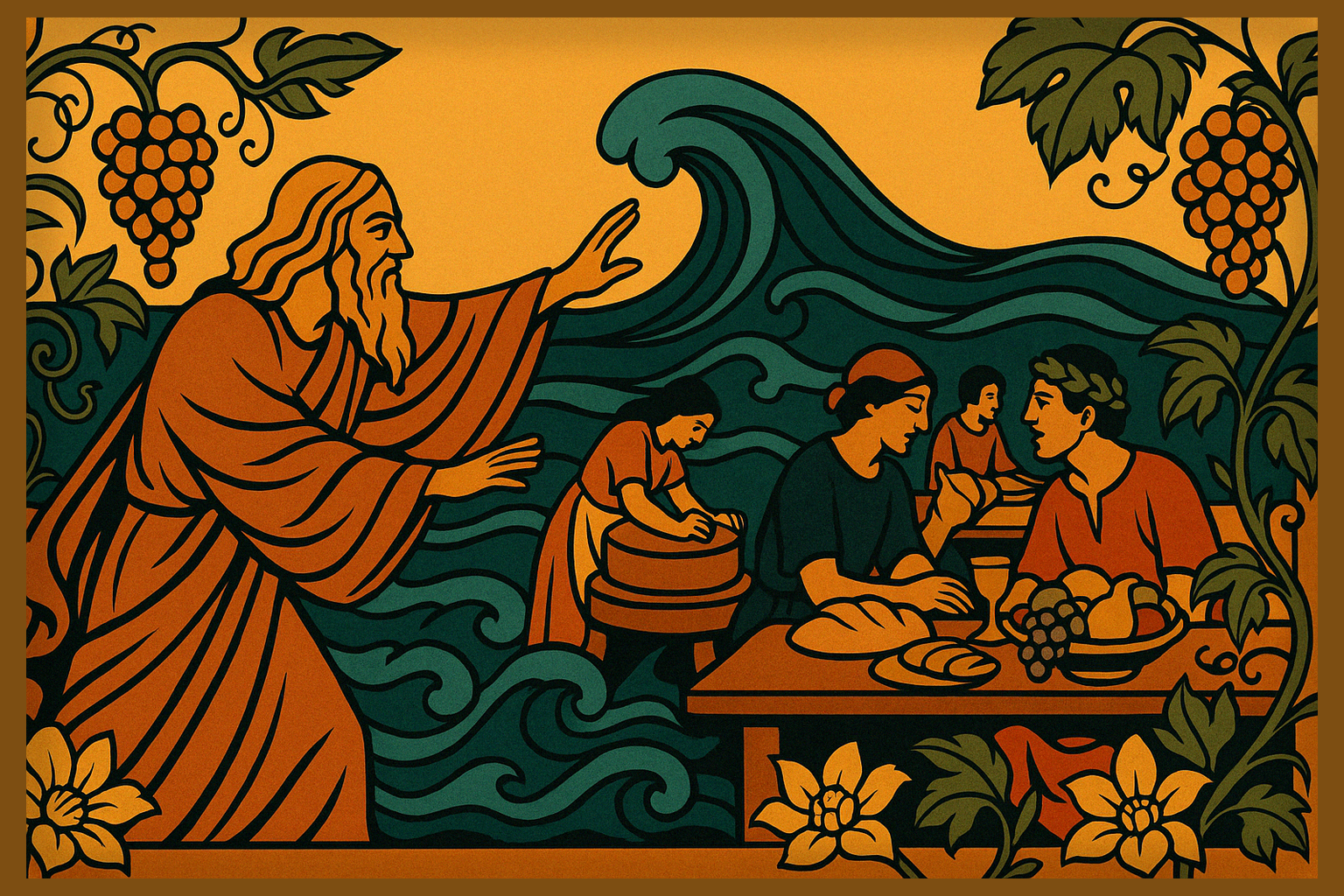
Taken Like the Flood Took Them, Left Like Noah Was Left
Now, this reframing has direct consequences for one of the most quoted and most misread passages in the whole discourse. In Matthew 24:37-41, Jesus compares his coming to the days of Noah. People were eating, drinking, marrying, and knew nothing until the flood came and swept them all away. Then he says two will be in a field, one taken and one left, two women grinding grain, one taken and one left.
Popular preaching, especially the sort fed by novels and films built around the rapture, treats "taken" as the good outcome, the believer snatched up to safety, and "left" as the bad outcome, the unbeliever abandoned to judgment. But look again at the analogy Jesus himself supplies. In the flood story, who was taken? The wicked, swept away by the floodwaters. Who was left? Noah and his family, safe on dry ground, because they were not taken by the flood. The comparison Jesus draws is exact. Those "taken" in his illustration correspond to those swept away in judgment. Those "left" correspond to Noah, left behind on solid ground because judgment passed over them.
What This Reversal Does to Popular End-Times Preaching
That is the opposite of how the scene gets preached from a great many pulpits and in a great many bestselling series. Getting this detail backwards is not a small slip. It inverts the entire emotional logic of the passage. If "taken" means rescued, then the anxious question becomes "will I be taken," and fear attaches itself to the prospect of being left behind on a ruined earth. If "taken" means swept away in judgment, as Jesus's own chosen illustration demands, then the anxious question reverses entirely, and the text is warning against the complacency of those who, like the generation before the flood, noticed nothing was wrong until it was too late.
I would suggest that correcting this single detail changes the pastoral temperature of the entire passage. It is not a summons to fear being left on earth. It is a summons to readiness, to living now in a way that does not require a flood to wake you up. That is a different sermon than the one most people have heard.
The Hope Was Never a Ticket Off the Planet
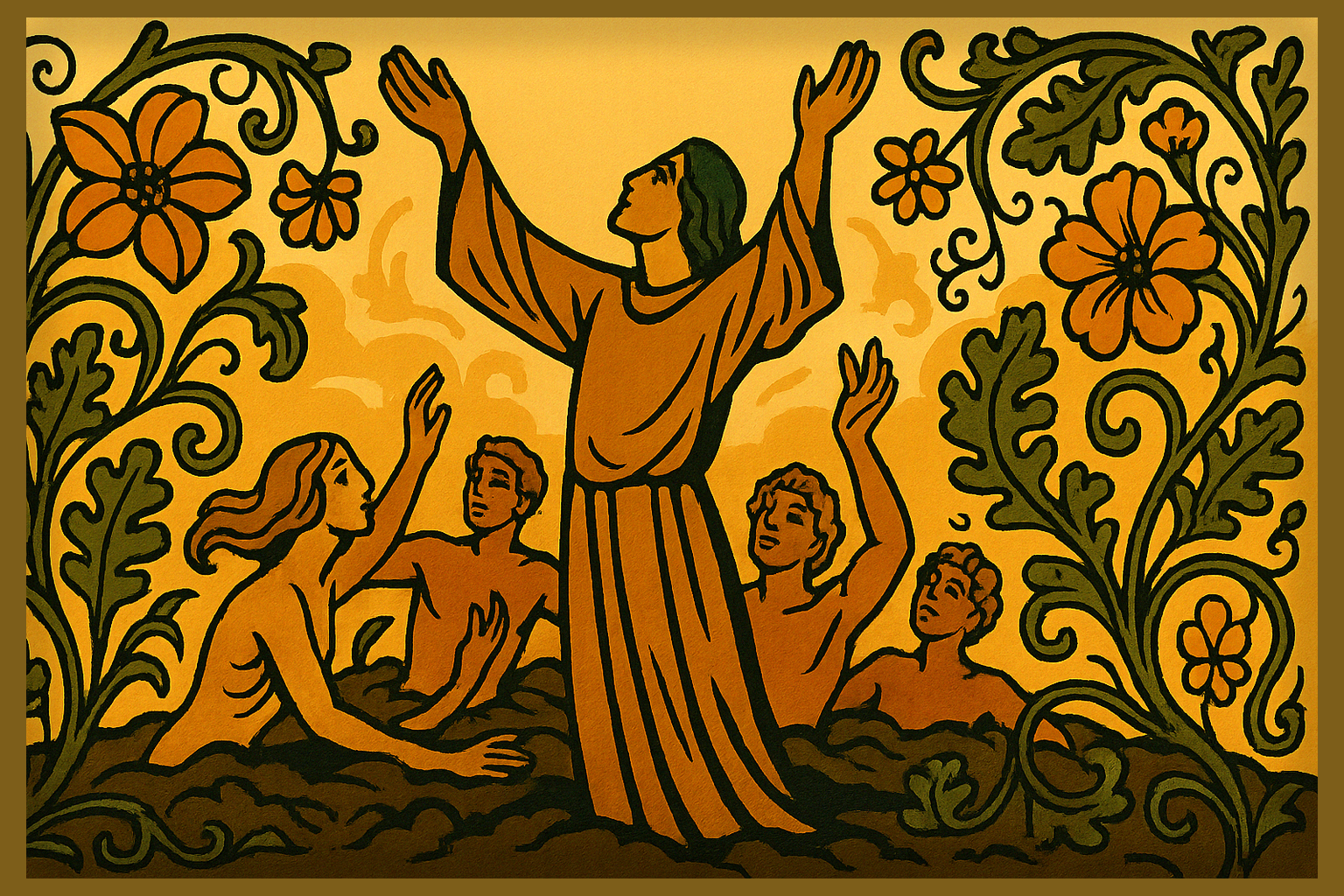
Bodily Resurrection and Creation Renewal as the True Center
Here is where all of this ought to lead, and it seems to me the New Testament could not be plainer about it, even though popular imagination has drifted far from it. Paul does not tell the Thessalonians that the dead in Christ will be dissolved into spirit and float off to an ethereal elsewhere. He tells them the dead in Christ will rise, bodies restored, and then together with the living they will meet the Lord in that royal procession we have already described. Resurrection, not evacuation, is the engine of Paul's hope.
And the resurrection itself points further still, toward what Paul calls in Romans 8 the liberation of creation itself from its bondage to decay. The biblical hope was never that God would scrap this world like a failed prototype and airlift a favored few to a different one. The hope was renewal, a heaven and earth made new, the way a garden long overgrown gets restored rather than abandoned for a different plot of land. That is no small matter, because it changes how a Christian is meant to regard the physical world in the meantime. A theology of evacuation breeds indifference toward creation, toward justice, toward the ordinary work of tending a garden you expect to be demolished. A theology of resurrection and renewal breeds the opposite, a patient investment in a world God intends to keep.
Eschatological Humility as a Pastoral Discipline
Eschatological humility simply means staying modest about the end times, holding firm belief without pretending to know the calendar. One might ask what practical posture follows from everything we have traced, the Roman siege, the apocalyptic idiom, the hinge at verse 36, the Latin verb behind "rapture," the reversed flood illustration. I would suggest it is this: firm conviction held together with genuine humility. Firm conviction that Christ will come, that the dead will rise, that creation will be renewed, none of that is in question across the traditions we have examined. Genuine humility about the calendar, because that is what Jesus himself modeled when he declined to name the day or hour available even to him in his incarnate state.
A pastor who holds both together, conviction and humility, gives a congregation something rarer than excitement. He gives them steadiness. He does not need a new chart every decade, because his hope was never staked on a date to begin with.
None of what we have covered requires you to resolve every disagreement between preterist and futurist readers, and honest scholars on both sides would tell you the same. What Matthew 24:36 asks of us is more modest and, I think, more durable. It asks for the humility to admit that a question Jesus himself declined to answer, in his incarnate mode, is not ours to answer either. Whatever framework you land on for the earlier verses of the Olivet Discourse, the hinge at verse 36 stands as a permanent correction to every calendar, every chart, every confident announcement that this generation has finally cracked what no generation before it could. The invitation is not to fear the date you cannot know. It is to trust that the same YHWH who, in flesh, chose not to know it, holds it in his fullness even now, and to live, in the meantime, as though the world he intends to renew is worth tending now.
A Close Reading
A close reading of the passage through Story, Symbol, and Praxis.
Want to read the passages behind this article in their original language?
Read the Greek and Hebrew behind this passage yourself, verse by verse, through the same scholarly lenses as Babel Report.
Explore Babel Lens →babellens.aiMore in origins


Explore the full gallery of essays and meditations
Browse the Collection