God's Unilateral Oath: Why Genesis 15 Makes the Cross Inevitable
The Abrahamic covenant in Genesis 15 shows God alone walking through the pieces, a self-maledictory oath that makes the cross its fulfillment, not a backup plan.
Most readers move through Genesis 15 the way you'd skim the fine print on a contract you're not planning to sign. There's a vision, some animals, a smoking pot, a torch, and then the story moves on to Ishmael and Hagar. But if you slow down and watch what happens in this chapter, something strange jumps out. God (Alohim) tells Abraham to cut five animals in half and lay the pieces out on the ground, the standard setup for an ancient covenant ceremony. Both parties are supposed to walk together between the bloody halves, speaking a curse against themselves: let this happen to me if I break this oath. But in Genesis 15, Abraham never walks. He's asleep. Only God passes through, alone.
This single detail is the hinge the entire Abrahamic covenant in Genesis 15 turns on, and once you see it, you can't read the rest of the Bible the same way. Jesus (YHWShA) is God himself in human flesh, not a separate figure sent to carry out someone else's plan, and the cross is that same God keeping an oath he swore to himself two thousand years earlier. The cross stops looking like an emergency measure and starts looking like the fulfillment of that oath.
What "Cutting a Covenant" Meant in the Ancient World
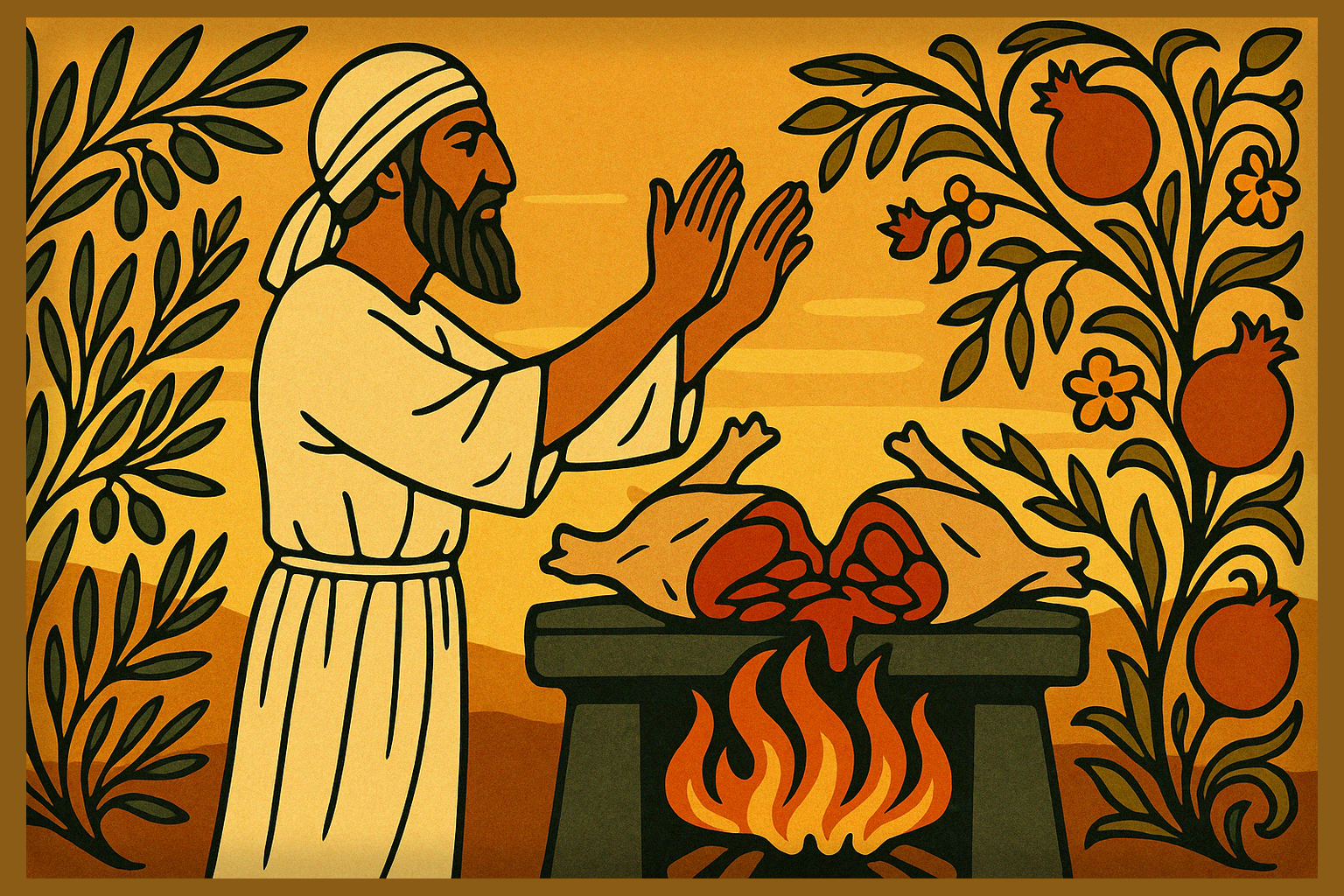
To feel the weight of Genesis 15, you have to know what a covenant ceremony involved in the ancient Near East. This wasn't a handshake. It was blood, fire, and a public, physical ritual that bound both parties with their own lives as collateral.
Karath Berith: Why Hebrew Says "Cut" a Covenant, Not "Make" One
Here's the detail that should stop you cold before you even get to the animals. The standard Hebrew phrase for entering a covenant is karath berith, which gets translated into English as "make a covenant." But that translation hides something. Karath doesn't mean "make." It means "to cut."
So the Hebrew idiom says "cut a covenant," not "make" one. Notice what that tells us: this phrase didn't start as a figure of speech that later writers forgot the origin of. It started as a description of an actual event. Someone cut something, and that cutting is what the covenant was. Genesis 15 isn't using a metaphor. It's showing us the ritual the metaphor is named after. Every time a Hebrew reader heard karath berith anywhere else in the Bible, Genesis 15 is the picture sitting underneath the phrase.
The Standard Script: Two Parties Walk Together Between the Pieces
Archaeological finds from the ancient Near East, including treaty texts from sites such as Mari and Alalakh, suggest a pattern Genesis 15 draws on. When two parties entered a binding agreement, especially a treaty between a greater power and a lesser one, they would slaughter animals and split the carcasses, laying the halves in two rows with a path down the middle.
Then both parties walked together through that path, between the bleeding halves, and spoke the oath aloud. The content of the oath was a self-curse: if I break this agreement, let what happened to these animals happen to me. Jeremiah 34:18 describes this exact practice centuries later, condemning the leaders of Judah for "cutting a calf in two and walking between its parts" and then breaking the covenant they swore. The ceremony wasn't symbolic sentiment. It was a legal act with teeth, backed by the vivid threat of bodily destruction.
The Animals, the Fire, and the Setting of Genesis 15
Now look at what God asks Abraham to do. In Genesis 15:9, Lord (YHWH) tells Abraham to bring a three-year-old heifer, a three-year-old female goat, a three-year-old ram, a dove, and a young pigeon. Abraham cuts the three larger animals in half and arranges the pieces opposite each other, exactly as the standard ceremony required. The birds, interestingly, aren't cut. The text doesn't explain why, though it could simply reflect a smaller offering fitting for a bird too small to divide.
Abraham drives off birds of prey that try to land on the carcasses, which is its own small, vivid image of a man guarding a sacred and dangerous scene. The sun begins to set. Then the text tells us something unexpected happens to Abraham before the ceremony even gets underway.
The Detail Everyone Reads Past: Abraham Never Walks
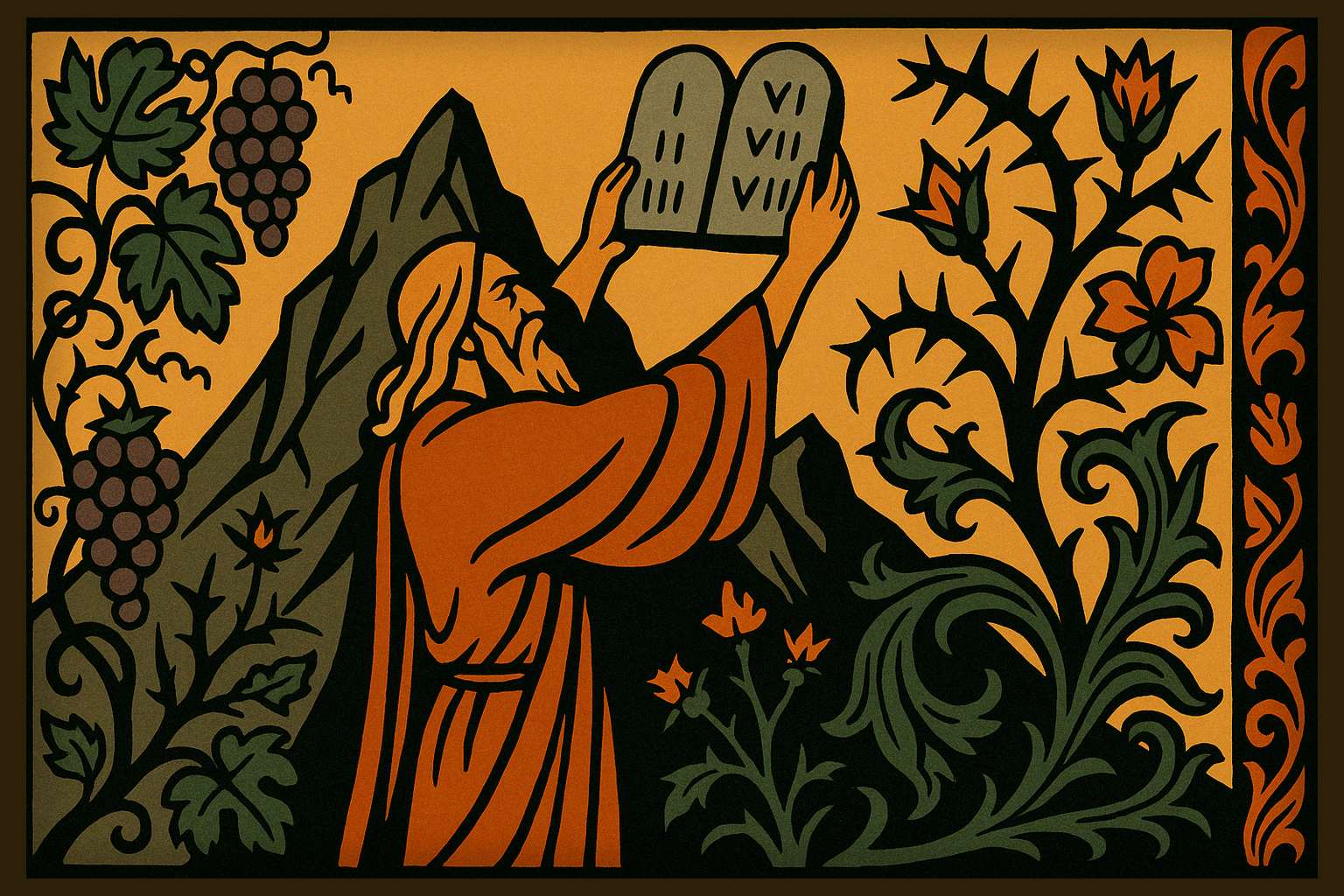
This is where most readers keep skimming, right past the moment that changes everything. Genesis 15:12 says that as the sun was going down, "a deep sleep fell upon Abram, and behold, dread and great darkness fell upon him." Then, once night has fully come, verse 17 says that a smoking firepot and a flaming torch passed between the pieces. Abraham is not mentioned as walking. He's asleep for the entire ceremony.
Tardemah: The Same Sleep That Fell on Adam
The Hebrew word translated "deep sleep" here is tardemah, and it's worth slowing down on this word because it's doing real theological work, not mere narrative housekeeping. Tardemah doesn't describe ordinary drowsiness or a man dozing off after a long day of butchering livestock. It describes total, God-induced unconsciousness, a state in which the person is entirely passive and unaware.
This is the same word used in Genesis 2:21 for the sleep God causes to fall on Adam before God opens his side and forms Eve. In both cases, tardemah marks a moment when God is about to do something decisive and the human being present is rendered completely unable to participate, observe, or contribute. Adam doesn't help build Eve. Abraham doesn't help seal the covenant. The word tardemah is a signal flare: whatever happens next, it is God's act alone. This is a pattern the biblical authors use deliberately, not an accident of narrative convenience.
A Witness, Not a Participant
In the standard ancient Near Eastern ceremony, participation was the whole point. Walking through the pieces is what bound you to the self-curse; if you didn't walk, you weren't under oath. Abraham's sleep, then, means he takes no active role in the ceremony at all.
Abraham, asleep in dread and darkness, cannot walk. He is present as a witness, the way you might watch something happen to you in a dream, but he is excluded from the act that would normally make him liable for breaking the covenant. In the ordinary two-sided treaty, both sides accept the risk together. Genesis 15 removes one side from that risk entirely. The biblical authors are inviting us to ask why God would design the ceremony this way, when every ancient reader would have known this isn't how it's supposed to go.
Smoking Firepot and Flaming Torch: God Walks Alone
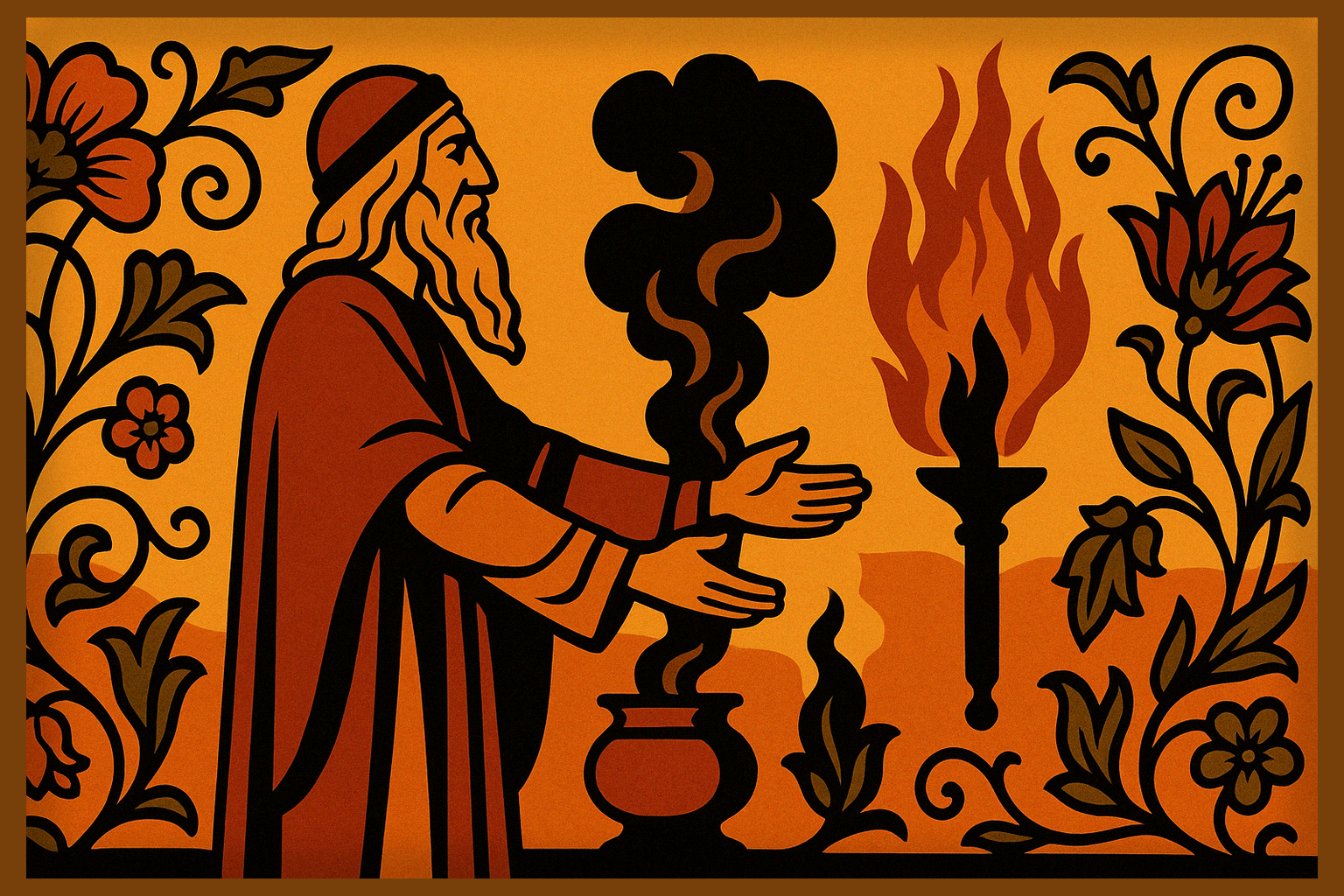
Genesis 15:17 gives us the answer, and it's one of the most striking theophanies, or appearances of God, anywhere in Genesis. "Behold, a smoking fire pot and a flaming torch passed between these pieces." Fire and smoke are standard images of God's presence throughout the Hebrew Bible, showing up again at Sinai in Exodus 19 and in the pillar of fire and cloud that leads Israel through the wilderness.
Here's what's so interesting: nothing represents Abraham passing through. Only the fire and smoke, images of God himself, move down the path between the bloody halves. In the normal ceremony, both parties walk and both parties accept the self-curse. In Genesis 15, God walks alone. God is taking on the liability for both sides of the covenant, Abraham's side and his own, while Abraham sleeps through the entire transaction. This is the theological hinge of the whole chapter.
Sinai: The Covenant Israel Could Break
If Genesis 15 were the only covenant in the story, the picture would already be striking. But several hundred years later, at a mountain in the wilderness, God enters a fundamentally different kind of agreement with Abraham's descendants, and the contrast matters enormously.
A Bilateral Covenant With Teeth: Deuteronomy's Curses
At Sinai, Israel doesn't get the Genesis 15 treatment. This covenant is bilateral, meaning both parties have obligations, and Israel's side of the obligation is extensive: keep the law, worship Lord alone, follow the statutes given through Moses. Deuteronomy 28 spells out what happens on both sides of this arrangement in exacting, almost unbearable detail. Blessing for obedience: fruitful fields, healthy children, victory over enemies. Curse for disobedience: disease, famine, defeat, and ultimately exile from the land itself.
Deuteronomy 27 even has Israel standing between two mountains, Gerizim and Ebal, pronouncing blessings and curses over themselves, a ceremonial echo of the ancient self-cursing oath, the kind where the one swearing invokes disaster on themselves if they break their word. Unlike Genesis 15, where God alone walked, at Sinai Israel walks. Israel accepts the terms, and Israel accepts the risk.
Israel's History as the Curses Landing
The rest of the Hebrew Bible, read honestly, is largely the story of those curses landing. The book of Kings narrates centuries of covenant unfaithfulness, idolatry, injustice, and broken law, and it ends with precisely what Deuteronomy 28 predicted: Israel conquered, the temple destroyed, the people deported to Babylon. The prophets, especially Jeremiah and Ezekiel, interpret the exile explicitly as covenant curse, not merely political misfortune.
This matters enormously for the larger argument. Israel entered a covenant it was fully capable of breaking, and it broke it. The Sinai covenant, unlike the oath in Genesis 15, left Israel exposed. And this is exactly the tension the apostle Paul picks up centuries later, when he has to explain how a law-breaking, exile-bound nation can still be heirs of a promise sworn before the law ever existed.
Paul's Chronology Argument: Why the Order of Genesis Matters
Paul's letters to Rome and to the Galatian churches aren't abstract theology dropped from nowhere. They're careful arguments built on the actual sequence of events in Genesis, and once you've seen the self-cursing oath of Genesis 15, Paul's logic stops looking like a technicality and starts looking inevitable.
Faith Before Circumcision: Romans 4 and the Badge of Covenant Membership
In Romans 4, Paul makes a point about timing that's easy to miss if you don't have the chapters in front of you. Genesis 15:6 says Abraham "believed Lord, and he counted it to him as righteousness." That declaration happens in Genesis 15, during the covenant ceremony itself. Circumcision doesn't show up until Genesis 17, some years later according to the traditional chronology.
Paul's argument in Romans 4:9-11 hinges entirely on this gap. Abraham was declared righteous while uncircumcised. Circumcision came afterward, as a sign of a righteousness Abraham already had by faith. This order matters because it determines who belongs to Abraham's family. If circumcision had come first, you could argue that the rite itself secured the status. But because faith came first and circumcision followed as confirmation, Paul can argue that uncircumcised Gentiles who trust God the same way Abraham did are genuine heirs of the promise, not second-class additions.
Circumcision and Law as Sign, Not Source
This is the distinction Paul is pressing throughout both Romans and Galatians: circumcision and the law given at Sinai are signs of covenant membership, not the source of it. The source of covenant standing goes all the way back to Genesis 15, to an oath God swore unilaterally before Abraham had done anything, including believe, to earn it. Paul calls this covenant righteousness faith in Romans 4:3, quoting Genesis 15:6 directly.
Law given at Sinai, Paul argues in Galatians 3:19, functions like a paidagogos, a Greek word for the household guardian or tutor responsible for supervising a child until maturity. It is not the one who grants the inheritance. The law has a real and good function. It guards, it instructs, it exposes sin. But it was never designed to be the mechanism by which the original Genesis 15 promise gets fulfilled. That mechanism was always faith, resting on an oath God alone swore.
The Curse of the Law and the Cross That Answers It
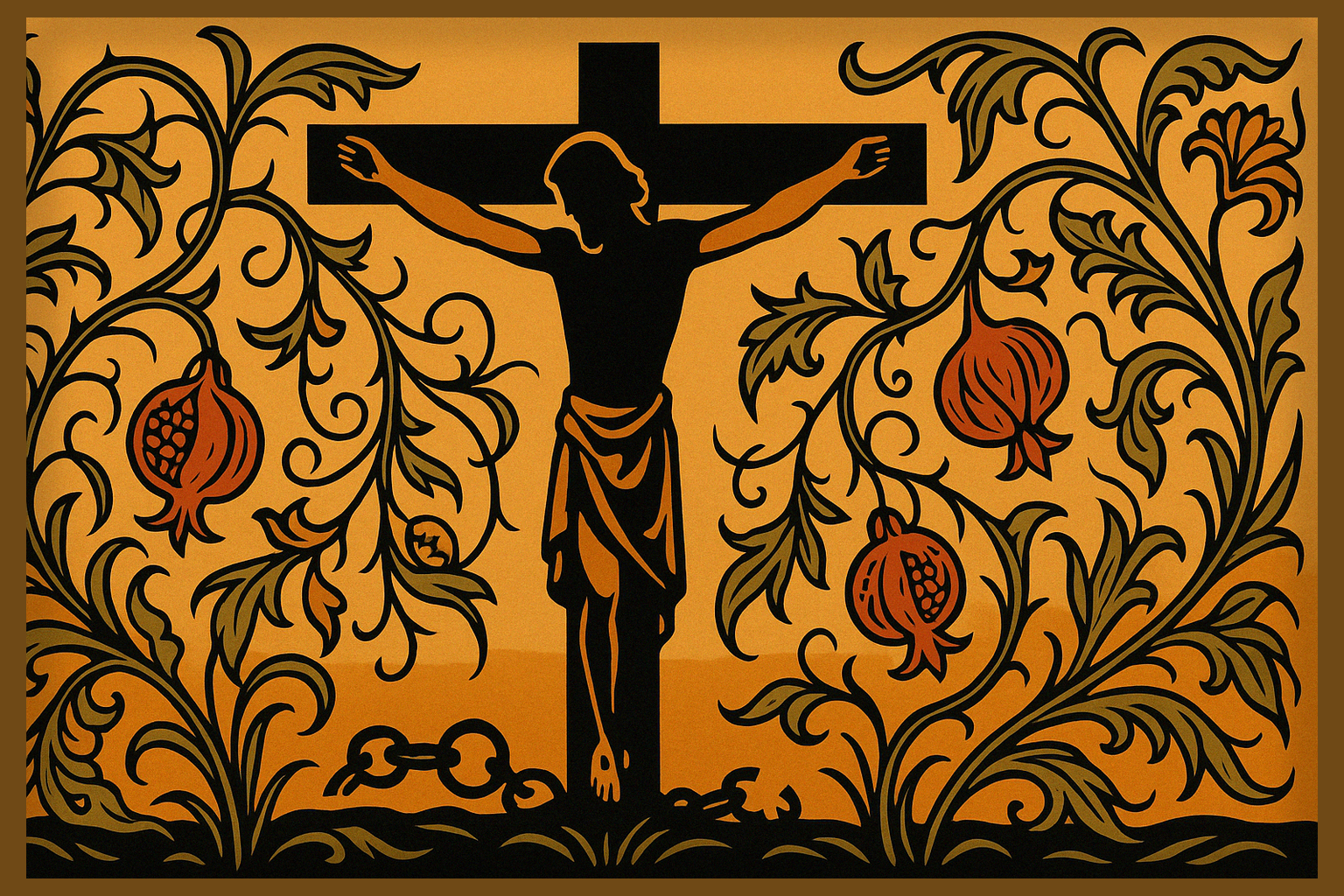
This brings the argument to the place where Genesis 15 and the cross finally meet, and it's worth tracing the connection slowly because the logic is precise, not merely poetic.
Galatians 3:13 and Deuteronomy 21:23: Becoming a Curse
Galatians 3:13 makes one of Paul's boldest claims: "Christ redeemed us from the curse of the law by becoming a curse for us, for it is written, 'Cursed is everyone who is hanged on a tree.'" That quotation comes from Deuteronomy 21:23, which addresses the body of an executed criminal, exposed as a sign of covenant curse.
Here's why this claim isn't arbitrary. Israel stood under real, specified curses because of the bilateral covenant it accepted and broke at Sinai, the curses detailed in Deuteronomy 28. Those curses needed to land somewhere, on someone, for the covenant's own internal logic to be honored. Paul is saying Jesus absorbed that curse, taking on himself exactly the covenant liability Deuteronomy had attached to Israel's failure. This is not God sending someone else to pay a debt. It is God, who alone walked through the pieces in Genesis 15, now bearing in his own flesh the liability he took on himself from the beginning.
Jesus as the Faithful Israelite Who Walks Where Israel Could Not
Scripture also presents Jesus' earthly life as recapitulating Israel's story: called out of Egypt, tested forty days in the wilderness as Israel was tested forty years, tempted with the same temptations Israel failed, and succeeding where the nation failed. This is God himself, in human flesh, living out the human side of the covenant that Israel could not keep.
Where Israel broke the law it swore to keep at Sinai, Jesus kept it. He walks the path Israel could not walk. And because he succeeds as the faithful Israelite, in his humanity, he is the one qualified to absorb the curse that Israel's failure under the Sinai covenant had generated, and in his identity as God himself, he is the one with the standing to do it. This isn't substitution pulled from nowhere, nor is it one divine person settling accounts with another. It's the only resolution available once you take seriously both the bilateral covenant Israel broke and the unilateral oath God swore, in his own person, before the law ever existed.
The Cross as Payment on an Ancient Bill
Here's where the whole argument closes the loop, and it's the detail most explanations of the cross skip entirely.
One Party Liable From the Beginning
Go back to the smoking firepot and the flaming torch. If God alone walked through the pieces in Genesis 15, then God alone accepted the self-cursing oath. God alone was on the hook, by his own design, for the failure of the covenant relationship between himself and Abraham's family, long before Sinai, long before the golden calf, long before the exile.
This reframes everything. The cross is not God improvising a solution to a problem he didn't see coming, nor a Plan B cobbled together after Israel's failure caught him off guard. The liability was already God's own, sworn in blood and fire while Abraham slept in tardemah, unable to participate, unable even to witness. Lord took on the debt before the debtor had done anything to incur it. The cross is the payment on a bill God wrote himself, two thousand years earlier, with his own signature.
Inheriting the World: Romans 4:13 and the Promise Beyond the Land
And the promise this oath secures turns out to be bigger than anyone standing in that darkened field could have guessed. Romans 4:13 says the promise to Abraham and his offspring, that he would be "heir of the world," did not come through the law but through the righteousness of faith. What started as a promise about land and descendants widens, in Paul's reading, into a cosmic inheritance, the whole world restored, the blessing reaching the nations.
That widening happens through the Seed of Abraham, a phrase Paul reads as singular in Galatians 3:16, pointing to one person who fulfills the promise on behalf of the many. The one who walked faithfully where Israel could not, who absorbed the curse Deuteronomy pronounced, becomes the means by which the original Genesis 15 oath finally reaches its full scope, Judeans and Gentiles alike incorporated into one family through faith.
Once you've watched the fire and smoke pass alone between those carcasses, you can't read Paul's letters as abstract theory anymore. You're watching him trace a single oath across two thousand years of covenant history, back to a man asleep in the dark, and forward to God hanging on a tree in human flesh. The Abrahamic covenant in Genesis 15 was never a prelude to the real story. It was the opening move in a single, coherent plan, and the cross is not an exception to that plan but its fulfillment. What began with God alone walking through the blood ends with that same God bearing the curse in human flesh, which means the invitation was never to earn your way into the covenant by walking the path yourself. It was always to trust the one who already walked it for you.
A Close Reading
A close reading of the passage through Story, Symbol, and Praxis.
Want to read the passages behind this article in their original language?
Read the Greek and Hebrew behind this passage yourself, verse by verse, through the same scholarly lenses as Babel Report.
Explore Babel Lens →babellens.aiMore in origins


Explore the full gallery of essays and meditations
Browse the Collection