Gadrel, Not Satan: What 1 Enoch Reveals About Spiritual Rebellion
Explore Gadrel, the divine council, and Satan theology in Second Temple Judaism. See how spiritual beings and rebellion were once far more complex.
A man stands in a courtroom. He did not break in. Someone called him.
The book of Job names him ha-satan. The word means accuser. It is a title, like judge or prosecutor, not a name like Cain or Abraham. The divine council convenes, and this figure takes his seat among the elohim, and God (YHWH), whom the Hebrews called Alohim, permits him to speak.
Centuries later, a different book names a different spirit. Gadrel. He does not accuse. He teaches. He shows men how to forge a blade and women how to paint a face, and for this he falls from the order of heaven.
The Bible never says these two are the same being. Christian tradition made them the same being. Somewhere between Job and the Council of Nicaea, a courtroom prosecutor and a fallen instructor of metallurgy got pressed into one villain, one story, one Satan. Second Temple Judaism knew better. It held a crowded sky, full of ranks and failures that did not need to collapse into a single adversary. This is an argument for that crowded sky. This is an argument for precision.
The Man Who Stood in the Court
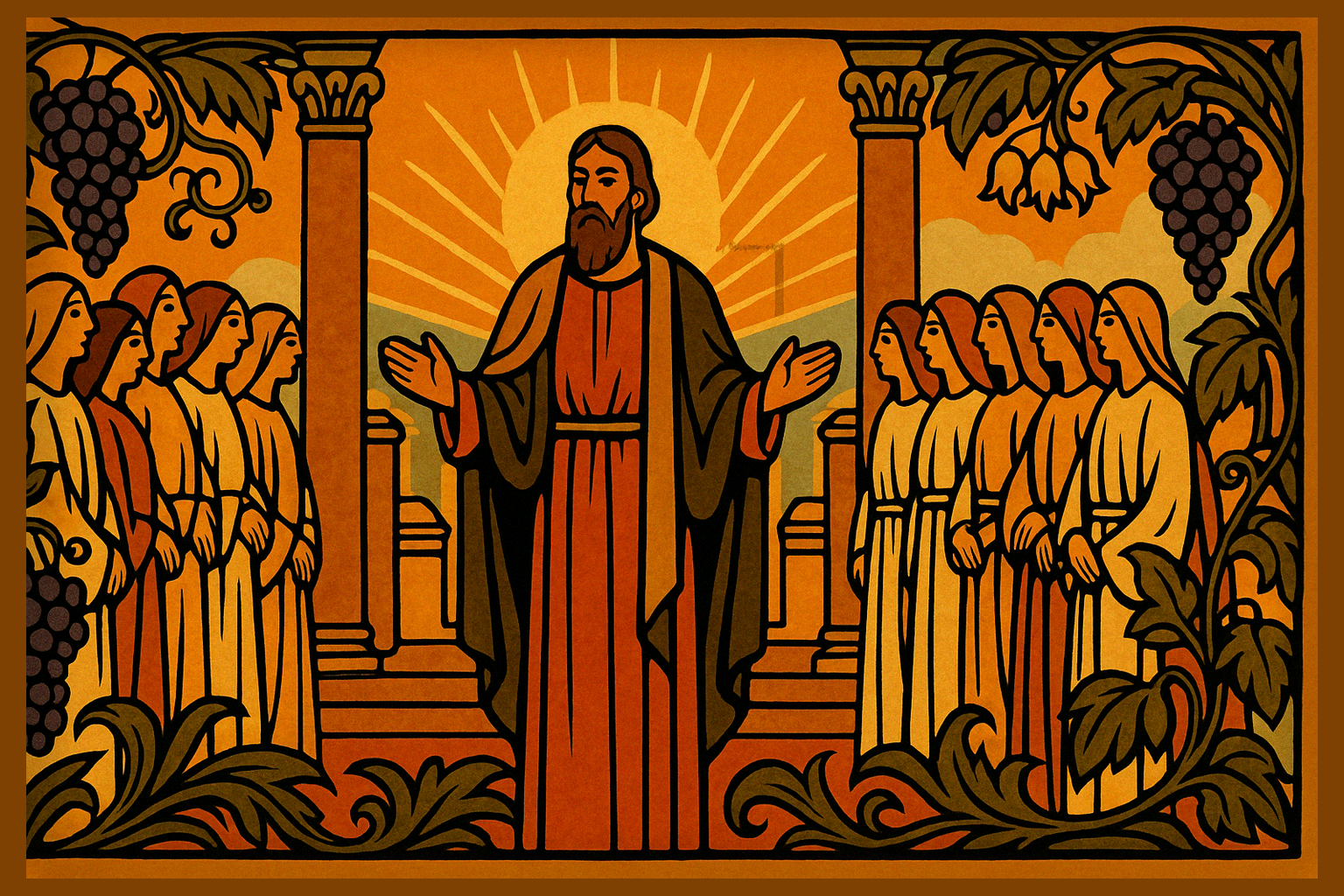
Job opens in a place readers rarely picture correctly. Not a battlefield. Not a throne room draped in menace. A court.
The Court, Not the Cage
The sons of God present themselves before the Lord (YHWH), and ha-satan comes among them. He does not sneak past a gate. He does not scale a wall. He walks in with the rest of the council, because he belongs there, because his post requires his presence.
The Lord speaks first. "Where have you come from?" The satan answers like a man reporting for duty, not like a fugitive caught in the act. "From going to and fro on the earth." This is the language of patrol, of assignment, of a job performed. Nothing in the text suggests he sneaked into a place he was forbidden to enter.
Then comes the exchange over Job. The satan proposes a test. YHWHs ets the terms. The satan executes them within the boundary given. He does not act outside the fence. He does not overthrow the bench. He argues a case before the judge and the judge rules, and the satan carries out the ruling. This is a courtroom, not a war.
Accuser Is a Title
The Hebrew carries a definite article. Ha-satan. The satan. Not Satan, capital S, a proper noun naming one specific fallen prince. The article marks a function the way "the mayor" marks a function. Someone holds the office. The office is not the man.
Nowhere in Job does the satan claim a kingdom. Nowhere does he lead an army of the damned. He asks permission and receives it. He tests and reports. Later biblical writers, in Zechariah and 1 Chronicles, use the same word for a role that shifts hands, sometimes a heavenly accuser, sometimes a human adversary raised up against Israel. The word travels. The word does not become fixed into a single cosmic villain until much later readers needed it to.
A Second Temple Judean reading Job would have recognized the prosecutor's chair. He would not have recognized the horned figure of medieval art, the red-skinned tempter of later Christian imagination. That figure had not been built yet.
The Council Behind the Curtain
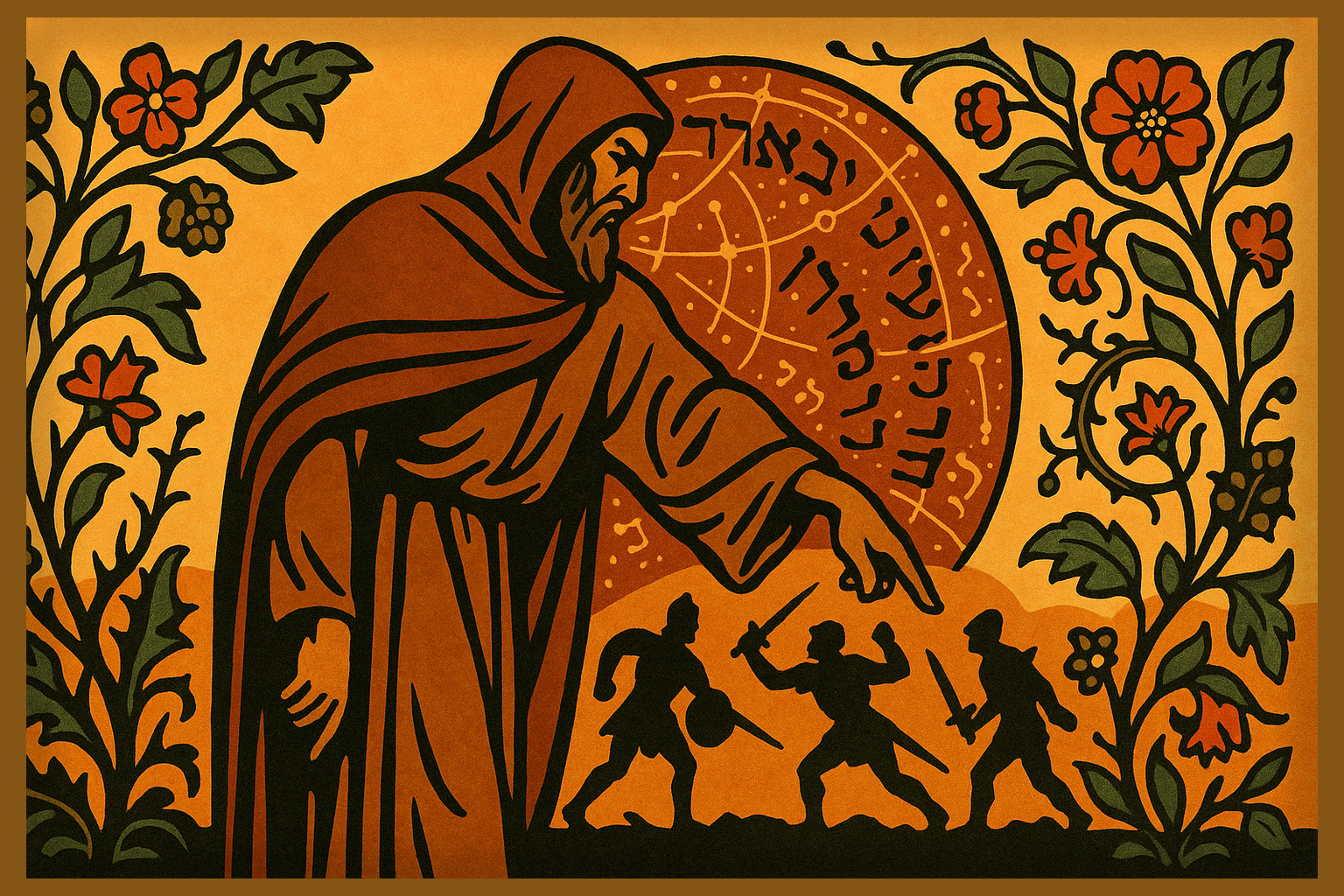
None of this makes sense without the room it happens in. The Hebrew Bible assumes a government in heaven the way a modern reader assumes a government in Washington or Westminster. Nobody explains it. Everybody presumes it.
Elohim Is a Rank, Not a Species
Psalm 82 puts a courtroom on trial, and the defendants are called elohim. "God stands in the congregation of the mighty; he judges among the elohim." The same word that names the God of Israel names the beings he judges. This troubles readers who assume elohim always means one specific deity. It does not. Elohim names a location in the order of being, a rank above humanity and beneath the one who presides. Angels are elohim. Divine judges are elohim. YHWH is elohim, and YHWH alone sits at the head of the assembly that bears the name.
This is not a marginal oddity. It runs through the Pentateuch, the Psalms, the prophets. Deuteronomy 32 describes the nations divided among the "sons of God." Daniel sees thrones set up, plural, with one figure like a son of man approaching one called the Ancient of Days. The assumption of a heavenly bureaucracy, populated by spiritual beings under a single sovereign, sits beneath the text the way bedrock sits beneath a house nobody built to notice it.
Government, Not Polytheism
This is not the pantheon of Ugarit or the councils of Babylon, where the gods conspired and warred as rivals. Israel's writers borrowed the architecture, the courtroom, the assembly, the ranks, and stripped it of rivalry. One God presides. The elohim under him do not vote him out. They obey or they do not, and when they do not, they answer for it, as in Psalm 82, where the corrupt elohim are sentenced to die like men.
Some obey. Some do not. This is not a threat to monotheism. It is a description of governance, the same way a king can have disloyal governors without ceasing to be king. Second Temple Judeans lived inside this assumption without needing to defend it. It was the furniture of their cosmos.
Gadrel and the Weight of Forbidden Knowledge
Genesis 6 gives four verses to a strange event. Sons of God take human wives. Giants result. The text moves on, offering no names, no mechanism, no explanation for how spiritual beings came to walk among women at all.
The Book Genesis Assumes You Know This
1 Enoch fills the silence. Chapters 6 through 8 name two hundred Watchers who descend under a leader called Semyaza, and among them stands Gadrel. Each Watcher teaches something. One shows men how to read the stars for divination. One shows women how to cut roots for poison. Gadrel teaches the making of weapons of war, and he teaches "all the blows of death to the children of men," and he shows the daughters of men "the instruments of death, and breastplates, and shields, and swords for warriors, and every artifice for the beautifying of the face."
This book never made it into the Hebrew canon, and Protestant Bibles exclude it still, but Second Temple Judeans read it as history, not fable. Fragments of it turned up among the Dead Sea Scrolls, copied and recopied by a community that took its cosmology with seriousness. The book of Jude quotes it directly. Early Christians debated its authority for centuries before setting it aside. It was not fringe literature to the people who first heard it. It was an explanation for why the world had grown so violent, so fast.
The Sin of Metallurgy
Gadrel's transgression has a shape. He gives men the sword. He gives women the paint that makes the sword seem worth drawing. The text does not condemn iron or ornament as evil in themselves. It condemns the timing. Men were not ready for the blade. Society was not ready for the tools that turn desire into war.
This is a strange kind of sin for a modern reader trained to think of fallen angels as prideful usurpers reaching for a throne that was never theirs. Gadrel reaches for nothing. He gives something away. The crime is disclosure, not ambition, and the punishment in 1 Enoch is severe because the damage cannot be undone. Once men know how to forge a sword, they cannot unlearn it.
Two Falls, Not One
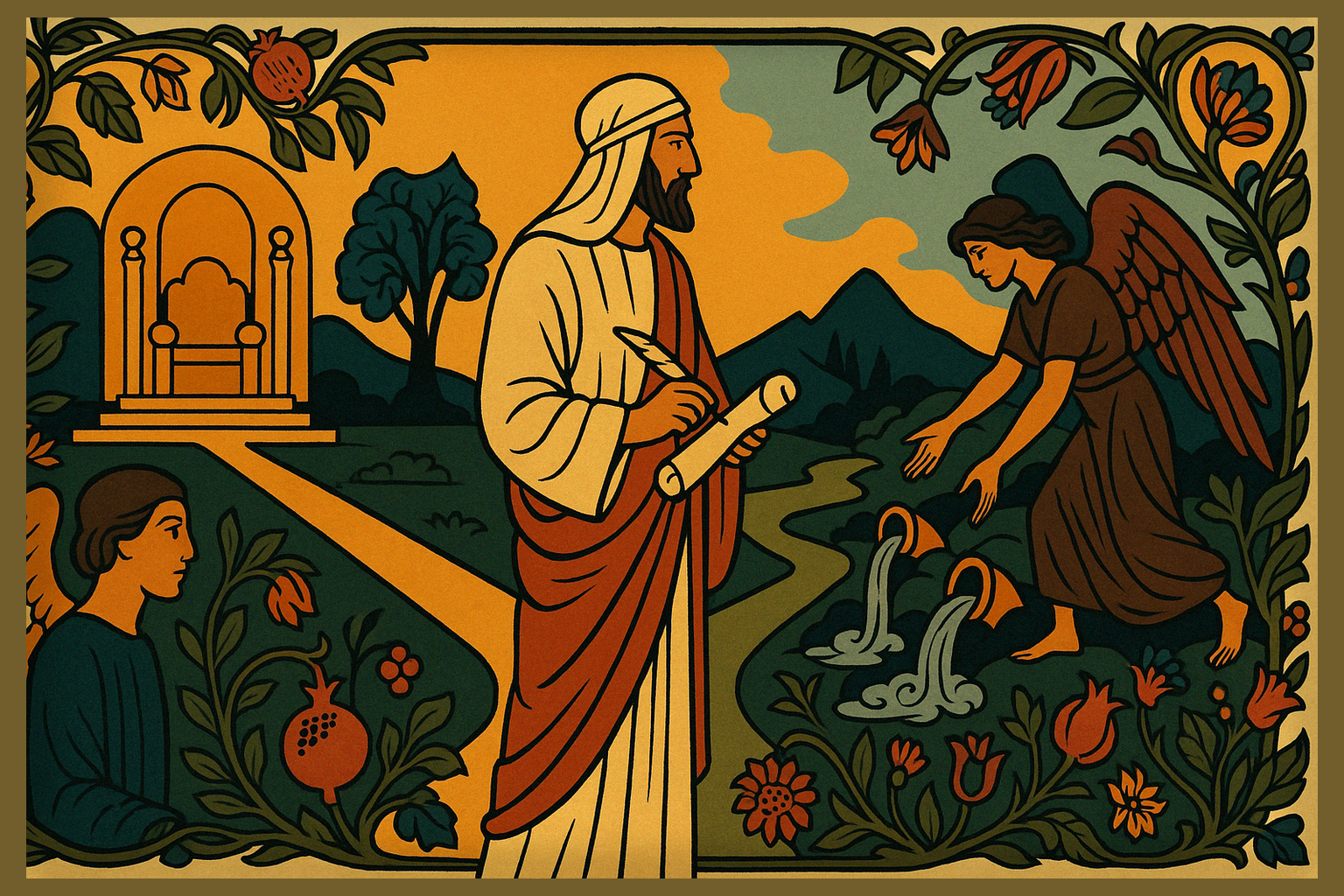
Set the satan of Job beside Gadrel of 1 Enoch, and the difference is not subtle. One argues a case within the bounds of his office. The other breaks a boundary by teaching what should have stayed hidden. Second Temple Judaism held both without confusion.
Disclosure, Not Ambition
Christian tradition, shaped by Milton and centuries of sermon before him, tells a single story of a proud angel who wanted the throne and fell reaching for it. This story fits Isaiah 14's taunt against the king of Babylon, later read as a portrait of Satan's fall, and it fits Ezekiel 28's lament for the prince of Tyre, later read the same way. It does not fit Gadrel at all.
Gadrel's fall is not vertical. He does not climb toward God's seat and get thrown down. His fall is horizontal, a boundary crossed between heaven's knowledge and earth's readiness. The crime is timing. Metallurgy and cosmetics are not evil. They become dangerous when given to people who have not built the moral structure to hold them. This is a different category of sin from pride, and Second Temple writers did not confuse the two.
A Crowded Sky
The literature of this period holds Watchers who taught forbidden skills, giants born of their unions, an accuser who works Job's case, a council of elohim who judge and are judged, and later apocalyptic figures like Mastema and Belial who take on adversarial roles of their own. None of these figures needed to fuse into a single villain. The sky was crowded, and Second Temple Judeans were comfortable with the crowd. Multiple rebellions, multiple falls, multiple reasons for the world to break. No single figure had to carry all of it.
How the Splice Was Made
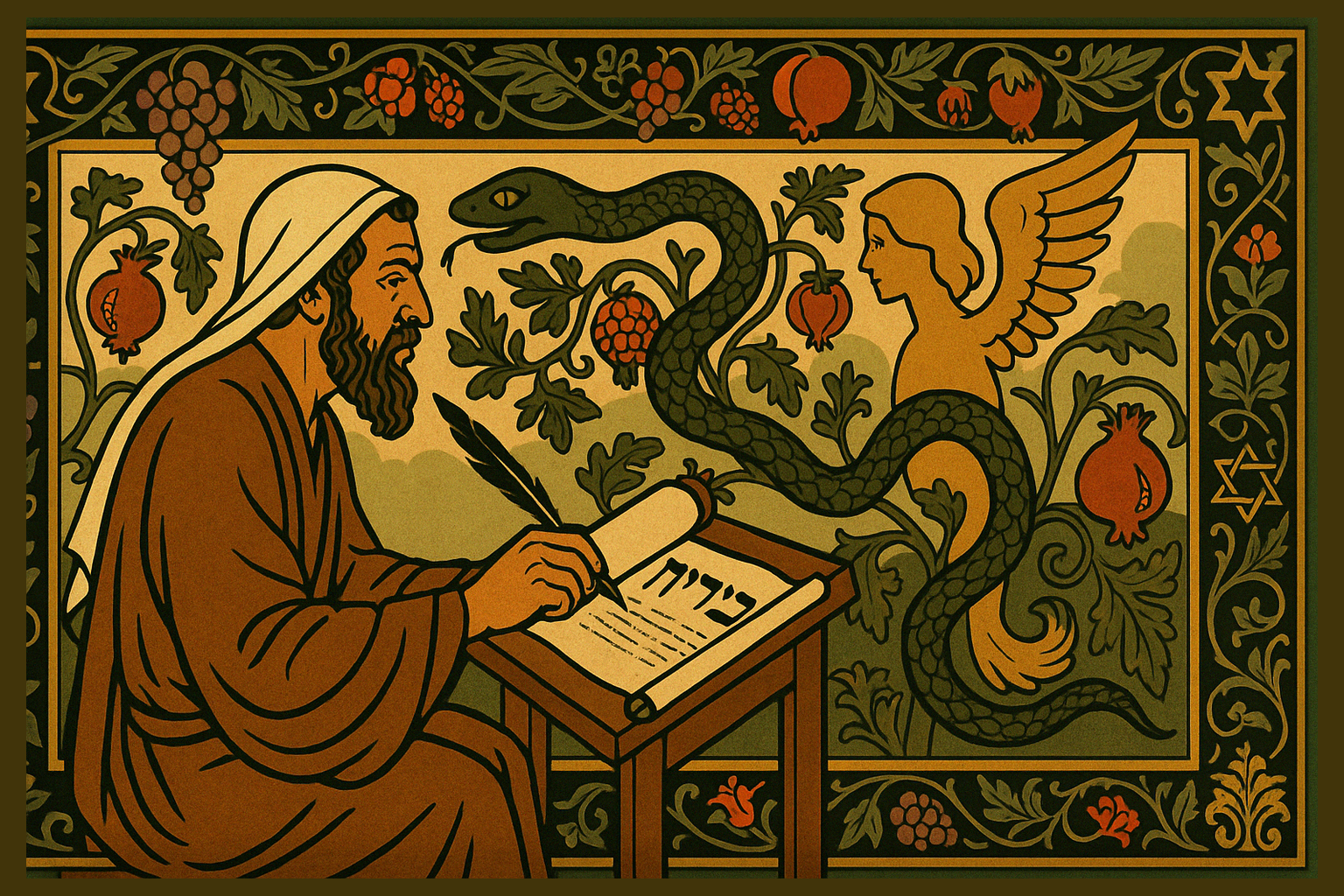
Somewhere the crowd thinned to one. The process took centuries, and it left fingerprints.
The Serpent Gets a New Name
Genesis 3 never names the serpent as a fallen angel at all. It calls him a serpent, more cunning than any beast of the field, and leaves the reader to wonder what kind of creature that makes him. Later Jewish tradition, and texts like the Wisdom of Solomon and later rabbinic sources such as Pirke de Rabbi Eliezer, began identifying the serpent with a rebellious spirit, and some strands folded Gadrel's story into that identification, treating the Watcher's transgression and the serpent's temptation as branches of one root rebellion. Christian writers inherited this splice already partly assembled and finished the work. By the time Justin Martyr and later Origen wrote their defenses of the faith, the serpent, the satan of Job, and the Watchers of Enoch had begun to merge into a single figure with a single biography: created glorious, fell through pride, tempted Eve, now roams the earth as chief adversary of God (YHWH) and humanity.
The text of Genesis makes none of these connections. The splice is theological work, performed by later readers solving a problem the original text did not pose.
One God Wants One Enemy
Monotheism prefers a clean architecture. One throne, one crown, one rebellion against it. A crowded sky of Watchers, accusers, and corrupt elohim complicates the picture a systematic theologian wants to build. Press it all into one adversary, and the story simplifies into something a catechism can hold: one enemy, one fall, one reason evil entered the world.
This synthesis served a doctrine well. It served the text less well. Job's satan performs a function within a functioning government. Gadrel commits a specific transgression rooted in a specific historical moment, teaching, timing, disclosure. The Genesis serpent tempts without explanation of his origin at all. Flattening these into one biography answers questions the ancient authors were not asking, and it silences distinctions they cared enough to draw.
What Precision Recovers
None of this argues that Satan does not exist or that Christian tradition invented evil from nothing. It argues that the tradition traded complexity for convenience, and something got left on the floor of that trade.
Naming the Danger Correctly
Gadrel's sin still happens. Knowledge arrives before the people receiving it have built the structure to hold it well. Nuclear fission split the atom decades before nations built the wisdom to govern it. Social platforms gave every voice a microphone before any culture had learned what to do with unlimited reach. Metallurgy, cosmetics, splitting atoms, coding algorithms, none of these are evil in themselves. Each becomes a wound when the season is wrong and the hand holding the tool has not been prepared to hold it. Second Temple Judaism named this pattern with a spirit and a story. The pattern did not end when the story left the canon.
The Cost of Flattening
A single Satan makes for a simpler sermon. One villain, one fall, one enemy for every congregation to fear and resist. It is not a false picture. It is an incomplete one, and the incompleteness has a cost. It trains readers to look for one shape of evil, pride reaching for a throne, when scripture and its surrounding literature describe several shapes: the prosecutor who tests within bounds, the teacher who discloses too soon, the serpent whose origin the text never explains. A reader who only knows the flattened Satan misses how differently the ancient world understood the anatomy of rebellion, and misses how many of its warnings still apply.
The divine council still stands behind the text, whether or not modern readers picture the room correctly. Gadrel, Satan theology, and Second Temple Judaism's crowded sky are not academic curiosities kept behind glass. They are an invitation to read Job, Genesis, and 1 Enoch again, slower this time, and to ask which specific failure each text is naming before reaching for the one word that explains everything and therefore explains too little. The names are still there, waiting to be read as they were written, not as they were later combined.
A Close Reading
A close reading of the passage through Story, Symbol, and Praxis.
Want to read the passages behind this article in their original language?
Read the Greek and Hebrew behind this passage yourself, verse by verse, through the same scholarly lenses as Babel Report.
Explore Babel Lens →babellens.aiMore in origins


Explore the full gallery of essays and meditations
Browse the Collection