A Roman Soldier in a Well: Leiden Reopens a Cold Case at Velsen
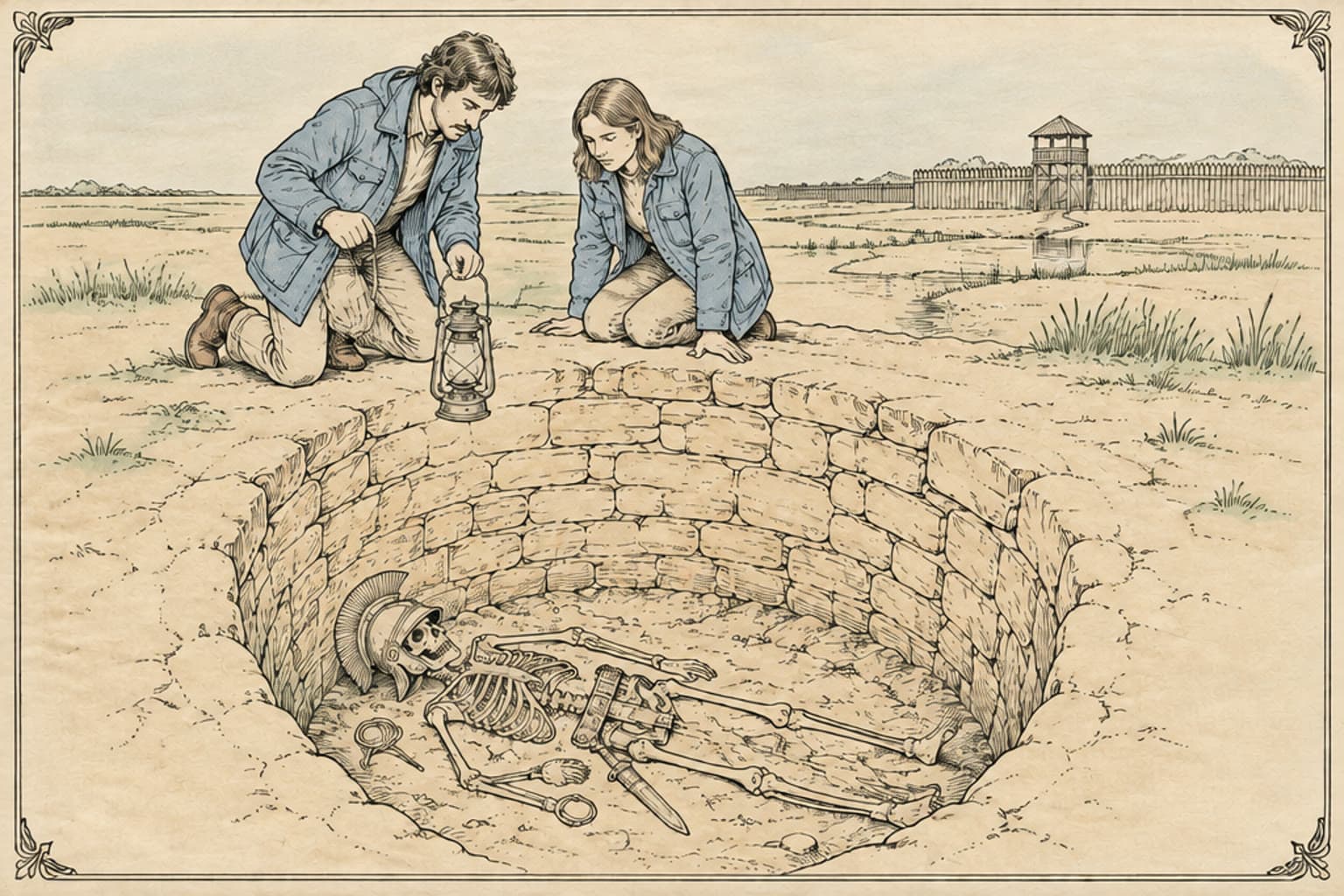
Archaeologists at Leiden University have reopened the case of a man found in 1977 at the bottom of a well at the Roman fort of Velsen, in North Holland. Both phys.org and La Brújula Verde report on a new book by Carol van Driel-Murray and Mark Driessen. The skeleton was nearly complete. A belt, dagger, ring, brooch and sandal lay with it.
The team used isotope analysis, forensic study, bone analysis and 3D imaging. They found more stab wounds than earlier researchers had, including some inside the rib cage and many perforations in the pelvis. The wounds most likely came from a Roman military dagger, probably the one beside him. Forensic experts called the attack "very brutal", according to phys.org. Driessen reads it as a targeted act of revenge. Tooth enamel points to a childhood in southern Europe. That undercuts the early 1980s idea that he was a Frisian. Neither source names the region.
Earlier scholars tied the find to the Frisian revolt of AD 28, which Tacitus links to a dispute over tribute. The new authors resist this. Van Driel-Murray says, in phys.org, that written sources and finds "often tell different stories". La Brújula Verde adds detail. It notes that Velsen is identified with Tacitus's fortress Flevum, though without definitive proof. It also says the archaeology shows a stay well past AD 28, with a withdrawal around AD 47. Phys.org says only that the finds show a longer presence.
On the culprit, the sources agree that the authors will not commit to one theory. Three scenarios are named: Frisians killing him in an attack, execution as a deserter, or revenge by locals. La Brújula Verde says the publisher counts six. Both say the authors think fellow soldiers, punishing misconduct, are the most likely killers. Both stress that certainty is not possible. Only La Brújula Verde describes the burial, with stones, household waste and Mediterranean fruit stones packed over the body. It also reports an older argument that the Romans themselves buried him.
For readers of the biblical text, the link is thin. La Brújula Verde notes only that Pontius Pilate governed Judea in AD 28, and that the Gospels have him later sentence Jesus (YHWShA). That is a date marker, nothing more. The real lesson is method. Tacitus wrote long after these events, and his account does not match the ground evidence neatly. Careful readers of any ancient text can borrow the same habit: weigh several readings and say plainly what remains unknown.
Compiled from the reports below. Read the originals.
Sources
- October 26, 2026
- October 27, 2026La Brújula VerdeWas This Roman Soldier Murdered by His Own Comrades? Archaeologists Reopen a 2,000-Year-Old Cold Case