Open your Bible to Isaiah 52:15 and you'll find one of the strangest verses in the whole prophetic tradition. Kings shut their mouths. They stare at someone who looks ruined. Most readers blow past this verse on the way to the more famous "wounds" and "stripes" language of chapter 53. But the apostle Paul did not blow past it. He pulled this exact verse out of Isaiah and used it, in writing, to explain why he kept moving to cities where nobody had ever heard the name of Jesus (YHWShA). This verse is the hinge Paul's whole missionary strategy swings on.
Stop on that for a second. This is a missionary reading his own job description off a page written more than five hundred years before he was born. Notice what that means: Paul did not invent a metaphor and go looking for a verse to back it up. He read an old promise about nations and kings and silence, and he built a career out of taking it word-for-word. Let's trace how that happens.
Kings Shut Their Mouths: Reading Isaiah 52:15 in Its Own Setting
The strange verse before the famous verse
Isaiah 52:13-53:12, the passage known as the fourth Servant Song, is where this begins. Everybody remembers verse 5: he was pierced for our transgressions.
Everybody remembers by his stripes we are healed.
These lines get quoted at funerals and in hymns and on Good Friday. But watch what comes right before all of that, in verse 15:
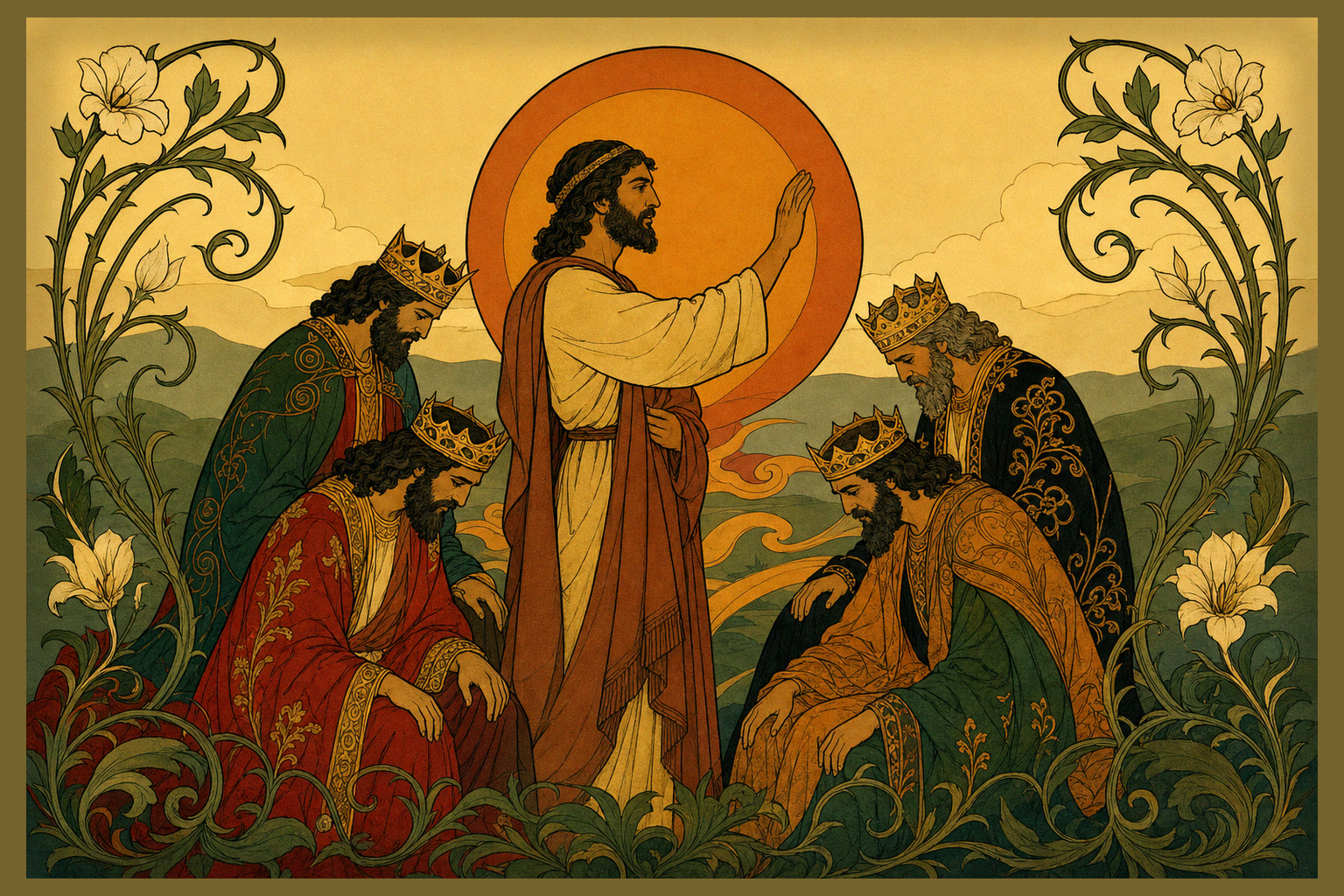
So he shall sprinkle many nations; kings shall shut their mouths because of him.
Here is the hinge of the whole song, and most readers walk right past it. It doesn't sound like anything we expect from a messianic prophecy. There's no throne here. No army. No coronation. Nations and kings going silent in front of a man who, according to the previous verse, looks ruined beyond recognition. If you skip this verse to get to the suffering language in chapter 53, you miss the reason the suffering matters in the first place. The Servant's humiliation is not the end of the story. It's the means by which something happens to the nations. Skip verse 15, and you've cut the wiring between the Servant's wounds and the world's response to them.
The Hebrew verb yazzeh: sprinkle or startle
Now it gets interesting, and disputed. The Hebrew verb at the center of this verse is yazzeh, and translators have split hard over what it means. The King James Version and most modern translations render it sprinkle.
But the word can also plausibly mean startle
or cause to leap,
and some translators, both ancient and modern, have gone that direction instead.
That is not a minor footnote. The choice changes the entire picture the verse paints. If yazzeh means startle,
then Isaiah 52:15 is describing shock. Kings see the Servant and recoil, stunned by what they're looking at, whether in horror or astonishment. That's a coherent reading, and it fits the surrounding verses about disfigurement. If yazzeh means sprinkle,
something else is happening entirely. The Servant isn't merely causing a reaction. He's performing an action on the nations, something ritual, something that changes their status. The nations go from being outsiders to being marked, consecrated, brought near.
Sprinkle
deserves serious weight for a specific reason. The same Hebrew root shows up throughout Leviticus describing one priestly action. Elsewhere in the Hebrew Bible the verb rarely if ever simply means to startle,
though translators debate that point too. When a word shows up dozens of times in one cluster of related priestly terms, that's the place worth checking first before reaching for a rarer, contested sense. And when you check that cluster, you land somewhere specific: the tabernacle.
Priestly sprinkling language from Leviticus
Flip back to Leviticus and you'll find this verb doing consistent work. Moses sprinkles oil on the altar to consecrate it (Leviticus 8:11) and blood around it (Leviticus 8:19). The priest sprinkles blood, then oil, to cleanse a person from skin disease and bring them back into the community (Leviticus 14:7, 16). The sprinkling changes the legal and ritual status of whatever gets sprinkled, rather than merely impressing an onlooker. Something unclean becomes clean. Something common becomes holy. Something outside the camp comes back in.
If the author of Isaiah 52:15 intended that same technical vocabulary, the Servant isn't performing a magic trick in front of kings to make them gasp. He's doing something priestly to the nations themselves. He is setting them apart. He is bringing them near. The text stops being about reaction and starts being about consecration. Ritual language doesn't wander into a text by accident. When Isaiah reaches for a verb that Leviticus uses almost exclusively for sacred cleansing, he's inviting us to read the nations as something being made holy, not merely something being awed.
A Disfigured Servant in a Chiastic Song

Isaiah 52:14 and the collapse of the warrior-king expectation
Before we get to the sprinkling, we have to look at what makes it so jarring. Isaiah 52:14 describes the Servant this way: his appearance was so marred, beyond human semblance, and his form beyond that of the children of mankind.
That is not messianic language as anyone in the ancient Near East would have recognized it. Kings in that world won nations through armies, tribute, and spectacle. They did not win nations by looking ruined.
This matters because it pushes back against the assumption that ancient Israel was simply waiting for an enthroned warrior-messiah who would subdue the nations by force. That image shows up elsewhere in the prophetic tradition, sure. But Isaiah 52:13-53:12 presents something else: witness through humiliation, consecration through disfigurement. The nations don't fall silent because the Servant conquered them. They fall silent because they are looking at something they have never seen before and cannot categorize. A king usually commands silence through power. This figure commands it through ruin.
The mirror structure of Isaiah 52:13-53:12
Something becomes visible once you step back and look at the whole song as one unit rather than four disconnected verses. Isaiah 52:13-53:12 is shaped as a chiasm, a structure that mirrors itself around a center point, the way the letters A-B-C-B-A mirror around C. The song opens in 52:13-15 with the Servant exalted, lifted up and highly exalted.
It closes in 53:10-12 with the Servant exalted again, given a portion with the great.
In between sits the long middle section describing suffering, rejection, and death.
This is a pattern, and it is deliberate. The song begins high, descends into the depths of humiliation, and climbs back out to a height that matches where it started. That structure is what makes the reversal land with its full weight. You are not simply told the Servant suffered, then was rewarded.
You are made to walk the whole shape of it, descending through the center of the poem and climbing back out the other side, so that by the time you reach the exaltation again, you've felt the cost of it. Good poetry does this. It doesn't tell you the point. It builds you a shape and lets the shape make the point.
Shifting voices: he, we, and I across the song
Watch one more design feature before we move on, because it changes how you read the whole thing. The poem shifts speakers. It opens in the voice of God (Alohim) himself, speaking about my servant
in third person (52:13). Then an unnamed group speaks in first person plural, confessing we held him in no esteem,
we have turned, every one, to his own way
(53:1-6). Then the voice returns to third person description of the Servant's suffering and death (53:7-9). Then God speaks again at the end, back in first person, pronouncing the Servant's vindication (53:11-12).
The shifting voice matters because it pulls the reader into the confession. You are not simply observing the Servant's suffering from a safe distance as a spectator watching him
suffer. For one long stretch, the poem puts words in your mouth: we
did this, we
misjudged him, we
are healed by his wounds. The biblical authors are inviting us to speak the confession ourselves, not merely witness it happening to someone else. That's a literary choice, not an accident, and it's part of why this passage has gripped readers across two and a half thousand years the way it has.
What the Exiles Needed to Hear in Babylon

Judah's collapsed witness to the nations, around 540 BC
Now step back into the historical moment this song was written for. Isaiah 40-55 speaks to Judean exiles living in Babylon in the decades after Jerusalem fell in 586 BC, around 540 BC. Whether Isaiah of Jerusalem saw that moment ahead of time or a later prophet in his school wrote from inside it is disputed, and nothing here depends on settling it. The audience is the same either way. These are people whose whole national story had collapsed. The temple was rubble. The Davidic king was gone. And crucially, Israel's calling to be a witness to the nations, the vocation given all the way back to Abraham in Genesis 12, that the nations would be blessed through this people, looked finished. There was no way to witness to anyone about the living God when your own capital city was ash and you were living as a captive population in the empire that burned it.
This is the emotional and theological crisis the Servant Songs are written into. It is not an abstract theological puzzle but a genuine, lived collapse. The people who first heard Isaiah 52:13-53:12 were not reading poetry about a distant future messiah as a purely intellectual exercise. They were asking whether their entire reason for existing as a nation, to be a light to the nations, had simply died along with Jerusalem.
The larger vision of Isaiah 40-55: nations seeing, ends of the earth watching
Isaiah 52:15 becomes even more interesting once you set it inside its larger neighborhood. This theme, nations and the ends of the earth watching what God is doing, runs like a thread through all of Isaiah 40-55. Isaiah 49:6 has God telling the Servant, I will give you as a light for the nations, that my salvation will reach to the end of the earth.
Isaiah 52:10, three verses before our passage, says the Lord (YHWH) has bared his holy arm before the eyes of all the nations, and all the ends of the earth shall see the salvation of our God.
Notice the repeated key word: see.
Over and over in these chapters, the nations and the ends of the earth are watching, seeing, witnessing something God is doing through Israel. Isaiah 52:15 is not an isolated verse making an odd claim about kings. It's one more thread in a vision these chapters return to again and again: a worldwide audience, previously unaware, suddenly confronted with something they cannot look away from. The sprinkling of the nations in verse 15 is this larger vision landing on one specific image.
A promise restored through the Servant, not through armies
The answer these chapters give to Judah's crisis is not the answer anyone would have expected. The nations will still see. The witness is not dead. But it won't be restored the way Israel's witness was originally imagined, through a triumphant king on a throne commanding the nations' attention by force. It will be restored through a disfigured Servant whose suffering somehow accomplishes what armies never could. Kings who would never have bowed to Judean military power fall silent in front of this ruined figure instead.
This is the reversal the whole song is built to deliver. Judah lost everything that looked like strength, and Isaiah says the witness to the nations will come anyway, through weakness rather than despite it. That's a strange promise to make to a defeated, exiled people. It's also, as we're about to see, exactly the promise one particular apostle took as a direct description of his own calling six centuries later.
What They Have Not Been Told
: From Hebrew Promise to Pauline Mandate

The Septuagint phrase Paul picks up word for word
By the first century AD, most Judeans living outside the land of Israel read their scriptures in Greek, through the translation known as the Septuagint, a Greek version of the Hebrew Scriptures produced centuries earlier. And the Septuagint's rendering of Isaiah 52:15 includes a phrase that becomes absolutely critical for where this study is headed: those who have not been told of him shall see, and those who have not heard shall understand.
This phrase, what they have not been told,
is the specific Greek wording Paul reaches for, word for word, when he explains his own missionary strategy in Romans. Paul was steeped in both the Hebrew text and its Greek translation, and here he picks up the Septuagint's exact phrase and plants it directly into his own argument. This is a citation, not a vague allusion.
Romans 15:20-21: Paul's missionary ambition and its scriptural warrant
Here is the passage where it all comes together. In Romans 15:20-21, Paul writes: so I make it my ambition to proclaim the gospel, not where Christ has already been named, lest I build on someone else's foundation, but as it is written, 'Those who have never been told of him will see, and those who have never heard will understand.'
Look at what Paul does here. He states his strategy in plain terms: he deliberately avoids places where the gospel has already taken root, and instead aims at territory that has never heard it at all. And then he grounds that entire strategy, explicitly, in a direct quotation of Isaiah 52:15. This is Paul naming his source. He is not saying this reminds me of a prophecy.
He is saying this is what the Scripture commands, and I am doing it.
Paul's whole apostolic career, the relentless movement toward Spain, toward the edges of the Roman world, toward cities with no synagogue and no prior gospel witness, is built on this one verse functioning as a job description written for him five centuries before he was born.
Reading directly, not allegorically
The move Paul makes here is worth slowing down on, because it's easy to miss how bold it is. Paul does not treat Isaiah 52:15 as a loose metaphor he can stretch to cover whatever he happens to be doing. He reads it as a literal, direct description of a historical reality still unfolding in his own lifetime. The nations who have not been told
are not a spiritual abstraction. They are actual populations in actual cities, people in Illyricum and Spain and across Asia Minor who have genuinely never heard the name of the Messiah.
This is the same move Paul makes elsewhere with the Servant Songs. In Acts 13:46-47, Paul and Barnabas quote Isaiah 49:6, I have made you a light for the Gentiles, that you will bring salvation to the ends of the earth,
and apply it directly to their own turn toward Gentile audiences. Paul doesn't treat the prophetic texts as isolated fragments to be mined for convenient phrases. He reads Isaiah 40-55 as one continuous story: God's servant brings light to the nations. Paul locates his own ministry inside that story as its fulfillment in the present. That's a bold step: Paul reads himself directly into a centuries-old prophecy as its next chapter, rather than treating it as a loose symbol. But it's the step Paul consistently makes.
Paul the Priest: Sprinkling the Nations in Romans 15:16
Offering the Gentiles like a sacrifice
Now watch how this connects back to the sprinkling question we started with. Four verses before Paul quotes Isaiah 52:15, he describes his own ministry in startling priestly terms. Romans 15:16 reads, in a fairly literal rendering: Paul describes the grace given him to be a minister of Christ Jesus to the Gentiles in the priestly service of the gospel of God, so that the offering of the Gentiles will be acceptable, sanctified by the Holy Spirit.
This is a striking sentence, and it's the one place in the New Testament where an apostle explicitly describes his missionary preaching as a priestly act. Paul calls himself a minister
using a Greek word connected to temple service. He calls his preaching a priestly service,
using sacrificial vocabulary. And he describes the result as an offering
that must be sanctified,
made holy. This is not incidental word choice. It only makes full sense if Paul already has Isaiah 52:15 running in the background of his mind: the Servant sprinkles the nations, setting them apart as something consecrated. If the Servant's work is priestly sprinkling, then Paul, carrying that Servant's mission forward, describes his own preaching in the same priestly terms. The two passages, four verses apart, are not a coincidence. They're one argument.
The nations as the offering, not only the ones making it
Here is a real ambiguity, because it doesn't collapse easily into one meaning. When Paul speaks of the offering of the Gentiles,
does he mean the praise and worship that Gentile believers now direct toward God instead of toward their former idols? Or does he mean something bolder: that the nations themselves are the offering, the gift Paul presents to God as the fruit of his ministry?
The Greek phrase can be read either way, and Paul seems to intend both senses at once. But notice what's at stake either way you land. If the nations themselves are the offering, then Paul is describing Gentile believers as something analogous to a sacrifice brought into the temple, consecrated and made acceptable. That is exactly the trajectory Isaiah 52:15 sets up: the Servant sprinkles the nations, and sprinkled things, in Levitical vocabulary, become holy things. The nations stop being outsiders standing at the edge of Israel's story. They become part of what gets offered at the center of it.
Isaiah's charter completed in Gentile mission
So trace the whole arc with me one more time, because this is where it lands. An exiled people in Babylon around 540 BC are told that their collapsed witness to the nations will be restored. Not through a conquering king, but through a disfigured Servant whose suffering somehow sprinkles the nations and silences kings. Centuries later, that promise gets translated into Greek, and one specific phrase from it, what they have not been told,
becomes fixed vocabulary for territory the gospel has not yet reached. Then a Judean apostle, trained in both the Hebrew text and its Greek translation, reads that phrase as his own job description. He builds an entire missionary career avoiding already-evangelized cities in favor of untouched ones, and describes his own preaching using the exact priestly, sacrificial categories the Servant's sprinkling work had set up centuries earlier.
These are not three separate observations but one continuous trajectory, a single promise moving from exile to empire without ever changing its shape. Paul didn't need to allegorize Isaiah 52:15; he needed to walk into the role it had already described for him.
What This Still Asks of Us
So where does this leave a reader of Isaiah 52:15 today, whether you come to this text as someone who trusts it or someone studying it with real skepticism? The historical case here is not speculative. Paul tells us, in his own words, which verse he's quoting and why. He names Isaiah 52:15 as the scriptural foundation for a specific, costly strategy: deliberately moving toward people who have never heard, rather than staying where the message has already landed.
That choice cost Paul almost everything a settled ministry would have given him. Comfort, established relationships, the safety of familiar cities. He went to Illyricum instead. He planned for Spain. He read an ancient promise about silenced kings and sprinkled nations, and he built a life around making it come true in places it had never yet reached.
The pattern doesn't stop being true because the frontier has moved. There are still populations on this earth who have not been told. Isaiah 52:15 was never a prediction that would simply happen on its own, carried by momentum. It was a promise that moved an apostle's feet. What it asks of anyone who reads it carefully is the same question it asked Paul: who hasn't heard yet, and what will you do about it.