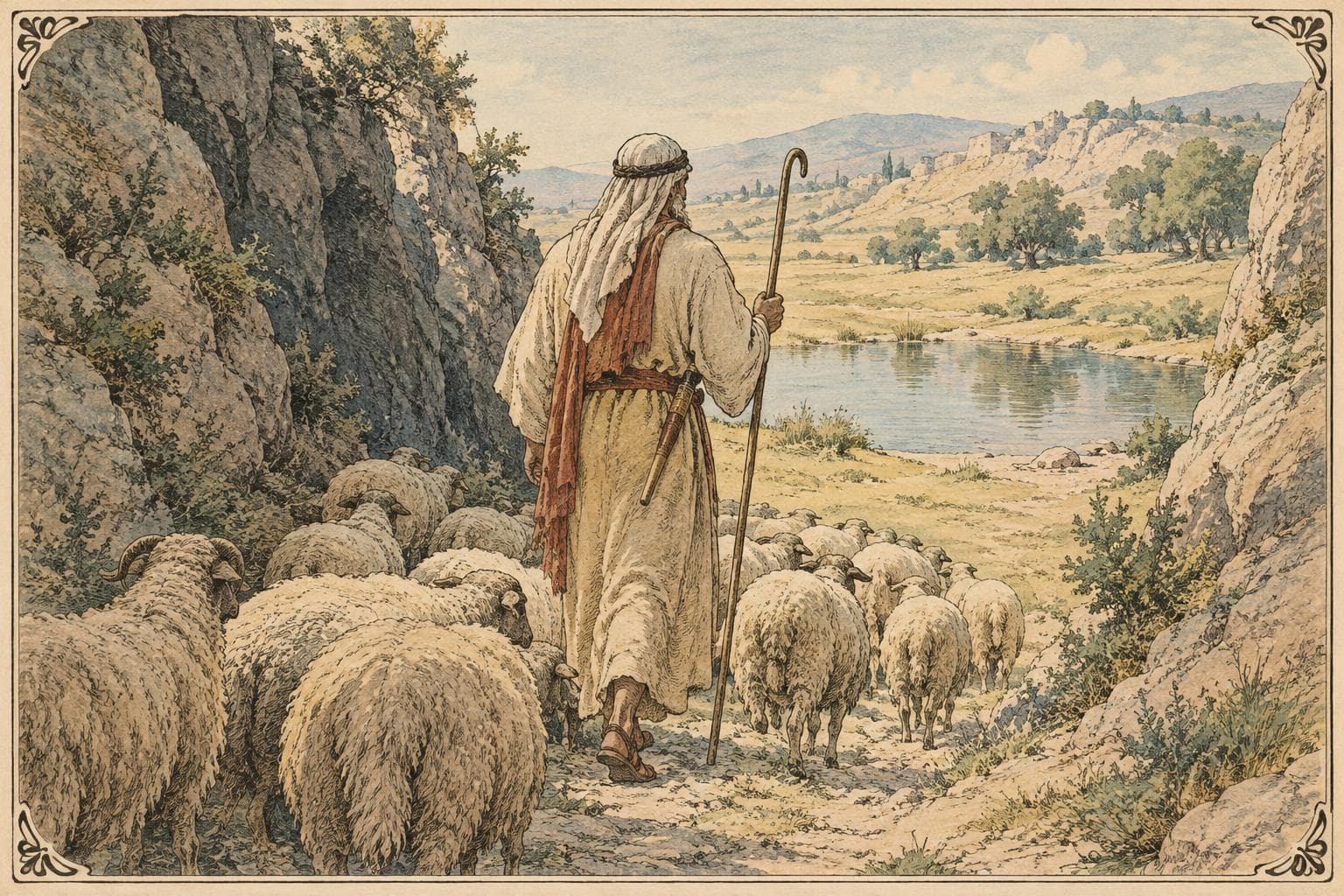
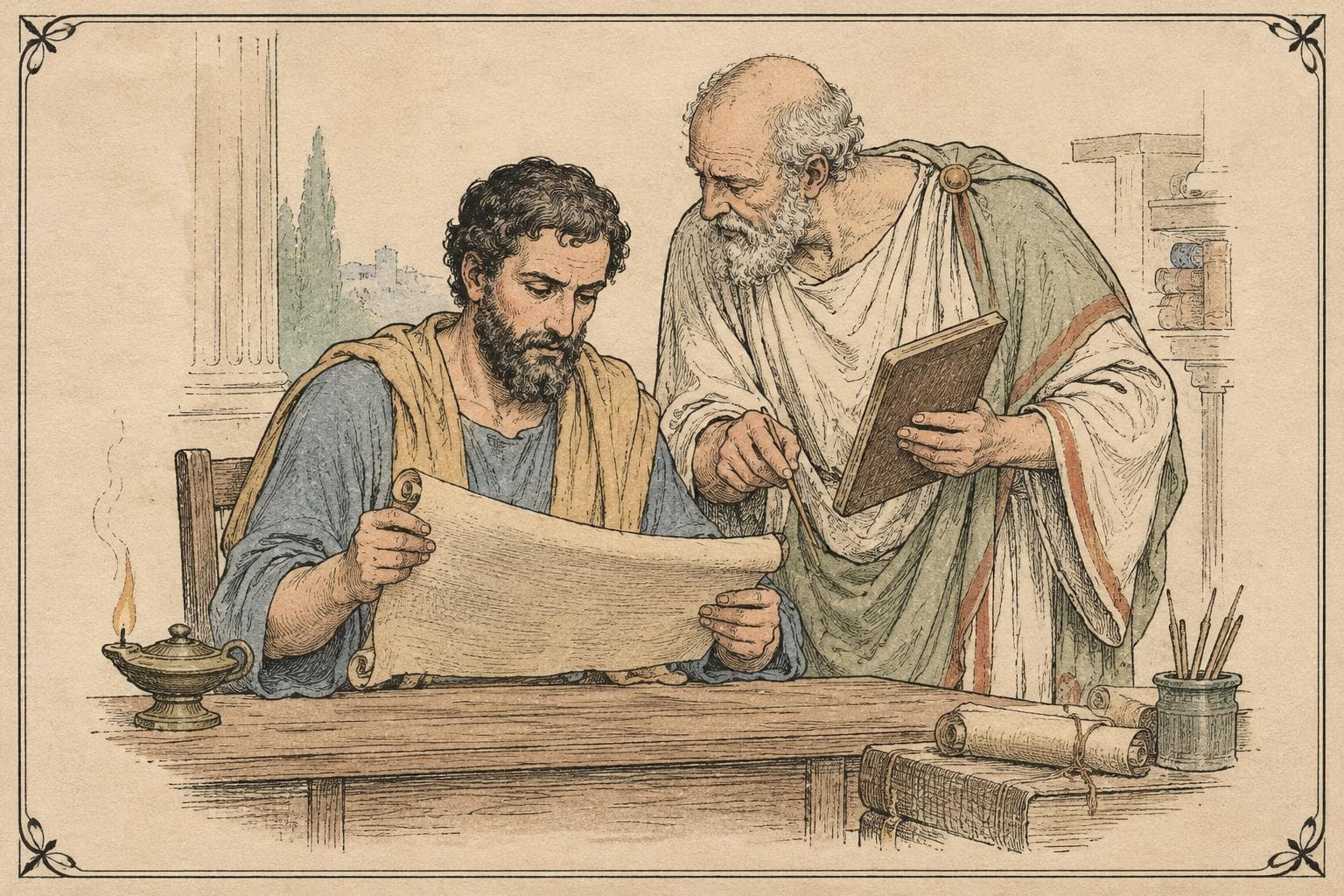
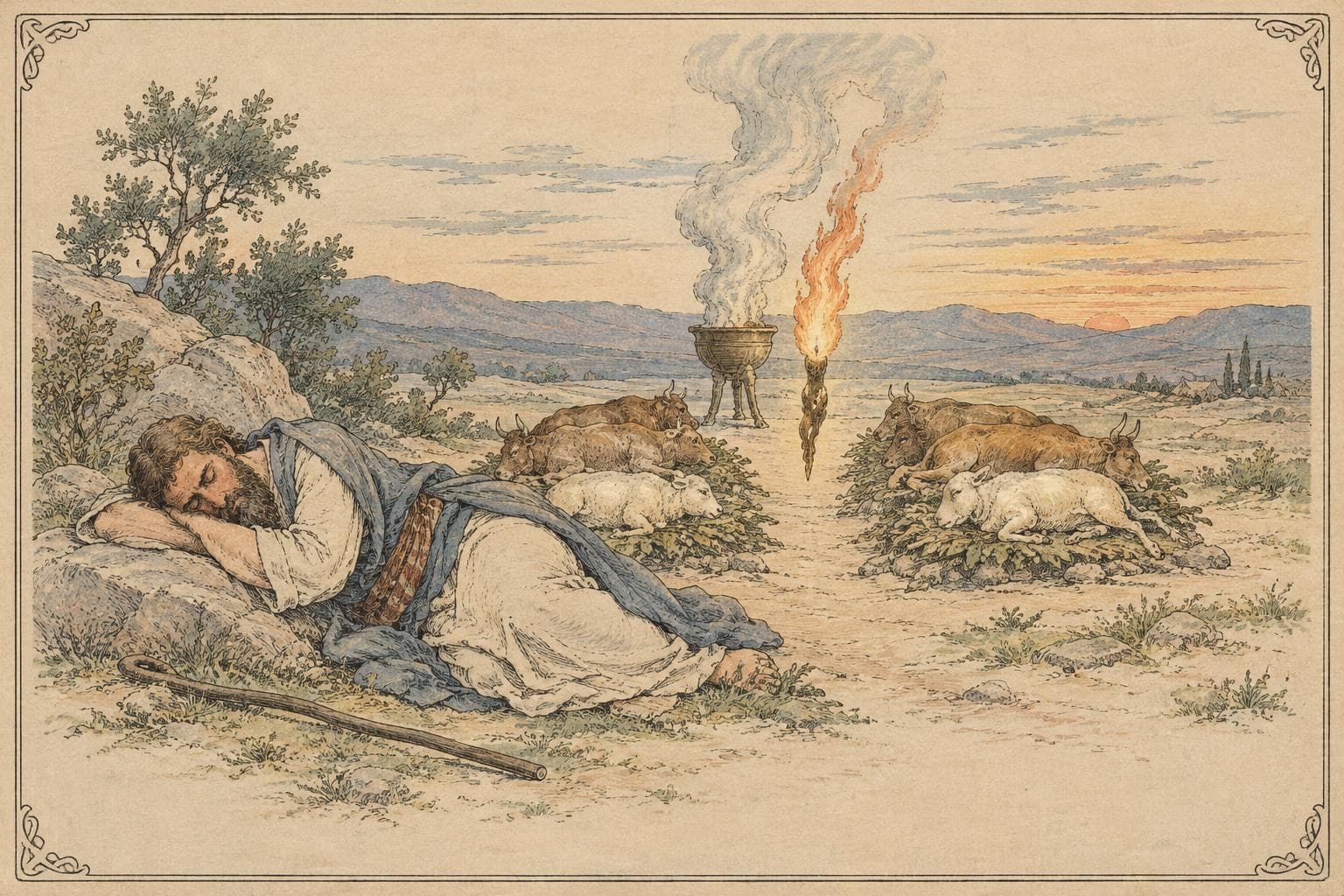
Before you crack open a Bible for the first time, you're likely to run into a simple question: where do you even start? Genesis, because it's first? A psalm, because someone said they're comforting? Yahuchanan, because a youth pastor once told you it's the easiest entry point? If you're looking for how to read the Bible for beginners, you've likely already hit this fork in the road and felt a little embarrassed that you didn't know the answer.
At that fork, the choice of book matters less than most people think. What matters more is a habit most of us were never taught. We were handed verses. Single lines, lifted out, printed on coffee mugs, read in isolation like fortune cookies. But the Bible wasn't written that way. It was written as literature, by authors who built patterns into their books on purpose, expecting readers to notice them.
Once you start reading for those patterns instead of hunting for isolated lines, the confusing parts of the Bible get more interesting instead of more frustrating. That shift is what this guide is built to teach, one step at a time.
Step 1: Pick One Book and Read the Whole Thing First
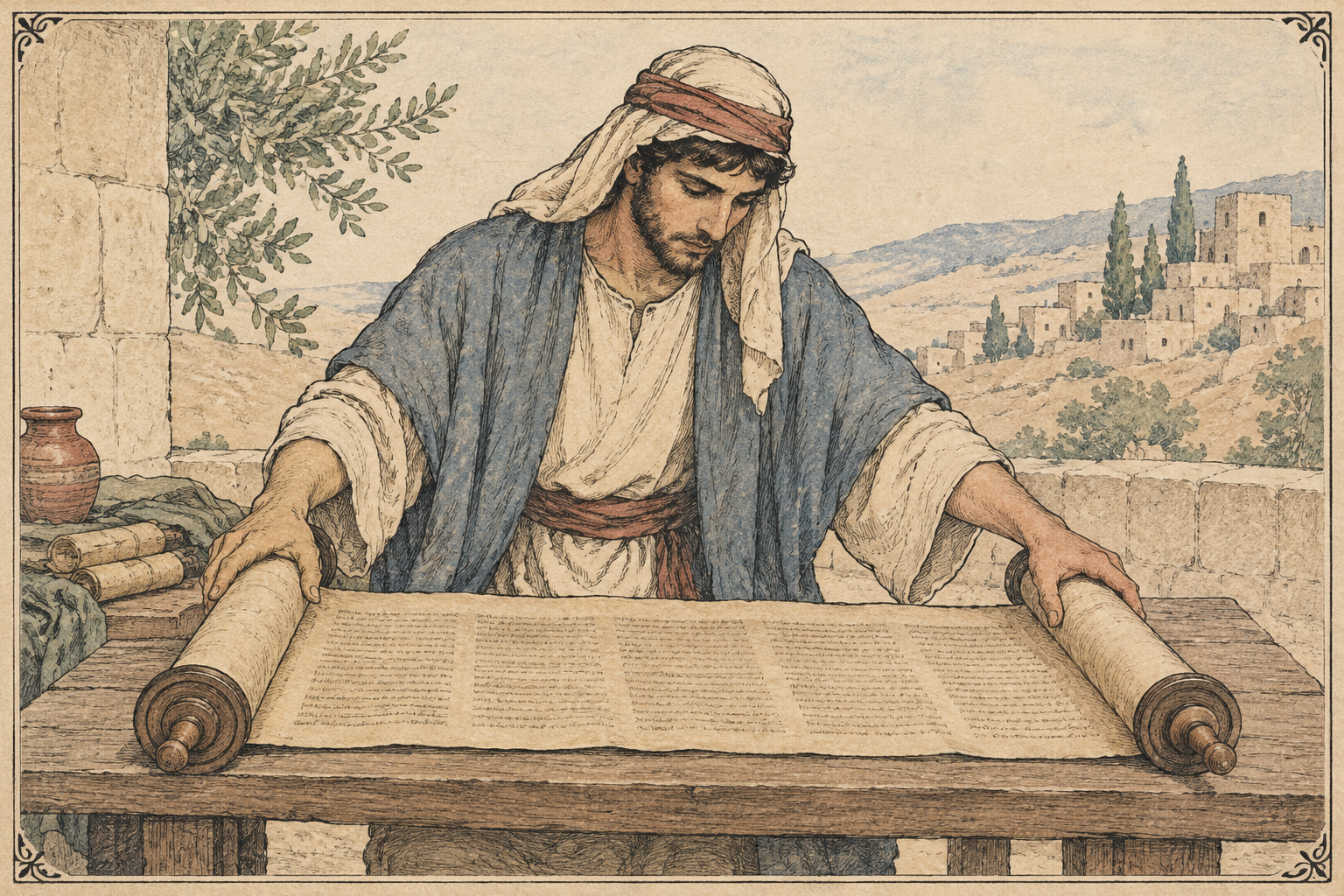
If you take nothing else from this guide, take this: pick a single short book and read the whole thing in one sitting before you stop to analyze a single verse.
Why Where You Start Matters Less Than How
Genesis is a fine place to start. So is a psalm. So is Yahuchanan. None of those choices are wrong. What's wrong is the method most of us bring to any of them: opening to a page, reading a few lines, closing the book, and calling that "reading the Bible." The real decision in front of you isn't which book. It's whether you're going to read a whole story or go verse-hunting.
Think about how strange it would be to pick up a novel, flip to page 140, read one paragraph, and set it down convinced you understood the book. Nobody does that with fiction. But it's exactly how most of us were trained to approach Scripture. Public reading in a lot of churches doesn't help here either. A few verses get read aloud on Sunday, disconnected from what came before and after, and the result is a kind of aural wallpaper, a pleasant religious hum that plays in the background while your mind drifts somewhere else. The fix isn't more verses. It's whole books.
Good First Books for Beginners
Three books work especially well for a first attempt: Mark, Ruth, and Jonah. Each one is short enough to read in a single sitting, maybe twenty to forty minutes depending on your pace. Each one also has something a lot of biblical literature has but readers rarely get told to look for: a clear shape. A beginning that sets up a problem, a middle that complicates it, and an ending that resolves it, usually not in the way you'd expect.
Jonah in particular is a great test case. Most people know the whale. Almost nobody reads the whole four chapters and notices that the real story isn't about the fish at all, it's about a prophet who runs from God (Alohim) because he doesn't want his enemies to be forgiven. The book ends on an unresolved question, with God asking Jonah if he has any right to be angry. You don't get that ending if you only know "the whale verse."
Reading in One Sitting Before Breaking It Down
The discipline here is simple to state and a little harder to practice: finish the book before you study anything inside it. Resist the urge to stop and look something up, cross-reference a footnote, or Google a word. Read the way you'd read a short story someone handed you. Treating a book like a story instead of a quote bank means letting the plot land first. You can go back and mine for detail later. In fact you should. But you need the whole shape in your head before the details mean anything.
Step 2: Stop Reading in Isolated Verses
If Step 1 gives you a practice, Step 2 names the habit you're trying to break. Most beginners come to the Bible already trained to lift a single verse out, treat it as a complete thought, and expect it to carry a whole worldview on its own. That habit has to go.
The Novel-Climax Problem
Picture handing someone one sentence from the climax of a novel they've never read. Maybe it's a single line of dialogue, tense and dramatic, torn out of its chapter. The sentence might sound striking. It might even sound profound. But without the two hundred pages that built up to it, you have no idea what it means, who's speaking, or what's at stake. Reading one verse of the Bible and expecting it to deliver a complete meaning is a close cousin of that problem.
This is why a verse like "I know the plans I have for you" or "Be still and know that I am God" gets quoted constantly and understood thinly. Those lines come from specific moments in specific stories, addressed to specific people in specific circumstances. Jeremiah 29:11 is spoken to exiles in Babylon, not to someone deciding between two job offers. Psalm 46 is a song about God's steadiness in the middle of geopolitical chaos, nations in uproar, mountains falling into the sea. Lifted out, both verses still sound nice. Read in context, they do something sharper and more specific.
How Authors Build Meaning Across a Whole Book
Hebrew and Greek narrative doesn't work sentence by sentence. It works book by book, scene by scene, building meaning cumulatively the way a piece of music builds a theme. A verse means what it means in relation to the whole thing it belongs to, not on its own. This isn't a modern reading theory imposed on an ancient text. It's how these authors composed.
Notice what this means practically: the next time a verse confuses you or sounds harsh out of nowhere, the first move isn't to defend it or dismiss it. The first move is to ask what chapter it's in, what's happening right before it, and what happens right after. Nine times out of ten, the surrounding story answers the question the isolated verse raised.
Step 3: Learn to Spot Repetition and Literary Design
This is where reading the Bible starts to feel less like homework and more like solving something. Once you start noticing that repeated words and mirrored scenes are placed on purpose, you stop being a passive reader and start being an active one.
Repeated Words as a Tap on the Shoulder
Here's a pattern worth testing for yourself. Go back to Genesis 1 and count how many times the word "good" appears. Then notice where it's missing. God calls light good, land good, vegetation good, sun and moon and stars good, sea creatures and birds good, land animals good. Six times, "good." Then on day two, when God separates the waters above from the waters below, the word doesn't show up at all. Ancient readers trained to notice repetition would have caught that gap immediately. Something is unfinished about day two. The author is signaling something worth noticing.
This happens constantly in Hebrew narrative. A word shows up three times in a single chapter, and that's rarely an accident of style. It's a signal. Genesis 22 repeats the phrase "the two of them walked on together" twice in the Abraham and Isaac story, once before Isaac asks his father a gutting question about the sacrifice, once after Abraham gives his unsettling answer. The repetition slows the scene down, leaving the reader to sit in the silence between question and answer.
Echoes Between Stories
Repetition doesn't only work inside one chapter. It works across the whole Bible, with later scenes hyperlinking back to earlier ones. When the author of 1 Kings describes Solomon's temple, the language echoes the Garden of Eden on purpose: gold, cherubim, trees carved into the walls, a space where heaven and earth overlap. When the Gospel of Yahuchanan opens with "in the beginning," the phrase deliberately echoes Genesis 1, inviting the reader to see the arrival of Jesus (YHWShA) as a new creation story.
Catching these echoes changes how the later story reads. Jonah being swallowed by a great fish and surviving three days, then Jesus saying the sign of Jonah will be given to his generation, isn't a throwaway comparison. It's the kind of structural echo the biblical authors expected careful readers to catch. Learning to read the Bible for beginners means training your eye to notice these links instead of reading each book as if it exists on an island.
Step 4: Read the Bible in Its Own Ancient World
This is a step that trips up more readers than almost anything else, including educated ones. The Bible was written by people living in an ancient agricultural, tribal, temple-centered world, and their metaphors, laws, and assumptions come from that world, not ours.
What a Phrase Meant to Its First Audience
Reading in context starts with a question most people skip entirely: what did this phrase mean to the people who first heard it? Start with what an ancient Israelite farmer or a first-century Judean fisherman heard when these words were first spoken.
Take something as basic as the Genesis creation account. Modern readers often come to it asking a material question: how did physical matter come into existence, and how long did it take. But ancient Near Eastern texts about origins weren't usually answering that kind of question. They were describing how something gets its function and its purpose within an ordered world, not explaining the mechanics of molecules. A text can make a real theological claim, that God is the active maker of everything and that humanity carries his image, without offering a scientific account of natural processes in the way modern readers expect one. Skipping that distinction is where a lot of needless arguments start, on both sides of the debate.
Why Ancient Categories Aren't Modern Ones
The same gap shows up with law codes, purity practices, and temple worship. Instructions that look strange or even troubling to modern eyes, dietary rules, land laws, sacrificial systems, were written into an ancient agricultural society with its own categories for order, holiness, and community boundaries. None of that erases the text's claims. It does mean that reading those sections through a strictly modern lens, without asking what function they served in their own world, guarantees misreading.
This is the payoff of reading historically: it doesn't make the Bible less meaningful, it makes it readable on its own terms instead of yours. A beginner's guide to Bible reading that skips this step will leave you constantly frustrated by texts that were never written to answer the questions you're bringing to them.
Step 5: Don't Read Alone
Somewhere along the way, Bible reading in the modern West became an almost entirely private activity: one person, one chair, one quiet morning. That's a recent habit historically speaking, and it's worth knowing that before you assume solo reading is the only legitimate way to do this.
How Ancient Communities Read Out Loud Together
For most of biblical history, these texts were read aloud, in community, and argued over afterward. Synagogue gatherings in the first century read Scripture publicly and then discussed it. Early Christian communities gathered specifically to hear letters like Paul's read out loud to the whole congregation, because most people couldn't read and few could afford their own copy.
Silent, solitary reading of a personal Bible owes a great deal to the printing press and rising literacy rates, advantages the original audiences largely didn't have, even though some ancient readers could and did read silently. Public reading at its best was never meant to be background noise. It was meant to be a dynamic, active event that the whole gathered community wrestled with together.
What Reading With Others Catches That Solo Reading Misses
Even one other reader catches things you'll miss alone. Try reading through the Gospel of Matthew with a friend and pausing together on the Lord's Prayer, letting each line sit for a moment before moving to the next. You'll notice that two people reading the same fifteen verses often walk away having seen two completely different details, and putting those together gets you closer to the whole picture than either reading alone would.
This doesn't require a formal Bible study group with a workbook and a leader's guide, though that works fine too. It can be one friend, a text thread about what you both read that morning, or a conversation over coffee about a passage that confused you. The point is simply this: reading in isolation, like interpreting in isolation, has blind spots that community exposes.
Step 6: Build a Daily Rhythm You'll Maintain
Most people who try to start reading the Bible fail for the same reason people fail at most new habits: they start too big. An ambitious hour-long daily plan lasts about five days before life interrupts it, and then guilt takes over where the habit used to be.
Ten Minutes a Day Beats an Hour Once a Week
A sustainable ten minutes a day beats an ambitious hour that collapses within a week. Habits work this way. Ten minutes is small enough to survive a bad morning, a sick kid, a late meeting. An hour is not. Bible reading for beginners works best as a small, repeatable rhythm rather than a one-time marathon you white-knuckle through.
Pick a consistent time, even a mediocre one. Right after coffee. On the train. Before the phone comes out at night. The specific time matters less than the consistency of it, because consistency is what turns an intention into an actual habit.
Reading as Formation, Not Mere Information
This is what makes reading the Bible different from, say, a reading challenge to finish a certain number of books this year. Regular reading forms habits as much as it adds to what you know: the more you read, the more it shapes the habits of your mind, your attention, even your character, slowly and almost invisibly over time. A single reading rarely changes anyone. A rhythm sustained over years quietly does.
That reframes the goal. You're not racing to finish a plan or check a box. You're building the kind of attention that notices things, asks better questions, and keeps showing up to the same text again and again because it keeps giving you something new.
Step 7: Use Real Tools, Not Willpower Alone
Willpower gets you to open the book. Tools get you through the hard parts once you're there. Beginners often assume that confusion means they're doing something wrong, when in fact it means they need a better instrument for the job.
Translations, Commentaries, and What Each Is For
Start with your translation. A more literal translation, like the ESV or NASB, sticks closer to the original word order and sentence structure, which is useful when you want to study a passage closely. A more readable translation, like the NIV or NLT, smooths that structure into natural English, which is useful for the kind of whole-book reading described in Step 1. Neither is wrong. They solve different problems, and knowing which one you're holding saves a lot of needless confusion.
A short commentary solves a different kind of problem entirely. Where a translation decides how to render the words, a commentary explains the historical and literary background behind them: who wrote this, who first read it, what customs or events the text assumes you already know. When a passage stops you cold, a one-paragraph note from a decent commentary often resolves in thirty seconds what would otherwise take an hour of guessing.
Seeing the Hebrew and Greek Underneath the English
There's one more tool worth naming, because it solves a problem neither translation nor commentary fully can: seeing the original language underneath the English. Every translation is already an interpretation, a set of choices about which English word best captures a Hebrew or Greek one that often has no single equivalent. Seeing the original text, even without reading the language fluently, lets you catch wordplay and repetition that any English translation inevitably smooths over or loses.
This is part of why we built Babel Lens, an app that puts the original Hebrew and Greek right under the English translation so you can see for yourself where a word repeats, where a pun is happening, or where a translator had to make a judgment call. You can find it at babellens.ai or in the App Store. It's one tool among several, not a requirement, but it's built for exactly this kind of curious, close reading.
Reading the Bible well was never about mystical insight reserved for the specially gifted. It's a set of learnable habits: read whole books, resist the pull of the isolated verse, watch for repetition, situate the text in its own ancient world, read with other people, build a rhythm small enough to keep, and reach for tools when you hit a wall. None of it requires a seminary degree or a particular set of beliefs walking through the door.
What it requires is curiosity and a willingness to slow down. If you've been wondering how to read the Bible for beginners without pretending you already know what you're doing, that's the right place to start. Pick a short book this week. Read the whole thing in one sitting. See what you notice the second time through.