Picture two men standing in front of a photograph of a sunset. One insists the photograph proves something about the chemistry of light. The other insists it disproves something about the chemistry of light. Both are, in their own way, mistaken, because a photograph was never built to do a spectrograph's job. It was built to show you a sky worth looking at.
Something close to this has happened to Genesis 1. Believers defend the chapter as a science textbook that happened to get the physics right. Skeptics dismiss it as a science textbook that got the physics wrong. Both have quietly agreed on the same assumption before the argument even starts, and the assumption is this: Genesis 1 is attempting natural history. Once you grant that, the fight is inevitable and, I would suggest, permanent. Meanwhile the chapter's own voice goes unheard: a sky of hammered metal, the image of God (Alohim) handed to ordinary men and women, a seventh day with no evening. Before refereeing the argument, it is worth asking what question the ancient text was answering.
Stop Asking Genesis 1 to Do Astronomy's Job
Here is the plain shape of the modern standoff. In the first camp, a believer opens Genesis 1 and reads it as a compressed scientific report, six literal days of material production, defended against every finding of geology and biology that seems to contradict it. In the second camp, a skeptic opens the same chapter and reads it exactly the same way, a scientific report, only a false one, refuted by the fossil record and the age of starlight. Notice that the two camps disagree about everything except the one thing that matters most: what kind of question the chapter is answering. Both have decided it is answering ours.
Two Men Arguing Over a Sunset Photograph
Return for a moment to that photograph. A camera captures a sunset beautifully and tells you nothing whatsoever about the wavelength of red light scattering through atmosphere. The camera is working perfectly. It was made for something else. You would not trust a sunset photograph to calculate the angle of the sun below the horizon, and you would not fault it for failing to do so. Genesis 1 is the photograph, and the useful question is what it was built to show.
Why Reading Genesis 1 Well Is a Journey Across Cultures
Reading an ancient document honestly means stepping, for a while, out of your own century and into someone else's. God did not speak to ancient Israel using diagrams and units that would only make sense three thousand years later. He spoke into the world they already inhabited, using the pictures, assumptions, and categories that were simply how reality looked to them. A parent explaining gravity to a four-year-old does not begin with tensors. They say a ball falls because it is heavy, and the child learns something true at a size she can hold. Reading Genesis 1 well means doing the harder work of finding out what the original hearers already knew about their world, so that we can hear what the text adds to it, rather than smuggling in questions from a world they never knew existed.
The Hammered Sky: Ancient Israelite Cosmology on Its Own Terms
Let the text draw its own map before anyone decides what to make of it. The Hebrew word erets, usually translated "earth," most often means land, a territory you could walk across, not a sphere spinning in space. Isaiah 40:22 pictures God stretching out the heavens "like a curtain" and spreading them "like a tent to dwell in," a canopy pitched over the land. The biblical authors thought in land, sky, and sea, stacked one over another.
The Word Raqia and the Verb Behind It
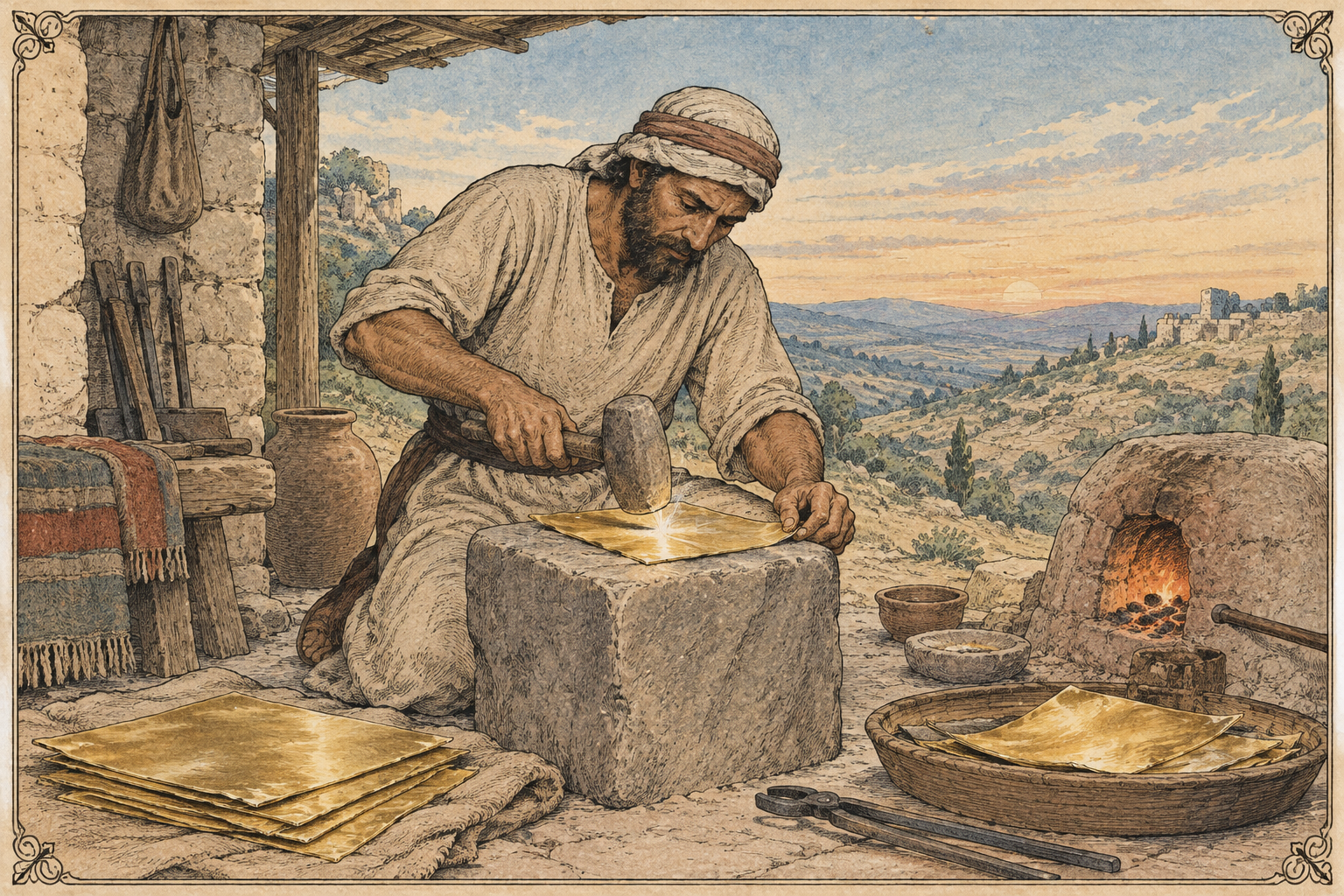
Genesis 1:6-8 introduces the raqia, usually translated "firmament" or "expanse," set in the middle of the waters to divide water from water. The word comes from the verb raqa, which means to hammer or stamp something flat. Exodus 39:3 uses it for gold beaten into thin sheets for the priestly garments. Isaiah 40:19 uses it for a goldsmith overlaying an idol with gold. Job 37:18 applies the verb to the sky itself: "Can you, like him, spread out the skies, hard as a cast metal mirror?" The raqia of Genesis 1 is pictured the same way, a beaten-out dome holding back a body of water above it. Genesis 7:11 describes "the windows of the heavens" opening at the flood, letting that upper water down. Windows in a dome were ordinary furniture in the ancient Israelite sky.
Land on Pillars, Waters Above
The picture completes itself elsewhere. Psalm 24:2 says the Lord (YHWH) founded the land upon the seas and established it upon the rivers, and Psalm 136:6 praises the one who spread out the earth above the waters. Hannah sings in 1 Samuel 2:8 that "the pillars of the earth are the Lord's," and in Psalm 75:3 God says, "it is I who keep steady its pillars." Genesis 1:20 has birds flying "across the face of the firmament," in the open air beneath that dome.
Ezekiel 1:22 sees "the likeness of an expanse," a raqia shining like crystal, spread over the heads of the living creatures, and Psalm 148:4 calls on "the waters above the heavens" to praise God, treating that upper sea as a real, ongoing feature of the sky, not a one-time flood reservoir. Exodus 20:4 forbids images of anything "in heaven above, or in the earth beneath, or in the water under the earth," assuming all three tiers without a flicker of self-consciousness. Put together, that is a three-story cosmos: land on pillars over water, sky as a hammered dome, water held above the dome. Some translators render raqia more loosely, as "expanse" or "atmosphere," and readers disagree about how solid the ancient audience pictured it. Still, the verb raqa and the talk of windows and pillars make the general shape hard to dissolve into metaphor. This was, on the most natural reading, how the biblical authors pictured the world.
Job 26:7 and the Point of the Picture
Here is where the sting comes out of all of it. Job 26:7 says God "stretches out the north over the void and hangs the land on nothing." The land, which the rest of the Bible pictures resting on pillars sunk into cosmic waters, is here hanging on nothing at all. The ancient writers were not slaves to a single rigid model they felt bound to defend. The pillars, the dome, and the waters above were the scenery. The point, stated outright in Job, is that the world stays steady because God holds it, moment by moment. Believers have since lived under several pictures of the heavens, from a land under a dome, to an earth at the center of crystal spheres, to a planet circling one star among billions, and the faith has come through each change, because its claim was about who holds the world and never about the shape of the furniture. Height, in this picture, speaks of rule and authority, not of distance measured in miles. A king sits "above" his subjects without anyone imagining he floats in the air.
Three Problems Solved in Order
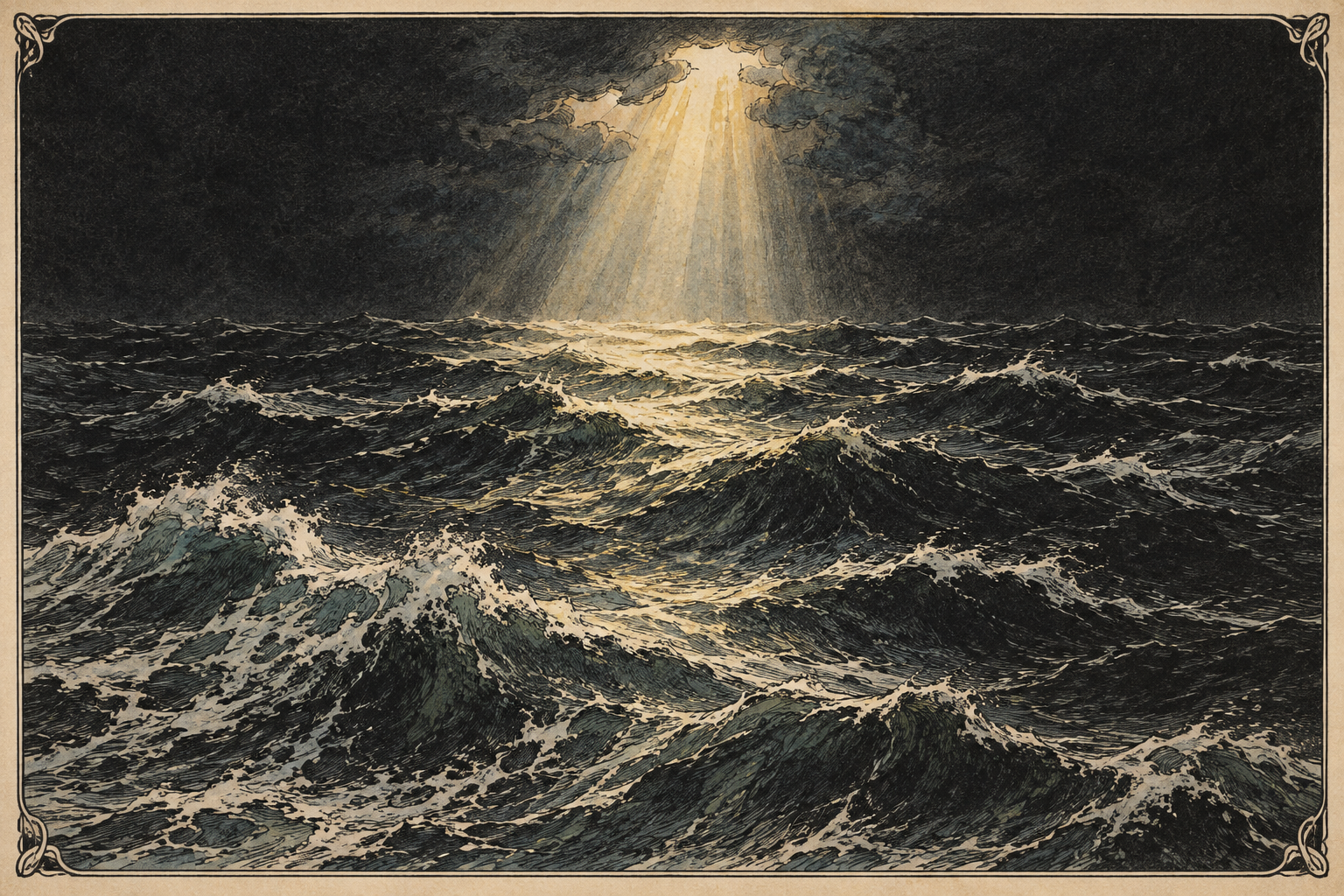
Now turn to what Genesis 1 says is happening. Genesis 1:2 describes the starting condition in three phrases: the land is tohu va-vohu, it is dark, and it is covered in deep water. Read what follows as a list of raw materials being manufactured and the chapter feels thin and strange, three days spent on light and sky and dry land before a single plant or animal appears. Read it as three problems being solved in order and the structure snaps into focus. Day one answers darkness with light. Day two answers the formless flood with a sky that separates water from water. Day three answers the water covering everything with dry land emerging and growing things upon it. Read that way, the six days make a plan of action.
Tohu Va-Vohu: A World Wild and Empty
The phrase tohu va-vohu is usually rendered "formless and void," but the more evocative sense is wild and empty, uninhabitable, good for nothing yet. Isaiah 45:18 uses the same word, tohu, to say God did not create the land to be tohu but formed it to be inhabited, directly contrasting the wild, uninhabitable state with the settled, livable one Genesis 1 produces. Jeremiah 4:23 pictures a reversed, devastated land as tohu va-vohu again, land and sky undone back into that same pre-ordered chaos. The phrase names a world not yet fit for anyone to live in, not a vacuum waiting for atoms.
Light Before the Sun and What That Tells You
Here is a detail easy to rush past and impossible to explain on the materials-list reading. Light is created and named "day" on day one. The sun, moon, and stars are not placed until day four, three days later. If Genesis 1 were listing physical objects brought into existence, this is a glaring error, light without a light source. But if day one is ordering time itself, naming the rhythm of day and night as the first governing structure of a habitable world, then the sun's later arrival as the "greater light" that rules the day fits without strain. It serves a rhythm already in place. Later biblical writers lean on exactly this separation of light from sun. Psalm 36:9 says "in your light do we see light," tying illumination to God's own presence rather than to any astronomical body. Isaiah 60:19 and Revelation 22:5 both picture a coming world lit by God himself, with no need of sun or moon at all. In this tradition light belongs first to God's ordering presence, the thing that makes a world fit to be seen and lived in.
A Thing Exists When It Has a Place, a Name, and a Job
In the logic of this chapter, something is not said to exist simply because its matter is present. It exists once it has been given a place to be, a name to be called, and a function to perform. Darkness and water already existed as raw stuff in verse two, but they were tohu, unusable, without a job. The days of creation assign roles. This does not deny that God made the material universe out of nothing. John 1:3 and Hebrews 11:3 affirm exactly that. It simply means that the question "where did the raw material ultimately come from" is not the question Genesis 1 has set out to answer. It is answering a different, equally serious question: who put this wild, flooded darkness into working order, and for what purpose.
Genesis Beside Babylon: What the Chapter Refuses to Say
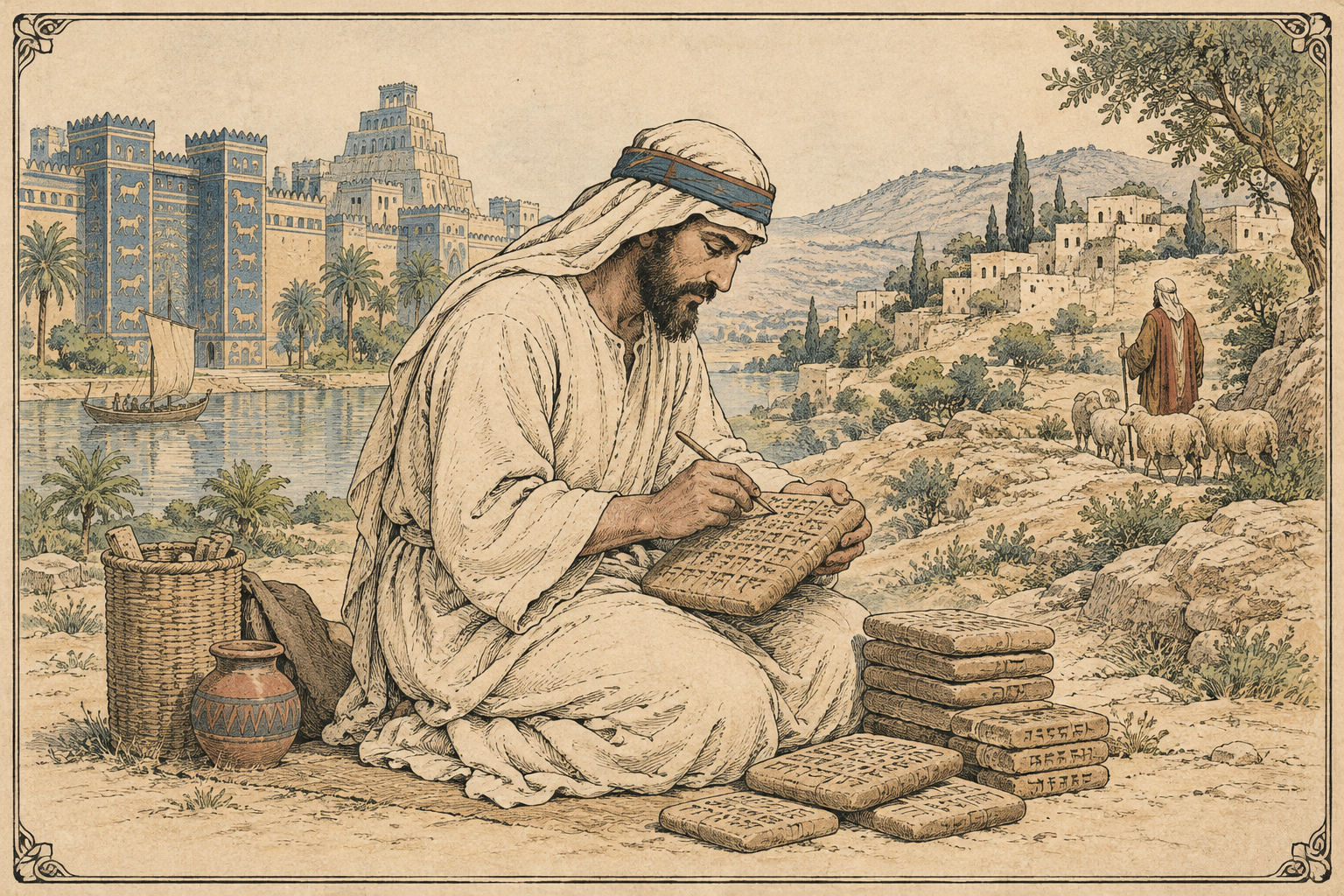
An ancient document is best understood beside its neighbors. Set Genesis 1 next to the creation stories circulating in the world around ancient Israel, and its silences become as loud as its statements.
Marduk, Tiamat, and the Battle Genesis Never Fights
In the Babylonian Enuma Elish, the god Marduk wins kingship among the gods by defeating Tiamat, a monstrous sea goddess embodying the salt-water chaos. He splits her corpse in two, using one half to form the dome of the sky and the other to form the land, and the ordered world is constructed from the carcass of a slain deity. In Egyptian tradition, the sky and land are themselves divine beings, and the sun is a god named Re who sails his boat across the heavens each day, battling the chaos serpent Apep along the way to make it to morning. Genesis 1 uses recognizably the same furniture, waters, sky, land, sun, sea creatures, and tells a story that would have sounded almost offensive in its plainness to a Babylonian or Egyptian ear. There is no battle. The waters do not resist. Nothing has to be killed and dismembered to make a world.
Sun, Moon, and Sea Dragons Put in Their Place
Notice what Genesis leaves unnamed. The sun and moon, worshiped across the ancient world, never get their ordinary Hebrew names in this account, and many readers take that silence as deliberate. They are called "the greater light" and "the lesser light," given jobs, to govern day and night and mark seasons, rather than identities. And the tanninim, "the great sea creatures" of Genesis 1:21, the same kind of creature that Babylonian and Canaanite stories cast as the enemy, are here simply made by God like everything else, and called good. There is no residue of a defeated enemy baked into the structure of this cosmos. Sky, sun, sea, and sea dragon are all, without exception, creatures. Nothing in this universe shares the throne with its Maker.
The Water and the Dragon Through the Whole Bible
This is what turns Genesis 1 from a diagram into a story. The chaotic waters held back on day two do not vanish from the biblical narrative once the chapter ends. They return, again and again, as a live threat the whole story keeps circling back to.
The Flood as Creation Run Backward
Genesis 7:11 describes the flood beginning when "the fountains of the great deep burst forth" and "the windows of the heavens were opened," the twin features, the deep and the dome's windows, that Genesis 1 had ordered and restrained. Genesis 7:22-23 describes everything with the breath of life being wiped out, the ordered world collapsing back toward its original, wild, flooded state. It is creation running in reverse. Then Genesis 8:13-14 describes the waters receding and dry land reappearing, a second creation echoing the third day of the first one.
From the Red Sea to Jesus on the Water
The same water, the same threat, keeps surfacing. Exodus 14:21-22 has Israel walk through the sea on dry ground, chaos water parted so a people can pass through to freedom. Isaiah 51:9-10 calls on the arm of the Lord to wake up, as in the days when it "pierced the dragon" and dried up the sea for the redeemed to cross, setting the exodus in the same line as the old victory over the waters. Centuries later, Mark 4:39 records Jesus (YHWShA) standing in a boat on a storming sea and saying, "Peace, be still," and the wind and the waves obey him. Psalm 89:9 had said it of God: "You rule the raging of the sea; when its waves rise, you still them." Job 9:8 says God alone "trampled the waves of the sea," and two chapters later in Mark 6:48 Jesus comes walking across them.
Why This Is Pastoral, Not Merely Literary
No reader needs to be convinced that the world does not feel entirely safe. You already know this. The ground has a way of shifting under people's feet, in sickness, in grief, in the collapse of things they had built their lives on. The biblical writers knew it too, and they reached for exactly this image, the sea, wild and untamed, barely held back, always capable of surging again. They admit the chaos is real, and they insist God holds it now and will end it one day. Revelation 21:1 ends the whole story with a new heaven and a new earth, and then this line: "the sea was no more." The waters that threatened every page are gone. The thread that started in Genesis 1:2 runs the entire length of Scripture and only closes on its final page.
Living Statues: What the Image of God Means
This is where Genesis 1 stops being merely interesting and becomes personal.
Kings, Statues, and the Tell Fakhariyah Inscription
The Hebrew word tselem, usually translated "image," most often refers in the Hebrew Bible to a physical statue. Numbers 33:52 commands Israel to destroy the cast metal images of Canaan. 2 Kings 11:18 has the people of Jerusalem tearing down the house of Baal and smashing its images. In the wider ancient world, kings often used statues to stand in for themselves. A king could not stand in every city he ruled. So he set up an image of himself at a distant border or a conquered town, and that image marked the ground as his. A ninth-century BC statue of a local ruler, dug up at Tell Fakhariyah in northeastern Syria, carries an inscription in Akkadian and Aramaic, and the Aramaic calls the statue his image and his likeness. Those are the same two words, tselem and demut, that stand together in Genesis 1:26. Egyptian texts called the pharaoh the living image of the god Re. Assyrian court scholars told their king he was the perfect image of a god.
Every Human, Male and Female, Handed the King's Title
Genesis 1:26-28 takes this royal title, which the courts around Israel gave to their kings, and hands it to every human being. "Let us make man in our image, after our likeness... male and female he created them." Every person, man and woman together, and not only a royal line, made to be God's own living statues, placed in his world to represent his rule and carry out his purposes where he has chosen not to stand visibly himself. The job that comes with the title is stated immediately: "let them have dominion," and later, in Genesis 2:15, to "work it and keep it," the language of a gardener tending land that belongs to someone else. Genesis 2:7 describes God breathing life into this image-bearer directly, and Psalm 8 marvels at exactly this strange dignity, a creature made a little lower than God himself and crowned with glory and honor, given dominion over the works of God's hands. Once you see this, the ban on idols in Exodus 20:4 makes sense. God has already placed his image in the world, and it breathes, walks, and works a garden. Setting up a carved one would demote the living image he already made.
Beasts Take the Throne, and the True Image Arrives
The vocation does not hold. Daniel 7 pictures four monstrous beasts rising out of the chaotic sea to seize dominion that was never meant to be theirs, the image-bearers' job usurped by the chaos they were meant to govern. Something has gone wrong with the plan. But Colossians 1:15 calls Jesus "the image of the invisible God," the true and faithful image where every other image-bearer had failed, and Colossians 3:10 describes those united to him being renewed "in knowledge after the image of its creator." The vocation given on day six is restored in the one who bore it perfectly, and extended again to everyone found in him.
The Seventh Day Has No Evening
Every day in Genesis 1 ends with the same formula: "and there was evening and there was morning." Every day, that is, except the seventh. Genesis 2:1-3 describes God resting on the seventh day, blessing it, making it holy, and then simply stops. No evening. No morning. No closing bracket.
Shabat and Nuakh: Stopping and Settling In
Genesis 2:2 uses the verb shabat, which means to stop or to cease, the root behind the word Sabbath. But Exodus 20:11, recalling this same seventh day, uses a different verb, nuakh, which means to settle down, to come to rest, to be at home. It is the verb used when Noah's ark comes to rest on the mountains of Ararat in Genesis 8:4. The noun from the same root names God's resting place in Psalm 132:13-14, where he says of Zion: "This is my resting place forever; here I will dwell, for I have desired it." Isaiah 40:28 insists God does not grow faint or weary, so this rest is no recovery from exhaustion. It is a king arriving at his finished house and settling in to stay.
Days 1-3 Build the Rooms, Days 4-6 Fill Them
The six days are arranged in two matching columns. Day one separates light from darkness, and day four sets sun, moon, and stars to rule them. Day two divides the waters above from the waters below, and day five fills the water with swimmers and the air with birds. Day three raises dry land, and day six fills it with land animals and, finally, humanity. The pattern pushes the chapter forward on purpose. The number seven threads through the Hebrew text as well: Genesis 1:1 contains exactly seven Hebrew words, verse two contains fourteen, and in the standard Hebrew text the word Alohim, God, appears thirty-five times, five sevens, from Genesis 1:1 to 2:3. The seventh day is the destination the whole chapter has been walking toward.
A Tabernacle Built the Same Way
The same pattern reappears later in Israel's story in a single, telling echo. Exodus 31:3 describes Bezalel being filled with the Spirit of God to build the tabernacle, language that recalls the Spirit hovering over the waters in Genesis 1:2. Exodus 40:33 says Moses "finished the work," the identical note struck in Genesis 2:2 when God finished his work. Then Exodus 40:34 describes the glory of the Lord filling the finished tabernacle, exactly as God comes to settle into his finished world on day seven. The tabernacle was built, quite deliberately, as a small working model of what Genesis 1 says the whole world was always meant to be: a house fit for God to move into and stay.
That trajectory does not stop at Sinai. Leviticus 25 scales the Sabbath up into the jubilee, every fiftieth year the fields lie fallow, land goes back to its families, and liberty is proclaimed throughout the land, as though the seventh day were meant to reorder a whole society and not only a week. Luke 4:18-21 shows Jesus standing in a synagogue, reading from Isaiah 61 about release for captives and the Lord's favor, and saying, "Today this Scripture has been fulfilled in your hearing," claiming the jubilee rest as arriving in himself, now. Matthew 6:10 puts the same hope on everyone's lips who has ever prayed it: "your kingdom come, your will be done, on earth as it is in heaven." And Revelation 21:1-3 pictures the end of the whole story not as souls evacuating a doomed planet for a distant heaven, but as God's dwelling coming down to be with humanity on a renewed earth, the seventh day finally, fully arrived.
Genesis 1 was never trying to settle a dispute about rock layers or the age of starlight, and asking it to do so has cost readers, on both sides, the chapter's own claim. The ancient Israelite cosmology of hammered sky and pillared land was simply how that claim was pictured for the audience God was addressing. What the chapter says is this: a wild and flooded darkness was brought into order by a speaking God, human beings were set in that ordered world as his living statues with a job to do, and God himself moved in to stay. The seventh day is still open. It never closed. So the question left standing is whether you will take up the job handed to every image-bearer in Genesis 1:26-28, starting with the ordinary ground you stand on tomorrow.