Explaining to a friend why "righteous" and "justified" are supposed to mean the same thing is harder than it sounds. English never built these words to sound related. One came from Old English, the other through a Latin courtroom, and neither carries what Paul's Greek carried: the weight of the Hebrew courtroom and the covenant standing behind it. This is where most people get stuck before they even start asking what does righteous mean or what is justification, because English hands them two words where the biblical authors only wrote one.
Paul never had this problem. He wrote in Greek, where "righteous" (dikaiosyne) and "justified" (dikaioo) share a single root, the way "run" and "runner" share a root in English. Nobody thinks "running" is a separate concept from "runner." But that's exactly what's happened with the righteousness of God (Alohim) and justified by faith in English Bibles. Translators had to split one Greek word family across two English words, and centuries of readers have paid the price, hearing two doctrines where the text gives one continuous argument.
Let's trace that argument from the courtroom floor all the way back to Abraham's tent.
One Word Wearing Two English Masks

When your English Bible says someone is "righteous" in one verse and "justified" three verses later, it's likely translating the same Greek word wearing two different outfits. Think about what that does to a reader working through Romans. The argument feels like it keeps switching topics, when only the translation changed.
Where "Righteous" and "Justify" Come From
"Righteous" comes from Old English, built on an Anglo-Saxon root that meant straight, upright, conforming to a standard. Think of a carpenter's level: something is "right" when it's lined up correctly. "Justify," by contrast, came into English from the Latin iustificare, the word the Latin Bible used for Paul's verb, and it has carried a courtroom sound ever since. That's why "justify" still sounds like a courtroom word and "righteous" still sounds like a moral word.
So English readers inherited two words from two different language families, one Germanic and one Latin, and nothing in the sound or spelling of either word suggests they're related. A reader working through Romans in English has no way to hear what a first-century reader of Paul's Greek heard immediately: one word family, used over and over, building a single sustained argument. The gap is built into English itself, and it has shaped how entire traditions read Paul.
The Greek Word Family Paul Wrote
In Greek, the noun is dikaiosyne, usually translated "righteousness." The verb is dikaioo, usually translated "justify." Same root, same word family, the way "wisdom" and "to be wise" share a root in English. When Paul writes in Romans 3:21-31 about "the righteousness of God" being revealed, and then a few lines later says people are "justified by his grace," he is not introducing a new idea. He's running the same word through its noun form and then its verb form, building one argument that an English reader experiences as two separate claims stitched together.
Look at Romans 3:26, where Paul says God is both "righteous" and the one who "justifies" the person who trusts in the faithfulness of Jesus (YHWShA). In Greek that sentence uses the same root twice. In English it uses two words from two different language families that share no visible connection. The wordplay Paul built into the sentence, the core point he's making, gets flattened the moment it crosses into English.
Why This Isn't Mere Trivia
This matters because readers end up constructing two separate doctrines out of one Greek word family. "Righteousness" gets filed under personal moral character, often imagined as a kind of spiritual purity score. "Justification" gets filed under legal status, a transaction that happens at conversion.
Readers then spend enormous energy trying to figure out how these two things relate to each other, as though Paul left them a puzzle to solve.
But Paul never separated them. He wrote one word family describing one reality: a person's status in God's court, where he judges by the covenant promises he has made. The biblical authors are inviting us to read "righteous" and "justified" as the same claim seen from two grammatical angles, not two different claims that need reconciling. Once you see that, half the confusion around Paul's argument in Romans simply drops away.
The Courtroom, Not the Chemistry Lab

If "righteous" and "justified" are one word family, that word family's meaning isn't found in a laboratory. It's found in a law court.
What "Righteous" Means When a Judge Says It
In the Hebrew Bible, when a judge in a legal dispute calls someone "righteous" (tsaddiq), the judge is not describing the person's inner moral substance. The judge is rendering a verdict. Deuteronomy 25:1 pictures exactly this scene: when there's a dispute between two people, and they come to court, the judges "justify the righteous and condemn the wicked." The righteous party in a lawsuit is simply the one the court has found to be in the right, given the facts of this particular case. It's a legal status, a verdict about standing in this case rather than a character assessment of their whole life.
"Righteous" names where you stand after the verdict, not what's been poured into you during the trial. A court doesn't make you righteous the way a chemist makes a solution turn blue. It declares you righteous, the way a court today might declare a defendant "not guilty." Nobody imagines the judge has transferred innocence into the defendant's bloodstream. The judge has rendered a finding, and that finding changes the defendant's public standing in the community.
Why a Judge Can't Give You His Own Righteousness
The judge's own righteousness is a completely different thing from the verdict the judge hands down. The judge's righteousness consists of judging fairly, refusing bribes, upholding the widow and the orphan, punishing real wrongdoing, and ruling according to the law without partiality. That's what makes a judge righteous.
Here's the problem. If a judge's righteousness is "ruling fairly," that quality cannot be the same thing handed over to the defendant when the defendant is declared righteous. The defendant doesn't receive the judge's fairness. The defendant receives the judge's verdict, which is a completely different kind of thing.
One is a moral quality belonging to the judge's character. The other is a legal status the judge's verdict creates for someone else. Collapsing these two into the same substance, as though God's righteousness gets physically transferred into a believer like a chemical, misreads what the courtroom language was built to do. The verdict is real. It isn't the same kind of thing as the judge's own character.
Where This Lands in Paul's Letters
This is exactly the picture sitting underneath Romans 3:21-31. Paul says "the righteousness of God has been revealed," and then describes people being "justified by his grace as a gift, through the redemption that is in the Messiah." Paul assumes his readers already know the courtroom scene. He doesn't stop to explain it, because every Judean reader trained in the Hebrew Bible already knew what a righteous verdict looked like.
Philippians 3:9 shows the other side of the same courtroom. Paul wants to be found "not having a righteousness of my own that comes from the law, but that which comes through the faithfulness of the Messiah, the righteousness from God that depends on faith." Watch the small word "from." This is not God's own righteousness, his faithfulness to his promises. It is the righteous standing that comes from God, the status the judge grants.
Paul isn't hoping a moral substance gets injected into him. He wants the verdict "in the right," and he knows his own record under Torah, the law of Moses, can't earn it. That verdict rests on the Messiah's faithfulness, and Paul receives it by trusting him. The courtroom, not the chemistry lab, is the picture Paul is painting throughout.
A Promise Kept, Not a Scale Balanced

So if God's own righteousness isn't a substance he hands out, what is it? Many explanations say God's righteousness means his moral perfection, full stop. That's not wrong, but it's incomplete, and it misses the specific shape the biblical authors gave it.
Genesis 15:6 and the Promise to Abraham
Remember back in Genesis, long before there was a Torah to keep or break, God made Abram a promise. Genesis 12 records the promise: through Abram's family, all the families of the earth would be blessed. Then in Genesis 15, Abram has no children yet, no land yet, nothing but a promise and the stars overhead. God tells him his descendants will be as countless as those stars. And Genesis 15:6 says: "Abram believed the Lord (YHWH), and he credited it to him as righteousness."
Look closely at that verse. Abram is declared righteous before there were any commands to keep. He trusted that God would do what God said, and that trust was the badge showing he now stood inside the covenant God was making with him. His righteousness is that standing, a verdict rendered over his trust in the promise-keeper. The rest of Genesis 15 is God binding himself to that promise in a covenant ceremony. And this sets up something even bigger: it plants the idea that God's own righteousness is bound up with keeping that promise to Abraham. If God's righteousness means anything, it has to mean that God stays faithful to his word, especially this word, the pledge to bless every nation through Abraham's family.
Romans 1:16-17 as the Announcement of That Faithfulness
God made that covenant commitment, and Paul picks up that exact thread in Romans 1:16-17. Paul writes that he's not ashamed of the good news, "for in it the righteousness of God is revealed from faith for faith." Paul isn't introducing a brand new theological category here. He's announcing that God is finally making good on the ancient promise to Abraham. The "righteousness of God" is God's faithfulness to his covenant, his promise to bless the world through Abraham's family. And because that covenant was always God's way of putting his whole creation right, his faithfulness to Abraham is also his faithfulness to the world he made. That is what's breaking into history now, the long-promised moment when the one family becomes a blessing for every nation.
This is the hidden piece most explanations skip. God's righteousness is relational and covenantal, closer to a kept promise than a scale balancing good deeds against bad ones.
But the story had a problem in it. Israel was called to be the family through whom the blessing would reach the nations, and Israel failed at the task. The messenger needed rescuing as much as the world did. So how could God stay faithful to a promise his own people had broken?
He provided the faithful Israelite himself. Jesus the Messiah did what Israel was called to do, all the way to his death, and that faithful death dealt with sin. This is why Romans 3:24-26 says God put the Messiah forward "to show his righteousness," so that God is himself in the right and declares in the right everyone who trusts in the faithfulness of Jesus. When Paul says the gospel reveals God's righteousness, he means the gospel shows God keeping, through Jesus, a promise made many centuries earlier.
Trusting the Promise-Keeper
This gives real content to "justified by faith." It doesn't mean reciting a formula that earns a legal credit. Romans 4 goes back to Genesis 15:6, but Abraham isn't there only as an example of how faith works. Paul is answering a family question: who are Abraham's children? His answer is that God always meant one worldwide family, Judean and non-Judean, marked out not by circumcision but by the same trust Abraham showed. Abraham believed the God "who gives life to the dead" (Romans 4:17), and everyone who believes the God who raised Jesus from the dead shares that trust and belongs to that family. Faith is trust placed in a specific, faithful promise-keeper, the one who said he'd bless the nations and is now doing it through Jesus.
The Verdict Comes Twice
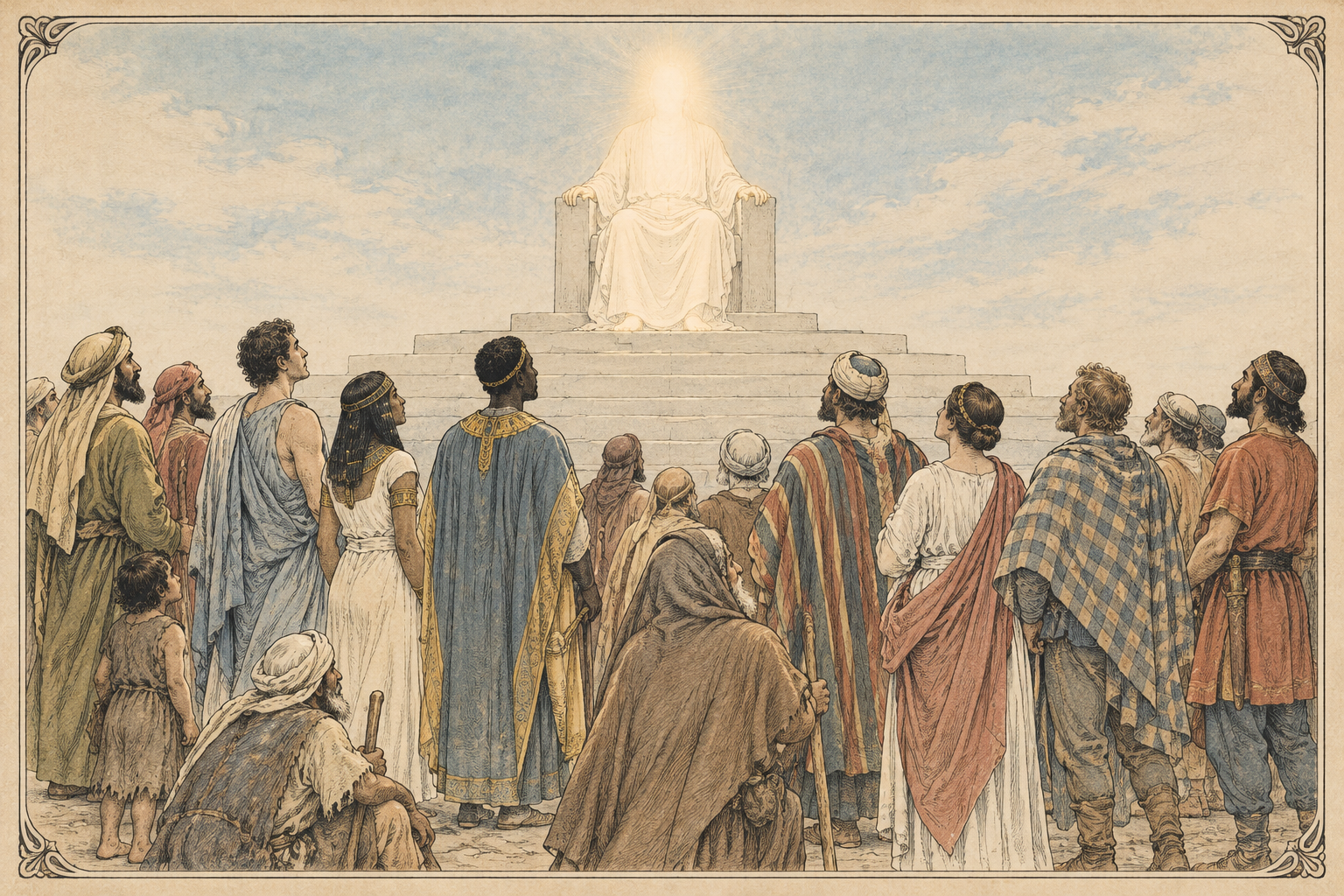
So when does this verdict land? Paul talks about justification as something that has already happened to believers, and he also talks about a final judgment still to come. These aren't contradictory. They're the same verdict, announced twice.
Present Justification as a Preview of Final Judgment
God renders his final verdict on the last day, when every life gets evaluated. But in the gospel, something significant happens. God announces that same verdict in advance, in the present, over everyone found "in the Messiah." Present justification is the last day's verdict breaking into today, pulled forward and spoken now, over anyone united to Jesus by faith.
This is why Paul can say in Romans 5:1 that believers "have been justified by faith" and also spend Romans 2 describing a future judgment still ahead. He isn't confused, and he isn't contradicting himself. He's describing one verdict that gets spoken twice: once now, as a preview and promise, and once finally, when it's confirmed before the whole world.
Romans 2:6-13 and the Judgment According to the Whole Life
Romans 2:6-13 says God "will render to each one according to his works," and that it's "the doers of the law who will be justified." Paul says this before he even gets to his famous argument in Romans 3 and 4, and he means it. There will be a final justification on the basis of the whole life lived.
That doesn't compete with justification by faith, because Paul tells us whose work that life is. The true Judean, he says, is the one whose heart is circumcised "by the Spirit, not by the letter" (Romans 2:29). The faith that unites a person to Jesus also brings the Spirit, who forms a life that matches the verdict already announced. Present justification isn't a vending-machine transaction, completed and forgotten the moment someone prayed a prayer. It's God's verdict spoken in advance, and the Spirit-led life is the evidence the last day brings into the open.
Declared Righteous, Not Made Righteous: Holding Both Moments Together
A person is both declared righteous and, in time, formed into the life that declaration describes, and the two aren't in tension. The declaration is genuinely legal. It isn't a polite fiction where God pretends something false is true. Yet the declaration isn't disconnected from real life, as if God hands down a verdict unrelated to how a person lives afterward.
Think of a judge who reads out the final verdict at the start of the case instead of the end. The verdict is real and binding the moment it's spoken, and it will not be reversed. Everyone it's spoken over is permanently in the right. What follows doesn't put the outcome in doubt. The final verdict will be given on the basis of the whole life, and because that life is the Spirit's work, it will match what the judge has already declared.
One Table, One Badge of Entry
Paul's justification language first shows up in his letters in a public fight about a dinner table.
The Antioch Dispute: What Was at Stake
Galatians 2:11-21 tells the story. Peter had been eating freely with non-Judean believers in Antioch, sharing meals without regard for Judean dietary law. Then certain men came from James in Jerusalem, and Peter pulled back, no longer eating with the non-Judean believers, out of fear of how it would look to the circumcision party, the believers who insisted non-Judeans be circumcised. Barnabas got pulled into the same withdrawal. Paul confronted Peter publicly, saying he wasn't walking straight "in line with the truth of the gospel."
Notice what the dispute was about: whether Torah's boundary markers, the practices that set Israel apart from the nations, decided who got to sit at the family table with whom. Nobody at Antioch was asking whether good behavior could earn salvation. Peter's withdrawal implied that non-Judean believers were second class, not full family, unless they also adopted Judean identity markers. Paul calls this out as a denial of the gospel itself, because it reintroduces exactly the dividing wall that the Messiah's death was meant to tear down.
Works of the Law vs. Faith in the Messiah
Paul's phrase "works of the law" means doing what Torah commands, and Torah as a whole marked Israel off from the nations. Its most visible badges were circumcision, food laws, and Sabbath, which is why those were the works at stake in Antioch. Paul is not attacking good behavior in general. We trace how this fits with the letter of James in James vs. Paul on Faith and Works: A Conflict That Never Was.
Galatians 2:16 draws the conclusion directly: a person is "not justified by works of the law but through the faithfulness of Jesus the Messiah; even we have believed in the Messiah Jesus." Both halves matter. Jesus' own faithfulness is the ground of the verdict, and our trust in him is the badge that marks us out as his family. That's what was at stake in the Antioch dispute, and it's what's at stake in justification language throughout Paul's letters: who's allowed to eat at one table as one family.
This also tells us what justification is and isn't. Justification is not the moment someone becomes a believer. It is God's declaration about who already belongs to his family, and that declaration settles who shares the table.
Faith and Baptism as the Single Doorway In
Entry into that family was never pictured as a private, one-time prayer prayed silently in a quiet moment. Galatians 3:26-27 ties faith directly to baptism: "for in Christ Jesus you are all sons of God, through faith. For as many of you as were baptized into Christ have put on Christ." Paul doesn't describe two separate steps here, faith first and baptism as an optional add-on later. He describes one doorway: faith expressed in baptism, by which a person is clothed with the Messiah and brought into the family.
Romans 6:3-4 says the same thing from another angle. Baptism unites a person to the Messiah's death and resurrection, so that "we too might walk in newness of life." This fits what Peter preached in Acts 2:38, when the crowd asked what to do and Peter answered: "repent and be baptized, every one of you, in the name of Jesus the Messiah for the forgiveness of your sins, and you will receive the gift of the Holy Spirit." Faith and baptism form one act of entry, the moment a person crosses from outside the family to inside it, marked by the Spirit who then begins forming the life the final verdict will confirm.
So faith and baptism bring a person into the Messiah. The verdict "in the right" is then God's declaration over everyone who is in him, and the badge he looks for is faith. Baptism doesn't compete with that verdict. It acts out, visibly and publicly, what the verdict says.
That also clears up 2 Corinthians 5:21, a verse often read as God moving righteousness across to us like money between accounts. Read in context, Paul is talking about his own work as an "ambassador" of reconciliation (5:20). The Messiah, who knew no sin, was made sin for us, so that in him we, the ones carrying his message, "might become the righteousness of God": living signs of God's covenant faithfulness at work in the world. What God counts true of everyone in the Messiah is his death and resurrection: "consider yourselves dead to sin and alive to God in the Messiah Jesus" (Romans 6:11).
Trace righteous all the way back to Abraham's tent and all the way forward to a shared table in Antioch, and the meaning holds steady: standing in the right before the court of the world's true judge. That standing comes not from a moral transaction completed in isolation, but from being joined by faith and baptism to the one family God always promised to bless the nations through. The Messiah is Israel in one person, so belonging to him means belonging to Abraham's family, the people through whom God is putting the world right. Justification, in turn, is not a private verdict whispered over an individual soul. It is a public announcement that the ancient promise to Abraham has finally reached you. The verdict has already been spoken over you. The whole of your life, lived by the Spirit, is where that verdict keeps coming true.