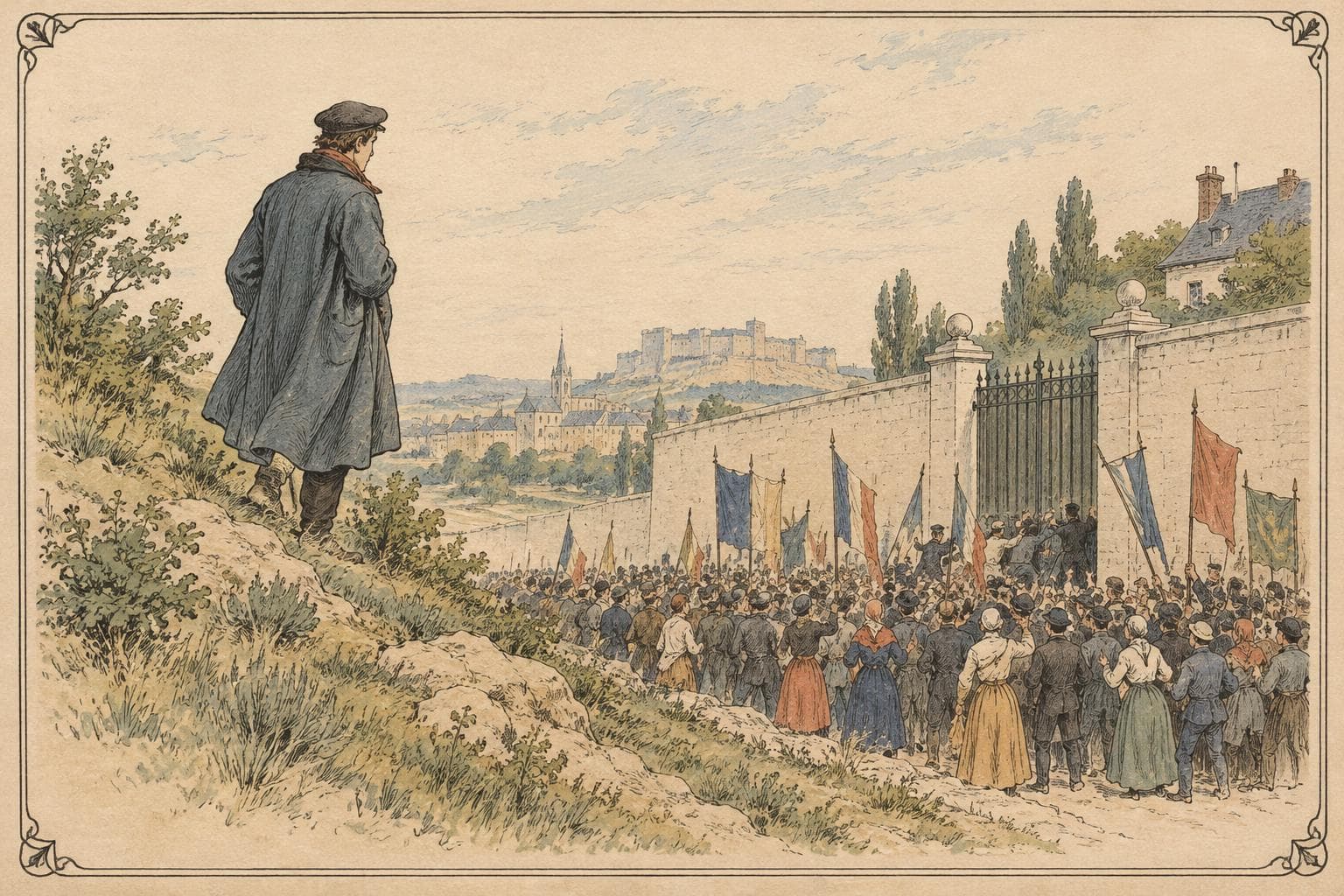
You have walked past it a hundred times without seeing it. The granite needle rising over the plaza where you eat lunch, the church spire you pass on the way to somewhere else, the obelisk stamped on the coin in your pocket. These shapes have become furniture. We stop asking what they are, who first carved them, or what those carvers believed they were doing when they raised stone toward the sky. The obelisk Osiris meaning behind that shape is not a matter of guesswork. It is recorded, named, and traceable, and once you see it, the skyline does not look the same again.
It is a historical argument built from a myth that survives in written form, a set of locations that can be found on a map, and a lineage of monuments that archivists and city planners have documented for centuries. The obelisk did not drift into public squares by accident. It was carried there, deliberately, by men who knew exactly what it represented. What follows is the case, piece by piece.
The Myth Carved in Stone: Osiris, Isis, and the Shape That Remains
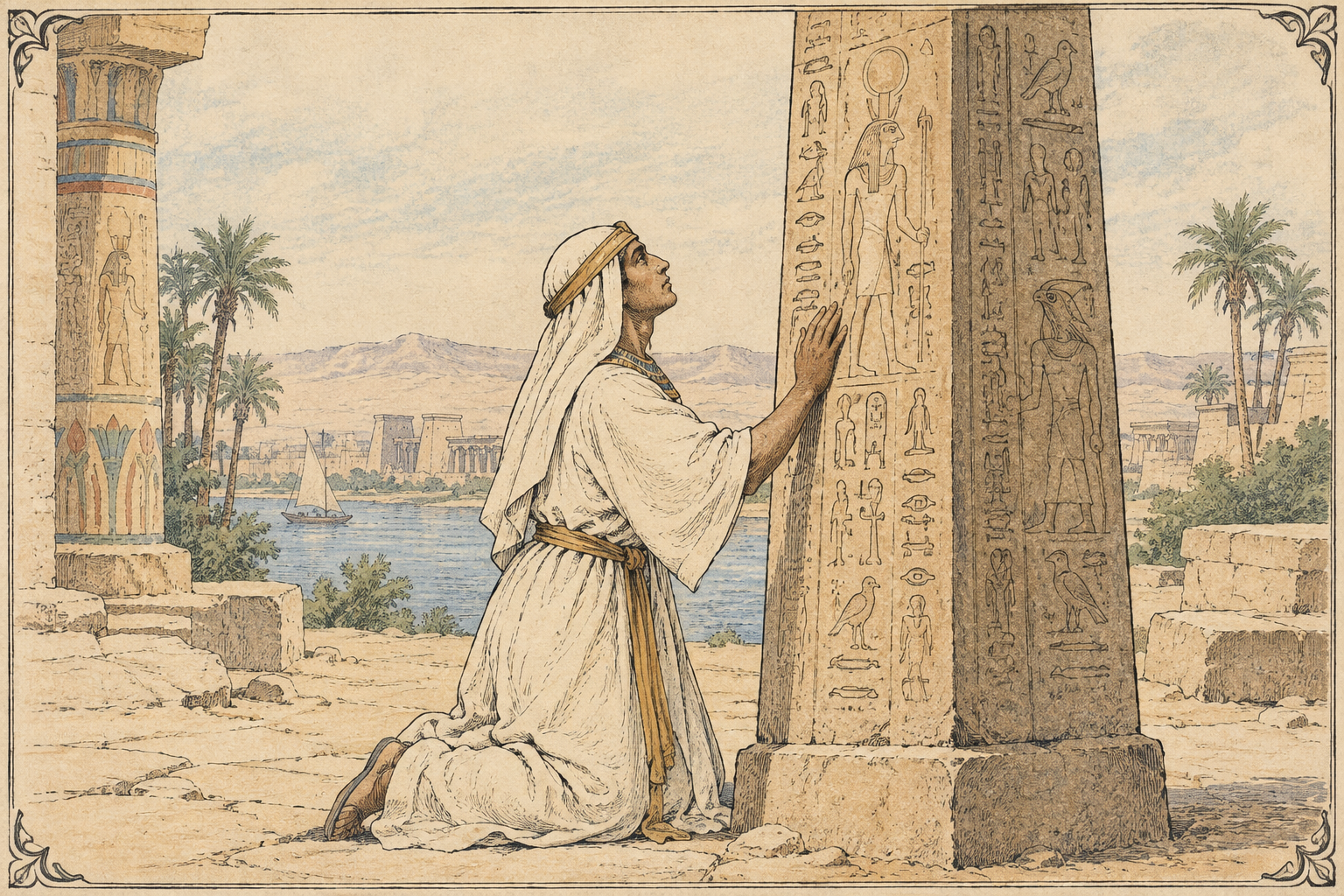
The obelisk's upright form did not emerge from generic ancient taste for tall, pointed things. It emerged from a specific, recorded myth about a god who died, was scattered, and was made whole again, and the shape the Egyptians carved was their way of holding that story in stone.
Osiris, Scattered and Reassembled
The fullest surviving account comes from an ancient Greek essay, On Isis and Osiris, which preserves a myth that circulated in Egypt for millennia before it was written down. Osiris, god of the dead and of renewed vegetable life, ruled as a fair king until his brother Set grew jealous and murdered him. Set did not stop at killing him. He cut the body into pieces and scattered them across Egypt, determined that no single resting place would ever hold his brother again. Isis, the wife of Osiris, refused to accept this as the end of the story and set out across the land to recover what remained of her husband.
The ancient account records that Isis traveled from place to place, gathering each fragment as she found it, and wherever a piece was recovered, a shrine was later said to mark the spot. This detail matters in Egyptian religion. The search and recovery of the scattered body became one of the central acts of devotion in the Osiris cult, reenacted in temple liturgy and tied directly to the flooding of the Nile and the return of fertility to the land each year. Osiris, dismembered and gathered again, became the god of resurrection precisely because his body had been broken and made whole.
The One Piece Isis Could Not Find
Here the myth turns toward something the modern reader rarely hears named plainly, though the ancient account states it without embarrassment. Of all the pieces Isis recovered, one eluded her. The phallus of Osiris had been thrown into the Nile and eaten by fish, lost beyond recovery. Rather than leave the reassembly incomplete, Isis fashioned a replica of the missing member and consecrated it, and it was through this consecrated replacement that she conceived Horus, the son who would avenge his father and reclaim the throne.
This episode is the hinge on which the entire story of renewed life turns. The same ancient source connects this episode to Egyptian religious practice, noting that the Egyptians held festivals in which a phallic image was carried in procession, a rite tied directly back to this moment in the Osiris story. The upright pillar, the standing shape, was built to commemorate an act of fertility accomplished through a man-made replacement for what death had taken. Resurrection, in this telling, runs through reproduction. The obelisk fertility symbolism embedded in the myth is not an inference drawn by modern researchers eager to find something scandalous in ancient religion. It is recorded plainly, by a sober ancient writer addressing an educated audience, as a known feature of the cult being described.
Heliopolis, the Benben Stone, and the Rising Sun
The obelisk carries a second root, and the Egyptians never treated it as separate from the first. In the city of On, which the Greeks later called Heliopolis, City of the Sun, stood a sacred object called the benben stone. Egyptian tradition held that the benben marked the primeval mound, the first dry land to emerge from the waters of chaos at the dawn of creation, and that upon this mound the sun god Ra first appeared in the form of a bird or a ray of light striking the stone. The benben became the model for every obelisk subsequently carved, its pyramidal cap (the pyramidion) representing the point at which the sun's light first touched the earth.
Egyptian pillar worship at Heliopolis was not a rival tradition to the Osiris cult but a companion to it. The sun that rose each morning over the benben stone was understood in relation to the same cycle of death and renewal that defined the Osiris myth, since Ra's nightly journey through the underworld and his dawn return mirrored the pattern of the dying and rising god. Egyptian religion did not keep its sun theology and its fertility theology in separate rooms. The obelisk, standing erect and catching the first light of morning, held both ideas in a single form: the risen sun and the risen god, the mound of creation and the member of resurrection. That is the shape the Egyptians raised throughout their land, and it is the shape later civilizations would carry home as plunder.
Beth-Shemesh and the Broken Pillars: Scripture's Verdict
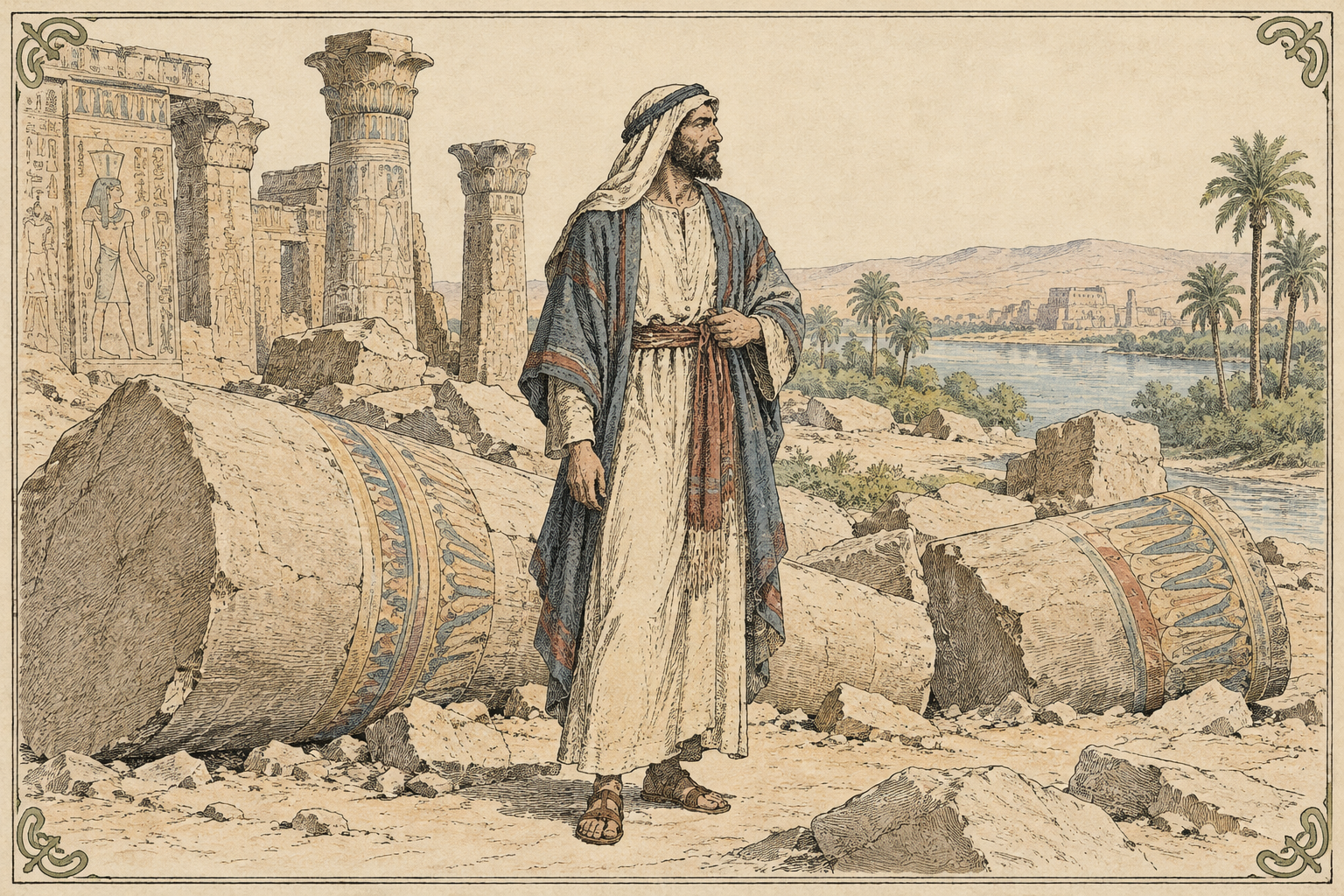
Long before any modern reader raised questions about ancient architecture, the Hebrew Bible named this symbolism directly, by location, and pronounced judgment on it in terms no honest reader can soften into vague metaphor.
Yashayahu Names the House of the Sun
The prophet Jeremiah, writing of events in Egypt itself, delivers an oracle specific enough that it cannot be waved away as generic denunciation of idolatry. Jeremiah 43:13 declares that the pillars of Beth-shemesh, "the house of the sun," which is in the land of Egypt, will be broken, and the houses of the gods of Egypt burned with fire. Beth-shemesh here is widely recognized as a Hebrew rendering of Heliopolis itself, the city of On where the benben stone stood and the sun cult of Ra had its ancient home. This is a named city, a named cult, and a named class of object, the sacred pillars, marked for destruction.
A prophet speaking in generalities might be dismissed as rhetorically inflating ordinary religious disapproval, but naming the house of the sun in Egypt and promising the breaking of its pillars is a claim about a particular place and a particular practice, one his audience would have recognized immediately given Egypt's standing as the dominant power and cultural influence of the ancient Near East. Jeremiah 43:13 pillars are not incidental props in his oracle. They are the target.
Deuteronomy's Repeated, Deliberate Command
If Jeremiah's oracle against Egypt could be read as judgment on a foreign nation and set aside as having no bearing on Israel's own practice, the law given through Moses removes that escape route entirely. Sacred pillars Deuteronomy addresses directly and repeatedly, and the instruction is not caution. It is demolition.
Deuteronomy 12:3 commands Israel, upon entering the land, to tear down the altars of the nations, smash their sacred pillars, burn their Asherah poles, and cut down the images of their gods, erasing their names from those places entirely. This is an order to physically destroy the standing stones associated with foreign religion. Deuteronomy 16:22 goes further still, forbidding Israel from setting up a sacred pillar of their own, "which the Lord (YHWH) your God (Alohim) hates." The verb matters. This is not regulation of improper use. It is prohibition of the form itself, regardless of what one intends to dedicate it to. The Hebrew Bible treats the shape itself as something Israel's God actively hates and commands broken wherever it is found, and forbidden wherever Israel might be tempted to raise one.
From the Nile to the Tiber: How Obelisks Came to Rome
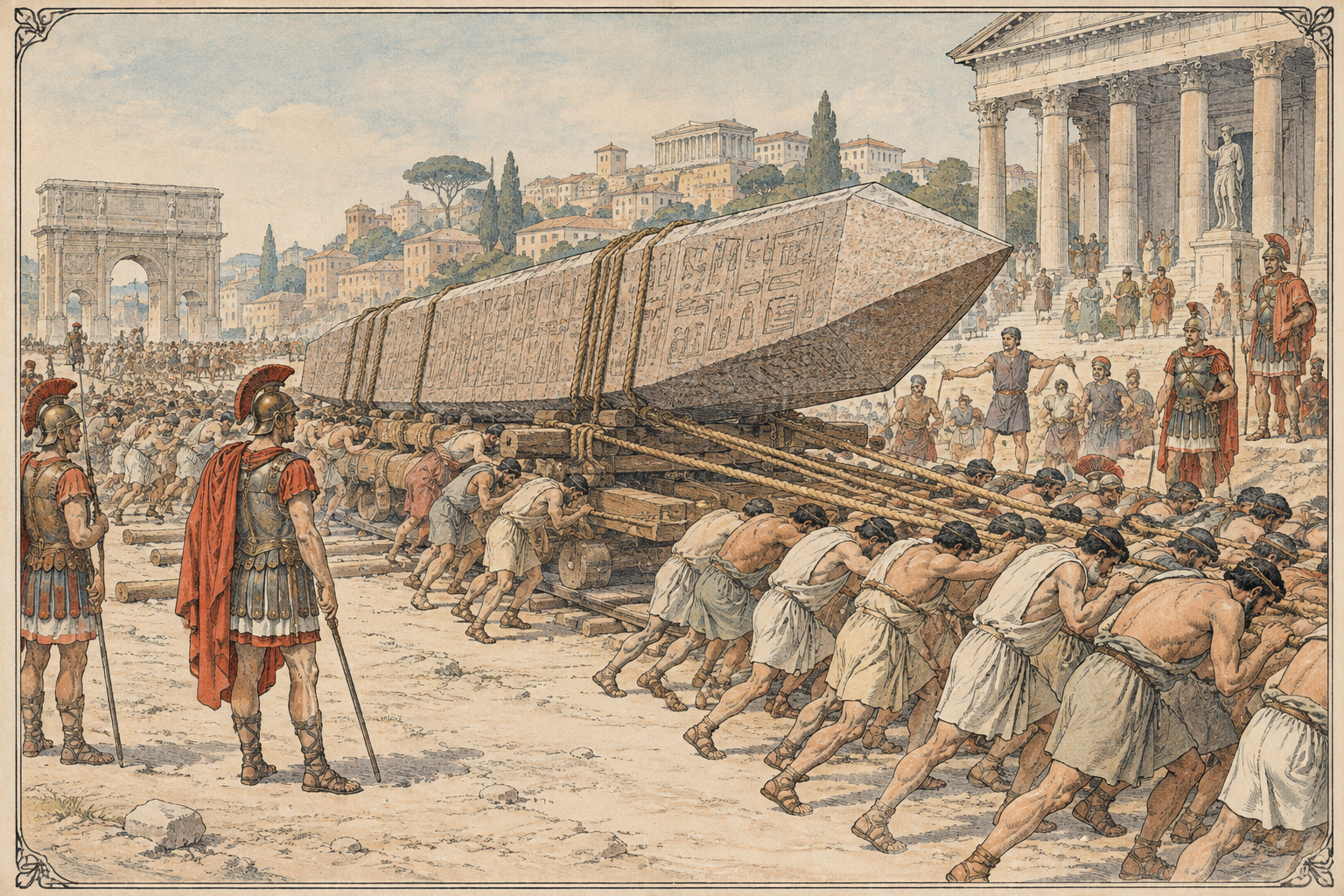
None of what follows requires speculation about symbolism, because the historical record of how these monuments moved from Egypt to Rome is documented, dated, and checkable in the ordinary archives of Roman history.
Caligula's Obelisk and the Making of a Trophy
Roman emperors did not regard Egyptian obelisks as art to be admired from a respectful distance. They regarded them as spoils of conquest, portable proof that Rome had subdued the oldest civilization in the Mediterranean world, and they went to extraordinary lengths and expense to transport these multi-ton granite shafts across the sea. The emperor Caligula, in the first century AD, had an obelisk originally quarried in Egypt under earlier Pharaonic rule transported to Rome and erected in what began as his circus grounds. The site later took the name Circus of Nero once that emperor expanded its use, and it was this same obelisk that would eventually come to stand at the Vatican.
Moving a single piece of granite weighing somewhere around three hundred tons across the Mediterranean required ships built specifically for that purpose. The sheer engineering difficulty says something about how much these objects mattered to the men who moved them. It was a deliberate assertion of imperial dominance, a way of declaring that even Egypt's gods now stood on Roman ground, planted there at Roman command.
Sixtus V and St. Peter's Square, 1586
That same obelisk, having stood in Nero's circus for over a millennium, was relocated in 1586 under Pope Sixtus V to the center of St. Peter's Square, where it stands today. The move itself was a celebrated feat of Renaissance engineering, involving hundreds of workers, winches, and ropes, and it was documented extensively at the time because contemporaries understood exactly what a difficult and significant undertaking it was. The Vatican obelisk history is recorded in the architectural histories of Rome and visible to any visitor who stands in the square today, where the obelisk now serves as the fixed point around which Gian Lorenzo Bernini's colonnade curves outward.
Sixtus V did not stop with this one monument. His papacy oversaw the raising of multiple Egyptian obelisks across Rome, repositioning ancient Egyptian monuments as landmarks within a thoroughly Christianized city. The pattern established in his reign, placing Pharaonic solar pillars at the heart of major church properties, continued under later popes who raised still more obelisks throughout Rome in the following centuries. The city that had once displayed these objects as trophies of Egyptian conquest now displayed them as ornaments of ecclesiastical authority, the form unchanged while its stated meaning was declared Christian by proximity to the church that now surrounded it.
The Shape Spreads: Obelisks in the Modern Capital
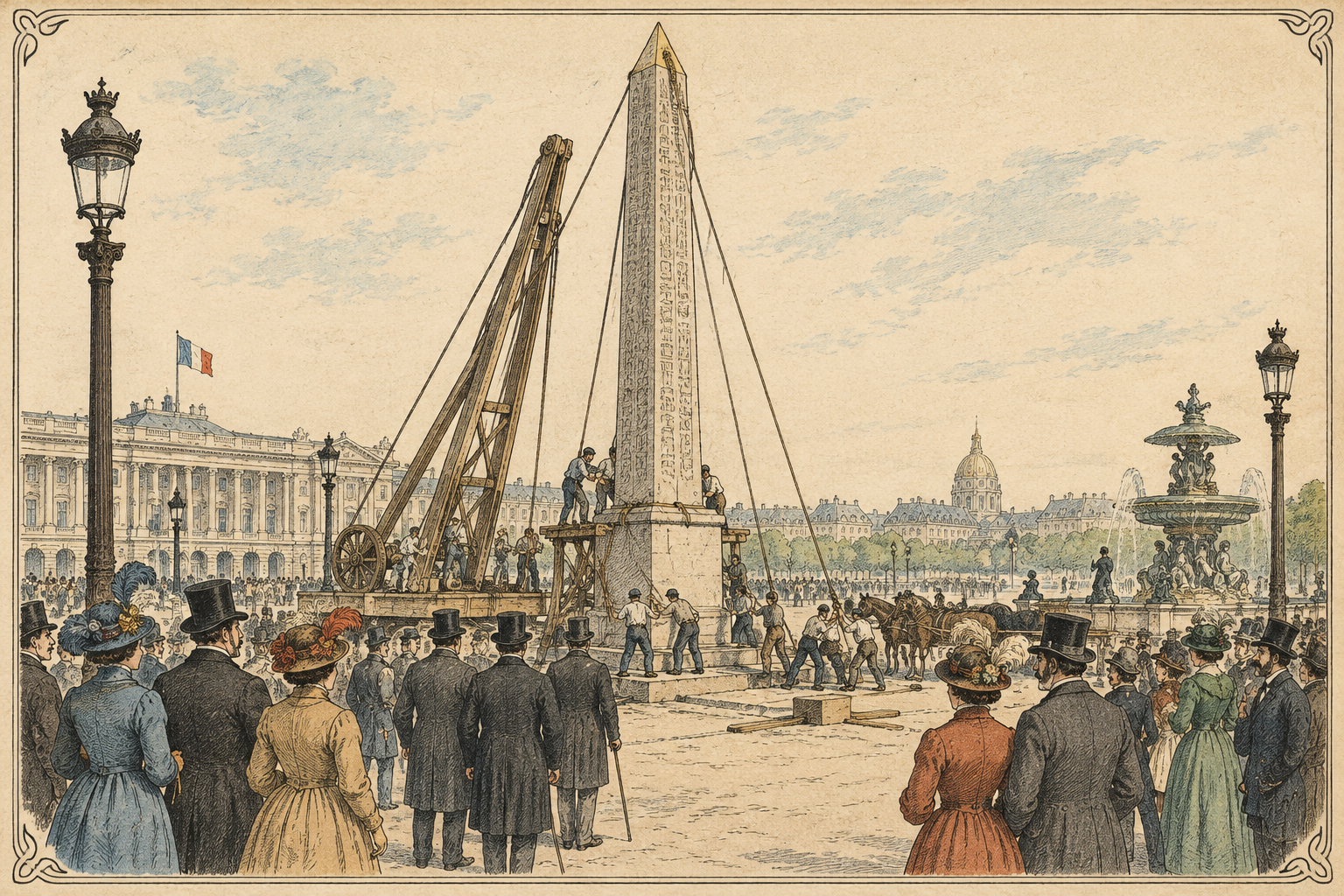
The form did not remain confined to Rome. Over the following centuries it migrated outward into the civic architecture of nations that had no inherited memory of Osiris, Isis, or the benben stone, carried now not as religious devotion but as a marker of national prestige borrowed from both Egypt and Rome at once.
Paris, London, and the Imported Needle
Paris erected the Luxor Obelisk in the Place de la Concorde in 1836, a genuine Egyptian monument gifted by the Ottoman ruler of Egypt and transported at considerable expense to stand at the center of French civic life. London raised Cleopatra's Needle on the Victoria Embankment, another authentic Egyptian obelisk, originally carved millennia earlier and relocated in the nineteenth century as a trophy of British engineering and imperial reach. Neither city pretended ignorance of the object's Egyptian origin. Both cities wanted precisely that association, borrowing the gravity of an ancient civilization to lend weight to their own national self-image, even as the original religious content of the monument, Osiris, Ra, the benben stone, had become entirely detached from its new civic function.
Washington's Needle and the American Skyline
The United States built its own obelisk from scratch rather than importing one, but the choice of form was deliberate rather than accidental. The Washington Monument, completed in 1884, stands as the tallest stone obelisk in the world, its shape unmistakably drawn from the same Egyptian tradition traced through Rome and the European capitals before it. Americans did not inherit this form through ignorance. The design was selected with full awareness of its Egyptian lineage, chosen because an obelisk communicated permanence, grandeur, and a connection to ancient civilization that a plain column or dome could not.
Familiarity has done what explicit argument never could. Millions of visitors walk the National Mall each year, photograph the monument, and never once ask what an Egyptian funerary and solar symbol is doing at the center of the American capital. The shape has become so thoroughly absorbed into civic furniture that the question of its origin simply stops occurring to people.
The Steeple Question: Did the Form Simply Stop at City Hall?
The obelisk's lineage runs continuously from Heliopolis through Rome and into the civic monuments of Paris, London, and Washington. The same upright, tapering, skyward-pointing form also found its way into the architecture Christians built for worship.
An Inherited Silhouette, Not an Original One
The tall, pointed spire rising from the local church did not spring into existence as a wholly original Christian invention with no architectural ancestry. Church steeple pagan origin is a question of form and lineage, not of accusation against any particular congregation, and it deserves the same historical scrutiny applied without hesitation to the obelisk standing in the public square. Early Christian basilicas, adapted from Roman civic buildings, did not originally feature the tall pointed towers that later became standard. The spire developed over centuries, borrowing height and verticality from a surrounding architectural culture that had, by then, spent well over a thousand years building skyward in exactly this tapering, pointed shape, from Egyptian obelisks to Roman monuments to the towers Sixtus V was busy relocating across Rome during the same general era church architecture was reaching its own mature form.
Shapes migrate. Builders borrow silhouettes that read as sacred, impressive, or skyward-reaching without necessarily investigating the full history of where that silhouette originated. The question is not whether any particular architect consciously intended to replicate Osiris worship when designing a parish steeple. The question is whether the form itself carries a continuity of shape that deserves acknowledgment rather than silence.
What We Build Without Asking Why
Set side by side, the visual lineage runs from the upright pillar of Osiris and Heliopolis, carried to Rome as imperial trophy, planted at the center of St. Peter's Square, echoed in the obelisks of Paris, London, and Washington, and rising still today from the roofline of churches that would be startled to hear their steeple discussed in the same sentence as Osiris. Continuity of shape does not, on its own, prove continuity of intended meaning. This article does not claim that every church architect across two thousand years was knowingly perpetuating Egyptian fertility theology; the argument rests on the documented migration of a visual form, not on hidden intent. The shape itself is not invented new in each generation. It is inherited, passed down a visual lineage stretching back to a myth about a god's scattered body and the piece that could not be found.
The pattern runs from stone to stone, city to city, century to century, whatever one concludes about its meaning for the church today.
Tradition of Men or Teaching of Christ: Reading Colossians 2:8 Over the Skyline
Having traced the shape from myth to monument to sanctuary, the final question is not architectural but scriptural, and Paul's words to the Colossians put it as directly as Jeremiah once did.
Paul's Warning Against Hollow Tradition
Colossians 2:8 warns believers to see to it that no one takes them captive through philosophy and empty deceit, according to human tradition, according to the elemental principles of the world, and not according to Christ. Paul is warning a specific congregation, in a specific city shaped by specific inherited religious and philosophical forms, against absorbing patterns of thought and practice that originate in human tradition rather than in God revealed in the person of Jesus (YHWShA). The warning assumes that such absorption happens easily, often without anyone noticing, which is precisely how inherited architectural forms move from culture to culture across centuries.
Paul elsewhere shows considerable flexibility about matters of custom and form, so this is not a demand that every traditional practice be discarded without examination. Colossians 2:8 insists that tradition be examined rather than assumed, tested against the teaching of Christ rather than inherited uncritically because it arrived wrapped in the authority of age, grandeur, or familiarity. A shape does not become theologically neutral simply because several centuries of believers have stood beneath it without asking where it came from.
Looking Again at What Stands Overhead
None of this requires tearing down a single building or assuming bad faith on the part of anyone who has ever worshipped beneath a steeple. What it requires is the same thing Jeremiah required of Judeans tempted to adopt the religious furniture of the nations around them, and the same thing Deuteronomy required when it commanded the breaking of sacred pillars rather than their rededication: a willingness to look honestly at inherited forms and ask what they were built to say before deciding whether that is the message worth standing beneath.
The obelisk in the plaza, the needle in the capital, the spire over the sanctuary, all of them share a silhouette with a history that long predates any claim made on its behalf by popes, presidents, or parish councils. Scripture's own verdict on sacred pillars was never ambiguous, and the Vatican obelisk history was never hidden. What has been hidden, mostly through sheer repetition and familiarity, is the question itself. BabelReport.com exists to keep asking it, and the invitation stands for anyone willing to look again at what they have been taught to see without question.