Every few years, someone on social media declares the Exodus a myth, and every few years someone else answers with a chart and a pharaoh's name, and the argument goes nowhere because nobody has laid out the actual evidence in order. The question of which pharaoh of the Exodus stood on the shore of the Red Sea, or sat in his palace while his land groaned under plague after plague, is not pious guesswork. It is a question historians can investigate the same way they investigate any claim from the ancient world: through chronology, through surviving testimony, through the careful comparison of dates. Babel Report has sat with the sources, Egyptian and biblical alike, and the convergence around Amenhotep II is harder to dismiss than most people assume.
The Exodus as a Question for Historians and Preachers Alike
Most readers come to the Exodus story already decided. Either it happened exactly as written, complete with a named villain hiding somewhere behind the text, or it is a foundational legend with no more historical weight than a flood story told around a fire. Both postures let readers off the hook. Neither requires doing the work.
Why the Pharaoh of the Exodus Narrative Has a Name to Find
The book of Exodus never names its pharaoh. This has struck some readers as evidence the whole account is theological fiction, a story unconcerned with the kind of specificity that marks genuine history. But ancient Egyptian writing had its own conventions, and Egyptian scribes themselves were often reluctant to record national humiliations in any detail, let alone preserve them for a conquered people's benefit. The silence in Exodus is not the silence of invention. It is the silence of a text written from Israel's side of the story, assuming its first readers already knew who sat on Egypt's throne. That assumption leaves a historical puzzle for later readers to solve, not a theological excuse to stop looking.
What Counts as Evidence When the Subject Is Three Thousand Years Old
Ask a historian how she knows anything about Thutmose III or Hammurabi or Cyrus the Great, and she will point to the same three tools every time: chronology, surviving testimony, and comparative dating against other fixed points. Nobody demands a photograph. Nobody expects a confession signed in triplicate. The question is whether the written record, cross-checked against independent evidence, produces a coherent picture. That is the same standard this inquiry will apply to the Exodus, no more and no less. If the biblical chronology, the Egyptian king list, and an ancient Egyptian account of the Israelite departure all point toward the same decades, that convergence counts as evidence in any other historical investigation. It should count here too.
Separating the Serious Debate from the Noise Around It
It is worth saying plainly that serious scholars disagree about the date of the Exodus, and that disagreement deserves respect. What does not deserve the same respect is the reflexive dismissal that treats the entire question as settled by sneer rather than argument. A chart posted without sources convinces no one who already doubts, and a scripture verse quoted without context convinces no one who already dismisses. The task here is slower and less dramatic: walk through the ancient testimony, walk through the biblical math, walk through the Egyptian dates, and see where they land.
Manetho's Testimony and Its Journey Through Josephus
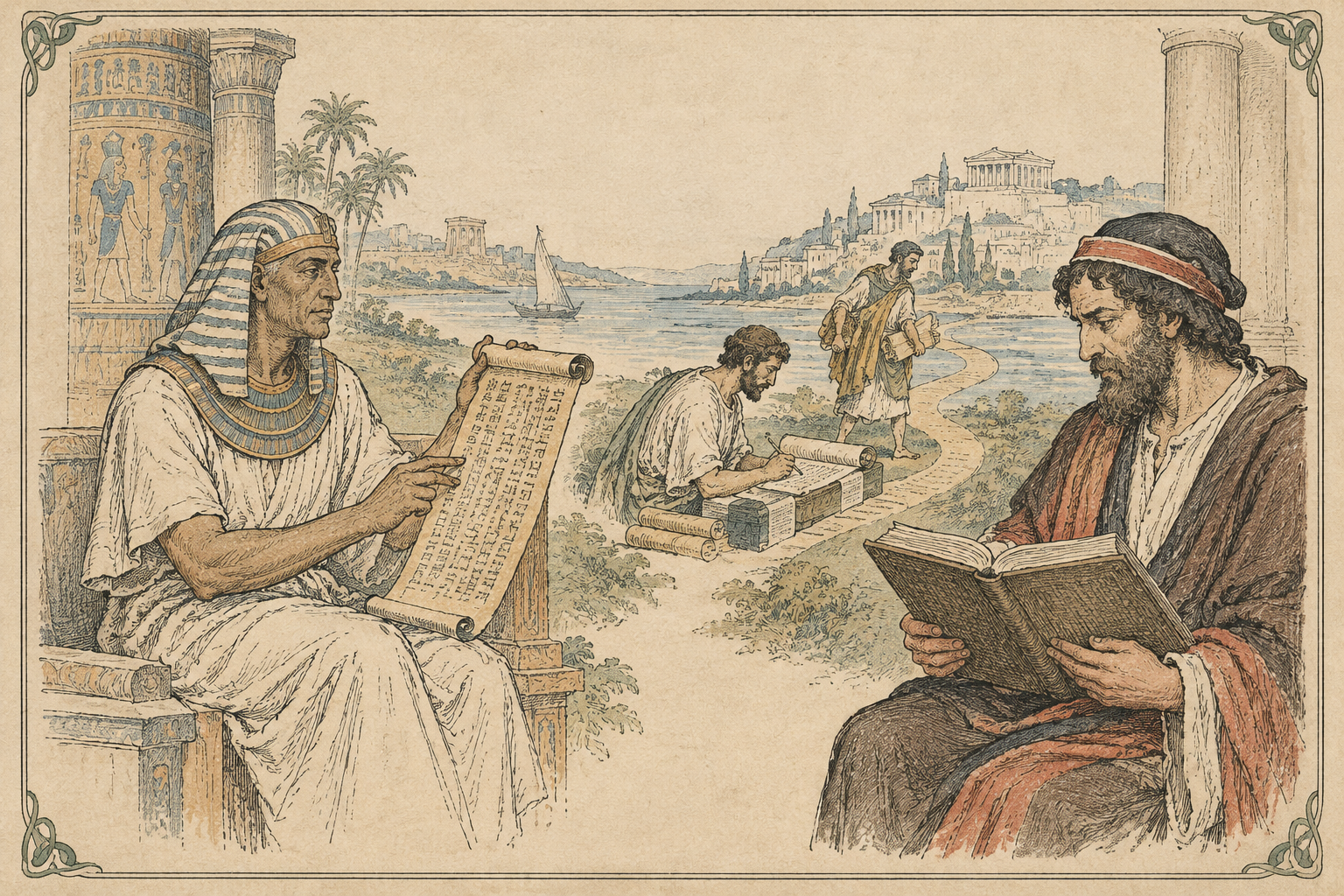
The most overlooked piece of this puzzle is not biblical at all. It is Egyptian, and it predates the New Testament by more than two centuries.
Manetho the Priest and His Aegyptiaca
In the third century BC, an Egyptian priest named Manetho compiled a history of Egypt known as the Aegyptiaca, written in Greek for the Ptolemaic court but drawn from native temple records and king lists kept by Egyptian priests for generations. Manetho had access to archives that no outsider could have fabricated from imagination. Among the material he preserved was an account of a foreign population that had lived in Egypt, caused upheaval, and eventually departed under a leader Manetho names as Moses. The pharaoh connected to this departure he calls "Amenophis," the standard Greek rendering of the Egyptian name Amenhotep. This detail sat in Egyptian priestly memory long before any Israelite or Christian writer had reason to invent it for apologetic purposes.
Josephus Against Apion: A Defense Built on Egyptian Sources
Manetho's original Aegyptiaca has not survived as a complete document. What survives are quotations, the longest and most significant of which appear in the first-century AD writings of the Judean historian Josephus, in his treatise Against Apion. Josephus was not writing devotional literature. He was defending the antiquity and legitimacy of the Judean people against Greek and Egyptian critics who mocked Judean origins as recent and derivative. To make his case, Josephus needed sources his opponents would already respect, and nothing served that purpose better than Egypt's own priestly historian. He quotes Manetho at length, precisely because an Egyptian account of Israel's departure, written by an Egyptian for Egyptians, carried a credibility that Israel's own scriptures could not supply to a skeptical Hellenistic audience.
Why a Pre-Christian Egyptian Record Changes the Conversation
This is the detail most popular treatments skip past, and it deserves more weight than it usually receives. The Manetho material is not a late rabbinic flourish or a medieval Christian gloss added centuries after the fact to prop up a weakening tradition. It is a documented appeal to Egyptian priestly records compiled in the third century BC, quoted by a Judean historian in the first century AD who had every incentive to get his Egyptian sources right, because his Greek and Egyptian readers would have caught him in a fabrication immediately. The chain runs from Egyptian temple archive to Manetho's Greek compilation to Josephus's direct quotation, and every link in that chain predates the gospels. This is the point. The identification of "Amenophis" as the pharaoh connected to Israel's departure is not a modern speculation looking for ancient cover. It is ancient testimony that modern readers have simply forgotten to ask about.
Counting Back From Solomon: The Biblical Chronology of 1 Kings 6:1
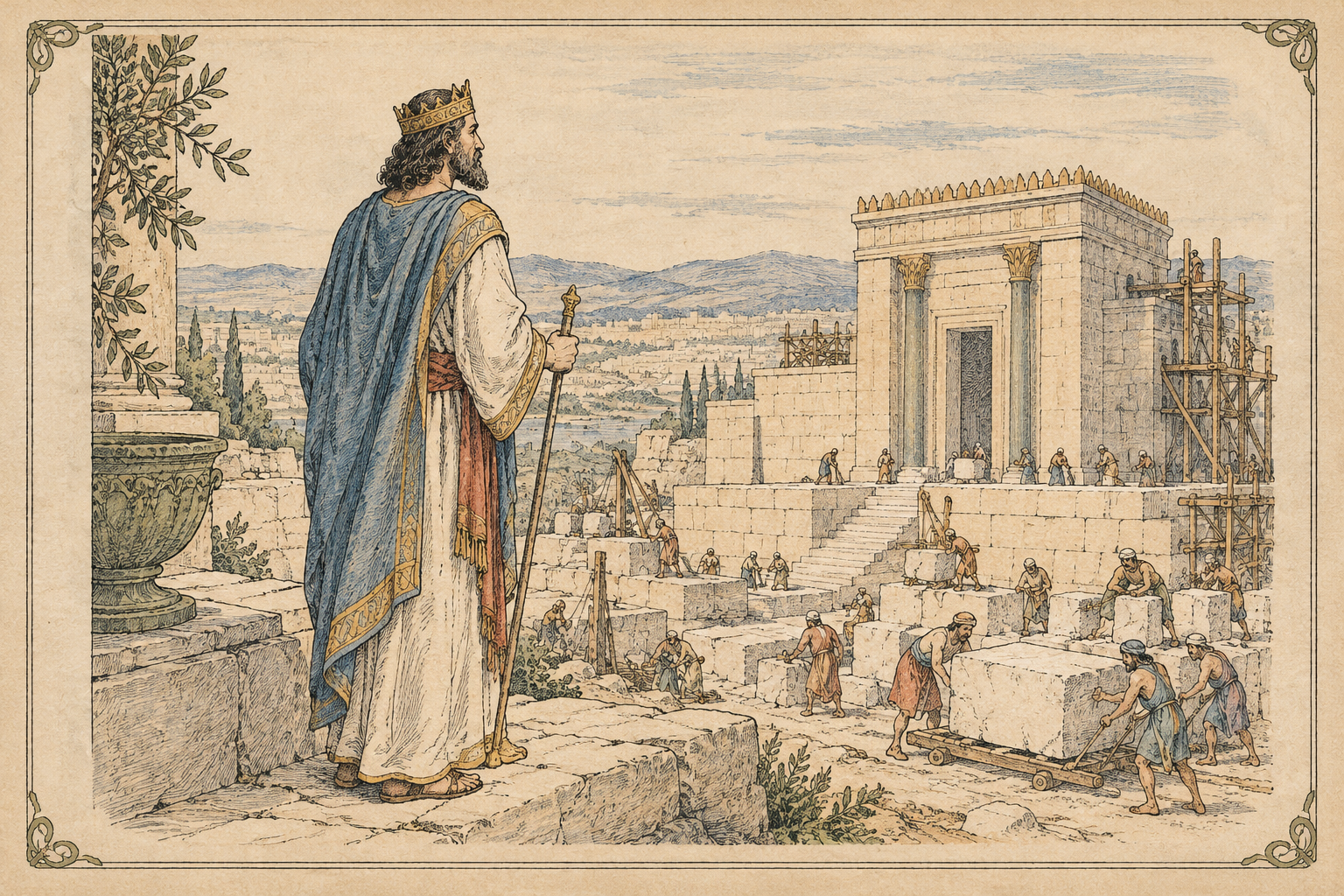
With the Egyptian testimony in hand, the next question is whether scripture itself supplies a date precise enough to test against it. It does, and the text does the arithmetic for us.
The 480 Years and Solomon's Fourth Year
First Kings 6:1 states that the Exodus occurred four hundred eighty years before the fourth year of Solomon's reign, the year construction began on the Jerusalem temple. Solomon's fourth year is fixed by well-established chronology, cross-referenced against Assyrian records and regnal data for the divided kingdom, at approximately 966 BC. Counting back four hundred eighty years from that fixed point lands on 1446 BC as the date of the Exodus. This is not a figure assembled from guesswork or theological preference. It is the plain result of taking the biblical writer's own stated number and applying it to an independently anchored date.
Other Biblical Markers That Reinforce the Count
First Kings 6:1 does not stand alone. Judges 11:26 has Jephthah telling the Ammonite king that Israel had occupied the region for three hundred years by his own time, a figure that fits comfortably within a chronology beginning at 1446 BC and fails to fit a chronology compressed into the thirteenth century. Genealogical spans elsewhere in the historical books point in the same direction, consistently assuming a longer interval between the Exodus and the monarchy than a late date allows. None of these texts were written to settle a modern chronological argument, which is precisely what makes their quiet agreement worth noticing. They were not coordinated to make a case. They simply assume the same timeline throughout.
Why This Number Deserves to Be Taken at Face Value
Some scholars have proposed treating the four hundred eighty years as symbolic, perhaps twelve generations of forty years each, a round figure rather than a literal count. This is a reasonable hypothesis to raise, and it deserves a fair hearing rather than dismissal. But the text gives no signal that it intends the number symbolically. First Kings dates kings by accession year and cross-references northern and southern reigns with notable care, a practice generally read as concerned with record-keeping rather than symbolism. To treat this one number as figurative while treating every surrounding regnal date as literal requires a reason drawn from outside the text, not from anything the text itself suggests. The question is not about anyone's sincerity in proposing a symbolic reading. The question is coherence, and the surrounding material argues for a literal count.
Matching the Biblical Date to the Egyptian King List
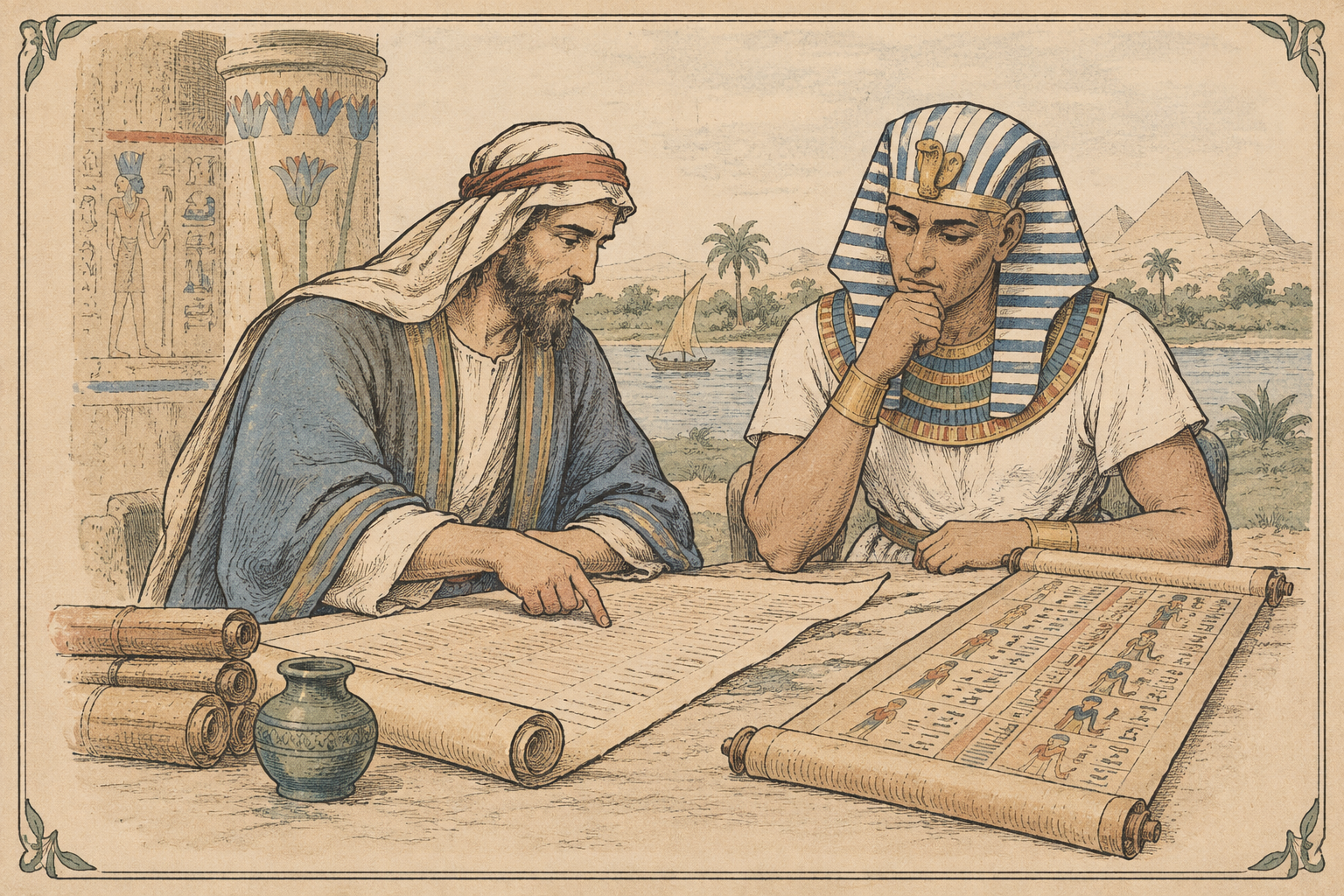
If 1446 BC is the Exodus date scripture itself produces, the next step is straightforward: see which Egyptian pharaoh occupied the throne at that moment.
Amenhotep II's Reign and Its Striking Fit
Egyptian chronology, reconstructed from king lists, astronomical observations, and cross-referenced regnal years, places Amenhotep II's reign at approximately 1450 to 1423 BC. A reign beginning four years before 1446 BC places him on the throne precisely when the biblical date requires a pharaoh to be present, old enough to have inherited a kingdom from his father and young enough to still be reigning when the biblical narrative calls for a confrontation with Moses. This is not a case where the biblical date was stretched or the Egyptian date rounded to force an agreement. The two figures, arrived at through entirely independent methods, land in the same narrow window.
What We Know of Amenhotep II From Egyptian Records
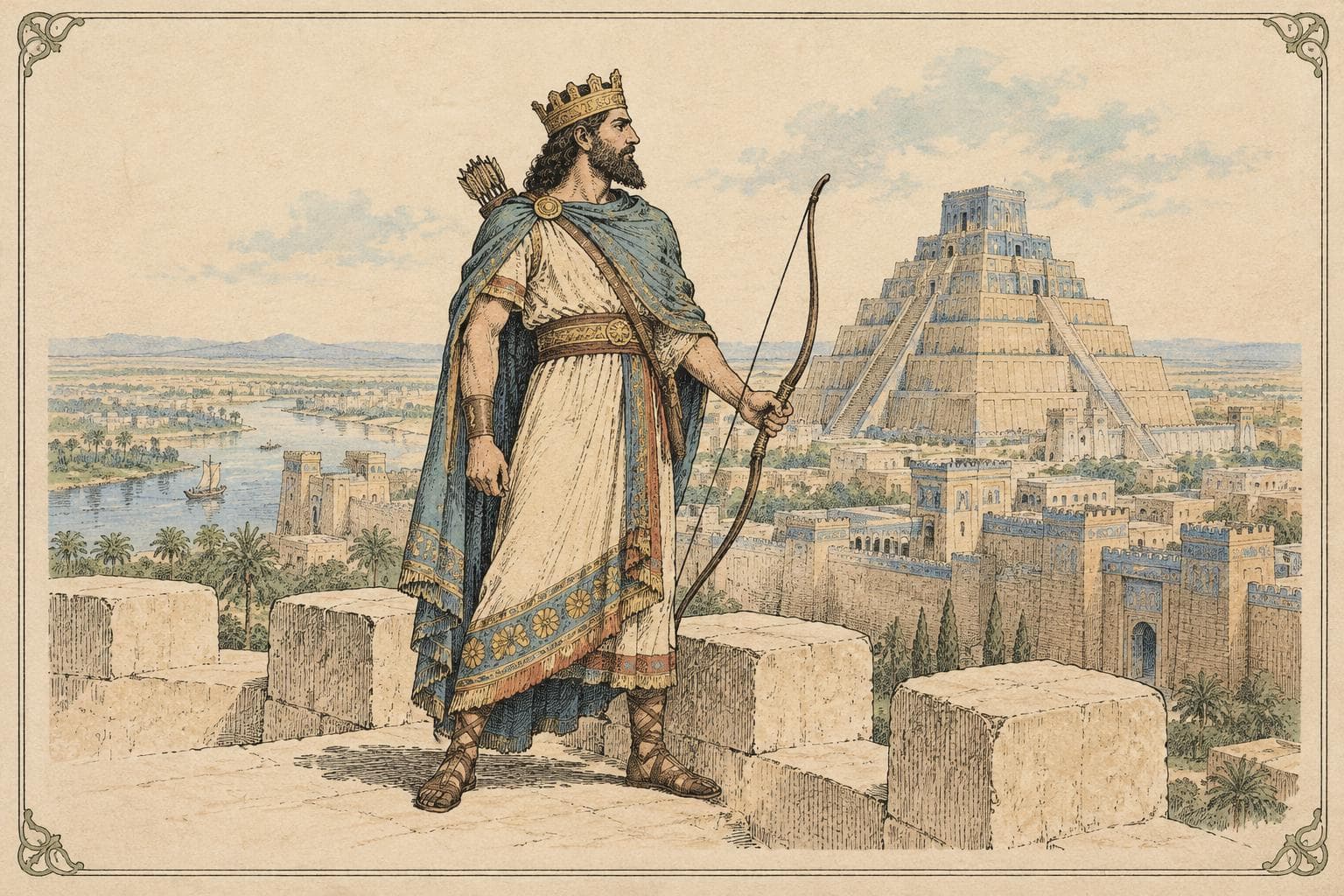
Egyptian inscriptions depict Amenhotep II as a pharaoh who took pride in his physical strength, boasting of his skill with the bow and his stamina on the battlefield, themes common to royal propaganda but also suggestive of a ruler eager to project unquestioned power. His military campaigns, while real, were notably smaller in scale than his father's, and some Egyptologists have noted a falling off in Egyptian military dominance during his reign compared to the preceding decades. Administrative records from this period also show no major building campaigns on the scale typical of a securely wealthy, confidently expanding Egypt, consistent with a kingdom that had suffered serious internal disruption. None of this constitutes direct Egyptian confirmation of the plagues or the Red Sea crossing, and it would be dishonest to claim otherwise. But the broad outline, a pharaoh whose reign shows signs of diminished military and economic momentum compared to his predecessor, fits comfortably with the biblical account of a kingdom staggered by catastrophe.
Thutmose III: The Pharaoh Who Built the Prison, Not the One Who Opened It
Here lies an insight most popular treatments of this question miss entirely, and it resolves a problem that has puzzled casual readers for generations.
A Warrior King's Legacy of Conquest and Forced Labor
Thutmose III, Amenhotep II's father, is remembered as one of the most formidable military rulers in Egyptian history, sometimes called Egypt's Napoleon for the scale of his campaigns across the Levant. His reign, lasting over three decades, was marked by relentless conquest, enormous building projects, and the kind of centralized, expansionist state that required vast labor reserves to sustain. A kingdom waging war on this scale for this long needed workers for its monuments, its granaries, its mudbrick cities, and a resident foreign population already living in the Nile Delta region made a convenient and already-present labor source. The biblical description of a pharaoh who "knew not Joseph" and set taskmasters over the Israelites to build store cities fits precisely this kind of decades-long, state-driven forced labor economy, the sort that only a long and aggressively expansionist reign like Thutmose III's could sustain.
Father and Son: Why the Oppression and the Exodus Need Different Pharaohs
Readers who assume the Exodus narrative requires a single pharaoh, enslaving Israel, watching the plagues unfold, and then drowning in the sea, are working from a popular image rather than the biblical text itself. Exodus 2:23 notes that "the king of Egypt died" during the period of Israel's affliction, after which "the children of Israel sighed by reason of the bondage." The narrative itself signals a change of throne between the start of the oppression and the events of the Exodus. This is the structural key that resolves what looks, at first glance, like an impossible biography: one pharaoh cannot plausibly enslave a people across decades of empire-building, then personally confront Moses, then die pursuing Israel into the sea, all within a single reign that also accounts for extensive foreign conquest. Separate the oppressor from the pharaoh of the departure, assign the enslaving decades to Thutmose III and the confrontation with Moses to his son Amenhotep II, and the chronology stops straining against itself.
The Early-Date and Late-Date Debate, Weighed Honestly
None of this means the matter is free from scholarly dispute. A substantial body of serious scholarship favors a different date entirely, and that position deserves a fair hearing before any conclusion is drawn.
The Case for a Thirteenth-Century Exodus
Many historians place the Exodus in the thirteenth century BC, during the reign of Ramesses II, pointing to the mention of the store city Pithom and Raamses in Exodus 1:11, a name that appears to echo Ramesses himself. Archaeological surveys of certain sites in Canaan associated with the conquest narrative have also been read by some scholars as better fitting a thirteenth-century arrival rather than a fifteenth-century one, and the broader pattern of Canaanite city destructions in this later period has struck many as a more natural match for the book of Joshua. These are not frivolous arguments, and scholars who hold the late date are not reading scripture carelessly. The case rests on real archaeological and textual observations that deserve engagement rather than dismissal.
Where the Late-Date Theory Struggles With 1 Kings 6:1
Of course one can adopt the late-date position. Many careful scholars do, and for reasons they find compelling. But what the late-date theory cannot do, not if it wants to remain coherent with the biblical text as a whole, is explain away 1 Kings 6:1 without simply overriding what the verse plainly states. The usual move is to treat the four hundred eighty years as symbolic or generational rather than literal, a solution already addressed above and found wanting on the text's own terms. The place name Raamses in Exodus 1:11 is better explained as an updated or modernized name applied by a later editor to a region known by an older name at the time of the events themselves, a common scribal practice across the ancient world and one scholars recognize in other biblical texts without controversy. The late-date theory is not without resources to answer these questions. But each answer requires setting aside the text's plain chronological statement in favor of an external archaeological preference, and that is a cost serious readers should weigh carefully rather than wave past.
The Cumulative Weight of Convergence
What strikes most readers as compelling about this case is the following. No single thread proves it alone. Manetho's testimony, quoted by Josephus from pre-Christian Egyptian priestly records, could in isolation be dismissed as a confused late tradition. The 480-year count in 1 Kings 6:1 could in isolation be read as symbolic. Amenhotep II's regnal dates could in isolation be a coincidence of timing. But these three independent lines of evidence, Egyptian priestly memory, biblical chronology, and Egyptian regnal record, were never coordinated with each other. Manetho was not writing with 1 Kings open in front of him. The author of 1 Kings had no access to Manetho's temple archives. And yet all three converge on the same narrow window of history. That is not the kind of agreement that emerges from inherited copying or theological wish-fulfillment. It is the kind of agreement that emerges when independent records are all describing the same event.
The case for Amenhotep II as pharaoh of the Exodus does not rest on a single clever argument or a single inscription waiting to be discovered. It rests on the patient alignment of an Egyptian priest's record, a Judean historian's careful quotation, and a biblical chronology that has sat in plain view for millennia, waiting for someone to do the arithmetic. The pharaoh of the Exodus has a name to be found, not because scripture tells us outright, but because the surrounding evidence, Egyptian and Israelite alike, keeps pointing in the same direction. The debate between early-date and late-date positions will continue, as it should among historians handling evidence this old and this fragmentary. But for readers willing to follow the sources rather than the slogans, the convergence around Amenhotep II stands as one of the more compelling cases the ancient world has left us. The invitation is to look at the evidence rather than the slogans.