Every few centuries, Egypt swallows a man whole. He rises from nothing, stands for a moment at the edge of real power, and then the record simply closes over the place where he stood, as if the Nile itself had smoothed the sand back into place. Senenmut is one of those men: a commoner's son who became Steward of Amun, architect to a queen, and tutor to a royal daughter, before vanishing from Egyptian inscriptions so completely that his own prepared tombs were never used to bury him. The Moses Senenmut theory asks a simple question with uncomfortable implications: what if that vanishing man and the Hebrew child raised in Pharaoh's household, who also disappeared into the wilderness at the height of his influence, were the same person?
This theory is built on two separate historical records, one Egyptian and one biblical, that describe oddly matching men at oddly matching moments. Put them side by side and the coincidences stop behaving like coincidences. They start behaving like corroboration.
The Commoner Who Climbed to the Edge of the Throne
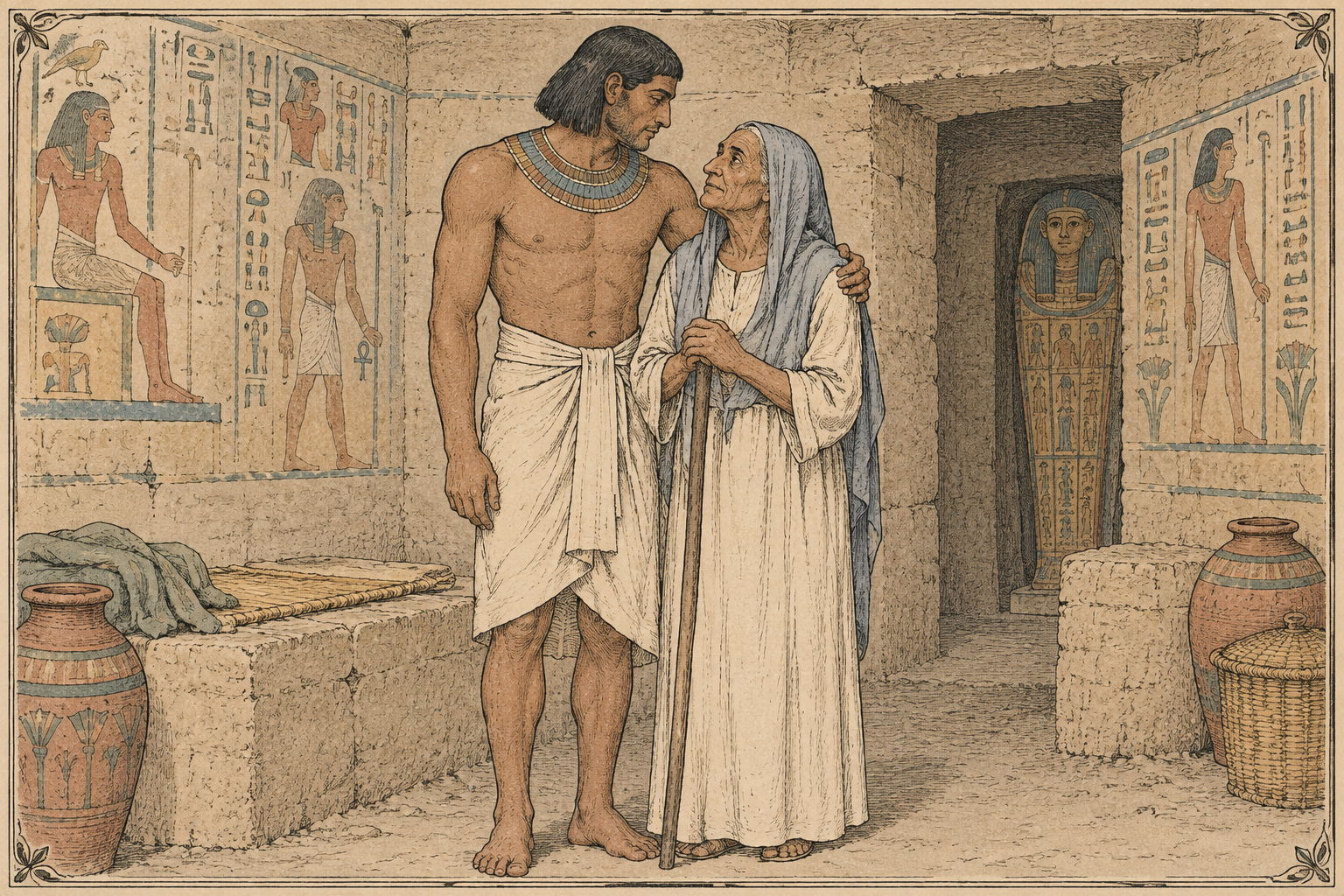
Egyptian court society in the Eighteenth Dynasty was not a meritocracy. Birth determined destiny, and the distance between a farmer's son and the royal household was, in practice, close to infinite. So when a man named Senenmut appears in the historical record holding more than ninety titles, several of them tied directly to the royal family itself, the Egyptologist's natural question is not "how interesting" but "how did this happen?"
Parents Who Left No Mark on History
Senenmut's parents, Ramose and Hatnofer, were buried in a modest tomb that Senenmut himself commissioned later in his career, a son's gift to people who otherwise left no trace in Egyptian records. They held no titles of consequence. They were not priests, not officials, not anyone the court would have noticed. This matters because it means Senenmut's rise to the center of Eighteenth Dynasty power was not inherited. It was built, title by title, trust by trust, in a system that rarely allowed such building to happen at all.
Tutor and Guardian to a Royal Daughter
By the time Senenmut reaches the height of his documented career, he holds the title of tutor to Neferure, daughter of Hatshepsut and heir to whatever royal legitimacy a female pharaoh's line could carry. Statues survive showing Senenmut holding the young princess, cradling her with the kind of physical closeness Egyptian art rarely grants to anyone outside blood relations. A commoner does not receive that kind of access by accident. He receives it because someone above him, someone with the authority to decide who touches the royal line, has already decided he can be trusted with everything.
A Queen's Unprecedented Intimacy with a Non-Royal Steward
Here is the first of two historical oddities the Moses Senenmut theory explains rather than ignores. Hatshepsut's reign is already strange by Egyptian standards. A woman ruling as pharaoh, not as regent, not as consort, but as pharaoh in her own right, wearing the false beard and the royal regalia in her statuary, was close to unprecedented in the Eighteenth Dynasty. Her closeness to Senenmut compounds the strangeness. He is mentioned and depicted far more often than his rank alone would explain. Some inscriptions even place his name and symbols in close proximity to hers, an intimacy court protocol did not normally allow for a non-royal steward. Two anomalies sit side by side in the Egyptian record: an unusually independent female pharaoh, and an unusually intimate commoner steward. The theory proposes a single explanation for both. The man she trusted above all others was not merely talented. He was someone whose formation and character set him apart from every other candidate for the job, because he had already been shaped by forces outside the ordinary Egyptian court.
A Palace Boy and His Unlikely Patroness
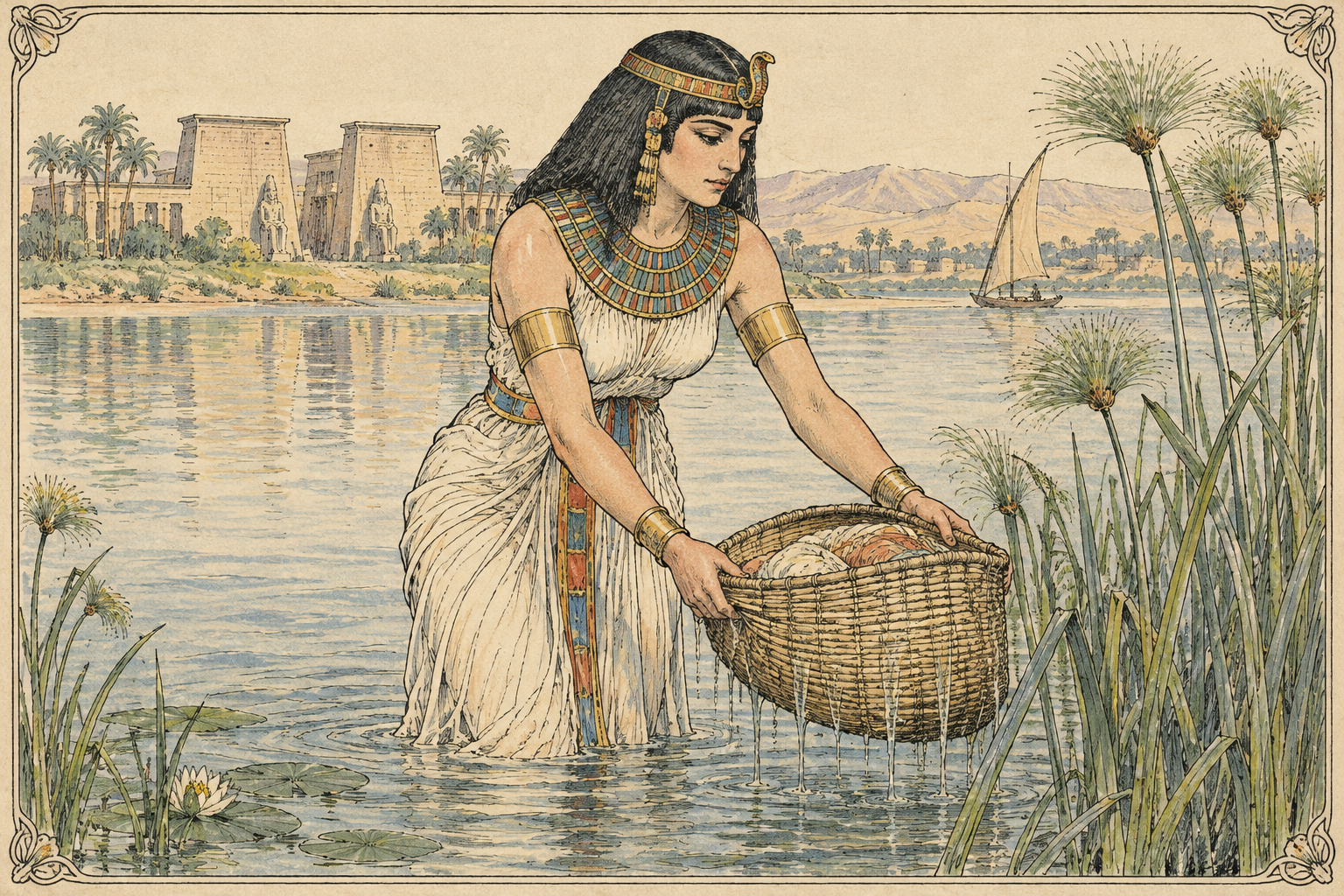
So far, we have an unusual Egyptian official. Now turn to the biblical record and the woman who pulls a Hebrew infant from a basket among the reeds.
Pharaoh's Daughter of Exodus 2:5-10
The text of Exodus names her with a title rather than a name: "the daughter of Pharaoh." She comes down to bathe at the river, finds the basket, recognizes the child as one of the Hebrews' sons, and chooses, against her own father's decree that Hebrew boys be killed, to raise him in the palace (Exodus 2:5-10). This is not a minor court lady acting on private sentiment. This is a woman with the standing to defy a direct royal order and make it stick, publicly, for years. Hatshepsut held the title "daughter of Pharaoh" before she ever wore the crown herself, as the daughter of Thutmose I. If the Exodus chronology sits within the range some scholars propose, the woman who raised Moses and the woman who later ruled Egypt as pharaoh in her own right become, at minimum, candidates worth weighing for the same identity.
A Woman Capable of Defying Her Father's Decree
The decree problem deserves more weight than it usually receives. Pharaoh orders Hebrew infant boys killed. Someone in his own household raises one anyway, under his nose, for years, without consequence. That requires either royal indifference or royal protection strong enough to override the command. Hatshepsut's entire later career is a study in exactly that kind of independence: declaring herself pharaoh over the heads of rival claimants, commissioning monuments depicting her own divine birth to legitimize a rule the court structure was never built to grant a woman. A woman who could rewrite her own legitimacy in stone at Deir el-Bahari is not a woman who would have flinched at overriding her father on the matter of one child's life.
Learned in All the Wisdom of Egypt
The book of Acts, describing Moses' upbringing, says he "was instructed in all the wisdom of the Egyptians, and was mighty in words and deeds" (Acts 7:22). This is not a throwaway line. It describes formal, high-level education, the kind reserved for scribes, priests, and officials destined for real responsibility, not casual palace hospitality. A boy raised as the ward of Egypt's most influential female steward and future pharaoh would receive precisely that formation. The wisdom Acts attributes to Moses is the wisdom you would expect from a man trained inside the highest administrative and religious circles Egypt had to offer, which is exactly where Senenmut's documented career places him.
One Builder, Two Sacred Blueprints
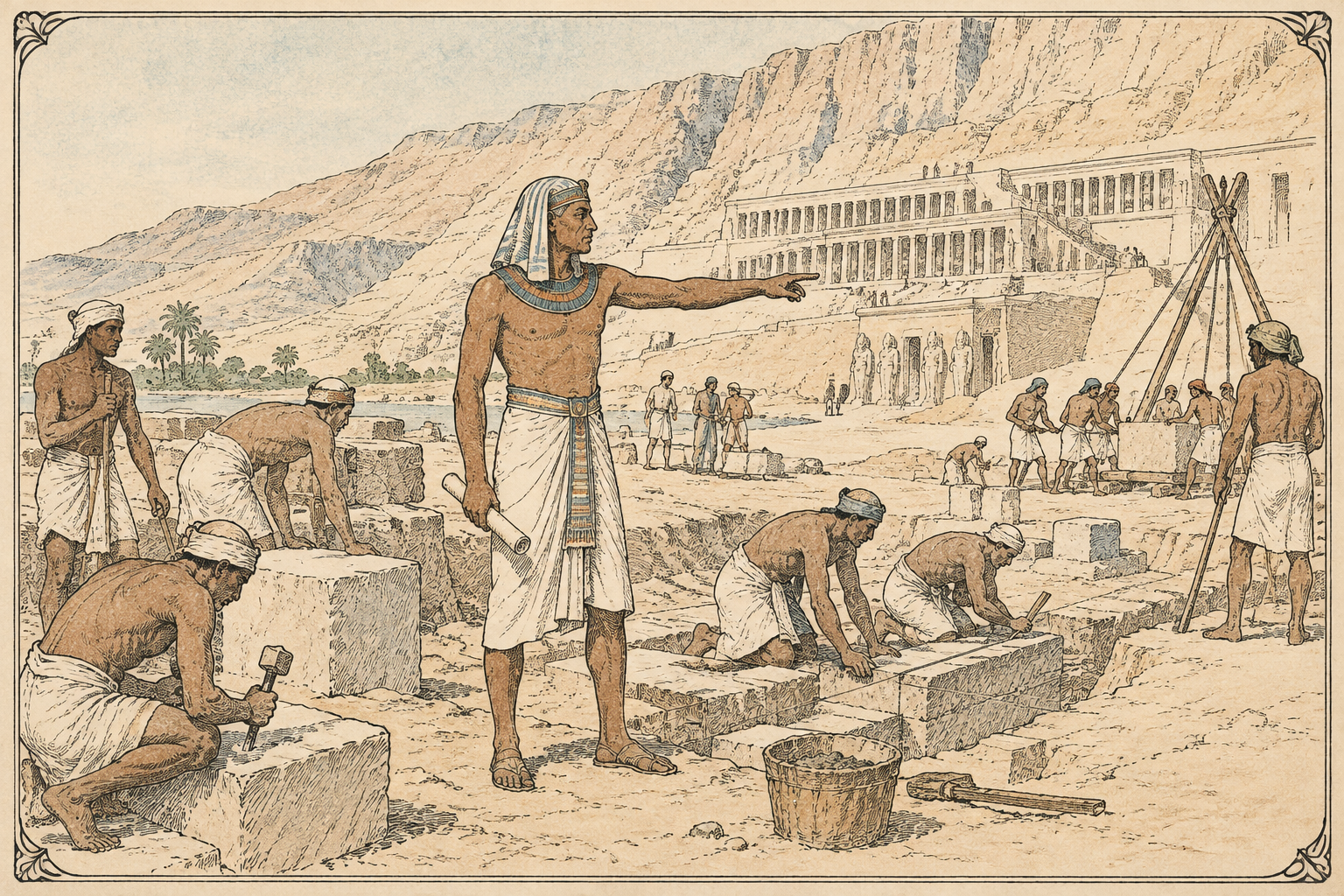
If Senenmut and Moses are the same man, we should expect to see the same mind at work in two distinct building projects, separated by exile but not by competence.
Deir el-Bahari and the Mind Behind It
Senenmut is widely credited as the architect behind Hatshepsut's mortuary temple at Deir el-Bahari, one of the most architecturally sophisticated structures of the ancient world, with its terraced colonnades set into the cliff face and its precise alignment with the solar calendar. This was not decorative work. It required engineering competence, command of skilled labor, mastery of materials, and the religious literacy to design a space meant to function as sacred architecture for generations. Whoever built Deir el-Bahari understood both stone and symbol.
The Tabernacle as a Pattern Received and Executed
Decades later, in the biblical account, Moses receives detailed instructions for a fundamentally different kind of sacred structure. "According to all that I shew thee, after the pattern of the tabernacle, and the pattern of all the instruments thereof, even so shall ye make it" (Exodus 25:9), followed by the actual construction in Exodus 40, down to exact measurements, metals, and textiles. The tabernacle is not a tent assembled by amateurs. It is a portable sanctuary engineered with the same precision Deir el-Bahari required, built by a man who already knew how to translate a sacred blueprint into physical form. Moses does not improvise this competence in the desert. He exercises it, carried over from wherever he first learned it.
The Disappearance With No Body
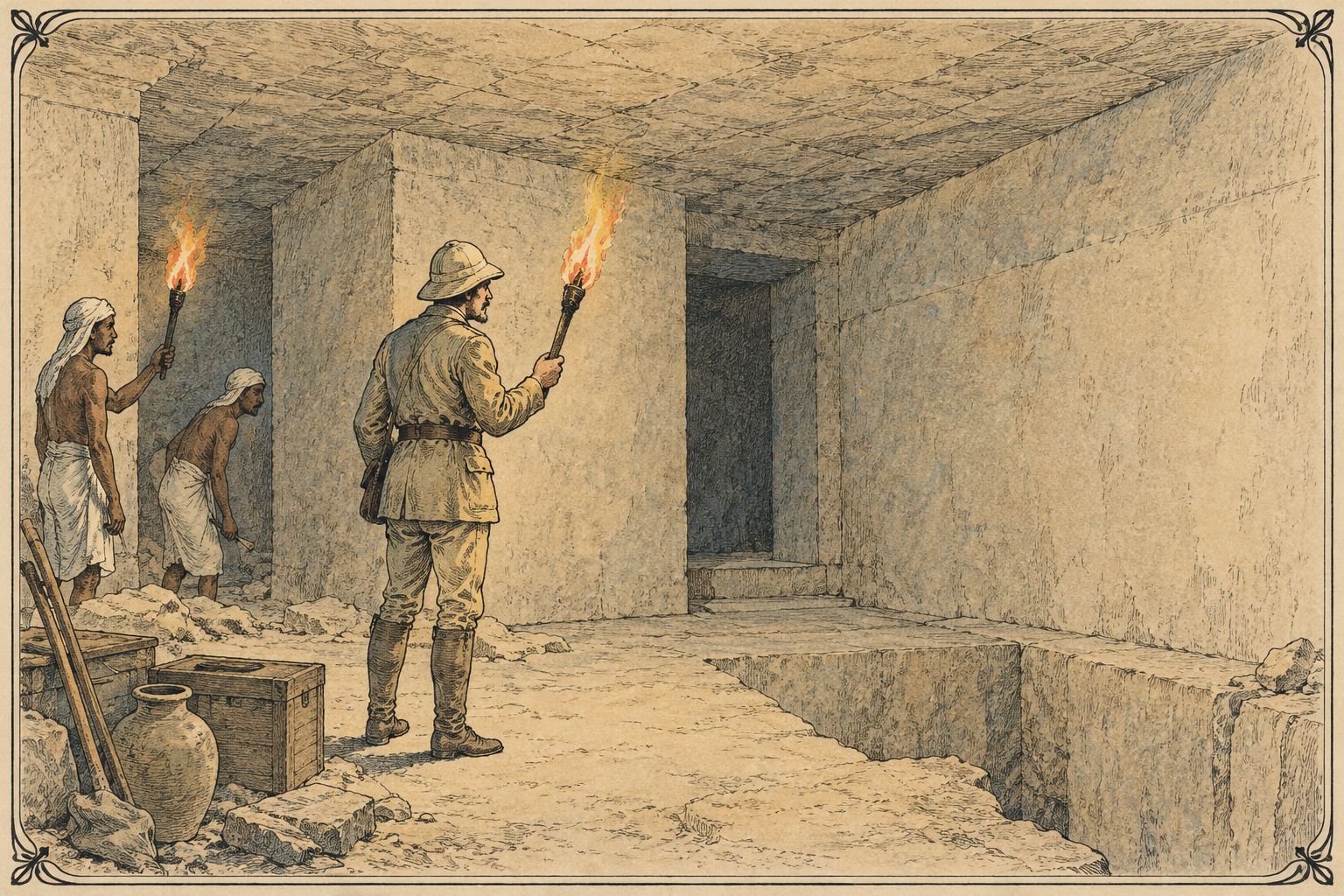
Here is where the theory earns its weight, because both records go quiet in strikingly similar ways.
Tombs Built but Never Filled
Senenmut prepared not one but two tombs for himself, including an unfinished one built directly beneath the Deir el-Bahari temple complex he had designed, close enough to Hatshepsut's own monument to suggest he expected to remain near her even in death. Neither tomb was ever used for his burial. No body has been found. A man who reached the summit of Egyptian religious and administrative power, who had the resources to build himself an elaborate resting place, simply never occupied it. He left, and he never came back.
Erasure as Evidence of Apostasy, Not Merely Political Defeat
Senenmut's name and image were deliberately chiseled out of numerous monuments late in Hatshepsut's reign, a practice Egyptologists typically file under damnatio memoriae: the deliberate condemnation of memory, in which a successor regime erases a predecessor's name and image from the record. That explanation works well enough when the man in question has died and a rival wants to blot out his legacy. It explains the erasure less well when the tombs were never filled in the first place, because damnatio memoriae usually follows a death, a funeral, a body to dishonor or at minimum a grave to neglect. Here there is neither.
Set the biblical account beside it. Moses kills an Egyptian overseer, sees that the act is known, and flees for his life before Pharaoh can have him executed (Exodus 2:11-15). This was no death but a disappearance, sudden and permanent from Egypt's point of view. A man who had stood at the center of the royal household, trusted with the heir's education and the queen's confidence, turns against the house that raised him and vanishes into exile. If that man is Senenmut, the erasure of his name and image stops looking like the aftermath of political rivalry and starts looking like exactly what a betrayed royal house would do to the memory of a favored insider who became, in their eyes, a traitor and a fugitive. The chiseled-out face on the temple wall suggests a man who left Egypt's gods behind and was never forgiven for it.
A Name That Confesses a Change of Allegiance
Names in the ancient Near East were rarely neutral. They declared something, and the two names in question declare opposite things.
Brother of Mut, Servant of Egypt's Gods
"Senenmut" ties its bearer directly to Mut, the mother goddess of Thebes and consort of Amun, one half of the divine pair at the religious heart of Eighteenth Dynasty Egypt. A man bearing that name, serving as Steward of Amun, operating daily inside the machinery of Egypt's state religion, was not a bystander to the Egyptian pantheon. He was formally and publicly identified with it. That identification is precisely the formation the Exodus plague narrative later requires of its author.
Drawn Out, and Drawn Toward Yahuah
Exodus gives the reason for its hero's name directly: Pharaoh's daughter "called his name Moses: and she said, Because I drew him out of the water" (Exodus 2:10). The Hebrew root behind the name carries the sense of being drawn out, pulled from one place into another. A man once named for his bond to Mut, now named for being drawn out, first from the Nile, and later, far more significantly, out of Egypt's service into Yahuah's, is not a coincidence of language. It reads as a confession embedded in the text itself, of a loyalty that changed hands.
Chronology, Honestly Weighed
No theory this interesting survives on parallels alone. It has to survive the calendar, and the calendar for this period is genuinely contested on both sides of the comparison.
Where the Disputed Ranges Converge
Egyptian dating for the Eighteenth Dynasty carries real uncertainty. Scholars determine the years of a pharaoh's reign largely by counting forward from known reference points and cross-checking king lists, a method that leaves real room for disagreement, and Hatshepsut's reign is commonly placed somewhere in the fifteenth century BC, though the exact years shift depending on which chronological reconstruction a given Egyptologist favors. Biblical dating for the Exodus is no less contested, with an "early date" tradition placing it around 1446 BC based on a straightforward reading of 1 Kings 6:1, and a "late date" tradition placing it closer to the thirteenth century BC based on archaeological readings of Canaanite settlement patterns. The honest observation is that the early biblical dating range and the commonly proposed range for Hatshepsut's reign and Senenmut's documented career sit close enough together that the theory is not asking the evidence to stretch beyond what serious chronologists already debate among themselves.
Answering the Hard Questions Rather Than Avoiding Them
A fair objection follows: if the dates do not align with precision, the whole theory would seem to collapse. Ancient Near Eastern chronology before the first millennium BC is reconstructed, not recorded with the kind of fixed-point certainty modern historians enjoy for later periods. Regnal years, the dates assigned to a ruler's time on the throne, get revised as new inscriptions surface. Matters are further complicated by co-regencies, periods when two rulers, often a parent and child, reigned jointly, which make reign lengths harder to pin down. The honest answer is not that every question has been settled, but that the Moses Senenmut theory fits within the same disputed ranges serious Egyptologists and biblical historians already argue over for independent reasons. That is a different thing from manufacturing a date to fit a theory. It is finding a theory that does not require breaking the chronology to work.
Theological Weight Behind the History
If this identification holds, even provisionally, the stakes run well beyond a historical curiosity. They reach into how we read the entire plague narrative.
An Insider's Knowledge of Egypt's Gods
A man formed inside the Steward of Amun's office, intimate with Mut's cult, present at the center of Theban religious life, would not need to guess at Egypt's theology from the outside. He would know precisely which god ruled the Nile, which god governed the sun, which god was supposed to protect Pharaoh's own firstborn. Every plague in Exodus lines up against a specific claim of Egyptian religion, and a man with Senenmut's formation is exactly the kind of author who could aim each one with that precision rather than stumbling onto it by folk memory generations later.
Exodus 12:12 as Judgment, Not Folklore
"Against all the gods of Egypt I will execute judgment: I am the Lord (Yahuah)," reads Exodus 12:12. Read as the work of a distant folk tradition, that line is a boast. Read as the testimony of a man who once wore the title Brother of Mut, who once served in Amun's household, who once stood close enough to Egypt's gods to know their claims from the inside and reject them, it becomes something else entirely. It becomes a renunciation, written by a man uniquely positioned to know exactly what he was renouncing, and exactly what he was leaving behind.
The theory does not resolve every question tidily, and no honest treatment of ancient history should pretend otherwise. What it does is take two separate records, one Egyptian stone and one Hebrew scroll, and show how precisely their silences and their details interlock. A commoner's son rises to the edge of the throne and disappears without a grave. A Hebrew child rises inside the same household and disappears into the desert. A steward named for an Egyptian goddess becomes a prophet named for being drawn out. Whether or not every reader leaves persuaded, the Moses Senenmut theory deserves to be weighed on its own evidence rather than dismissed before the case is heard.