Picture a newsroom bulletin, the kind with a ticker scrolling urgent words across the bottom of the screen. Now picture that ticker carrying words almost two thousand years old, spoken not from a studio desk but from a throne: he that overcometh shall inherit all things. The Revelation 21:7-8 meaning reads like breaking news because that is exactly what it is. It announces an outcome rather than merely describing one.
Two verses, one sweeping promise, one sober warning. A son inheriting everything stands beside a list ending in the lake of fire. Readers want to rush toward the comfort and skip past the warning, or dwell on the warning and miss the comfort entirely. Neither move does justice to the text.
What follows walks through these two verses in the order the vision itself gives them, starting with a single word that decides everything: overcome.
The Word That Changes Everything: Unpacking "He That Overcometh" (Revelation 21:7-8 Meaning)
Everything in Revelation 21:7 hangs on one verb. "He that overcometh shall inherit all things." Before we ask what is inherited, we need to ask what it means to overcome. Get that wrong, and the whole passage becomes either a trophy for the spiritually impressive or an anxiety machine for everyone else.
Nikao Across the Seven Letters: A Thread Running Through Revelation 2-3
The Greek word behind "overcometh" is nikao, and it does not appear once in Revelation and then vanish. It threads through every single letter to the seven churches in chapters 2 and 3. To Ephesus: "To him that overcometh will I give to eat of the tree of life." To Smyrna: "He that overcometh shall not be hurt of the second death." To Pergamum, to Thyatira, to Sardis, to Philadelphia, to Laodicea, the refrain repeats like a drumbeat beneath seven distinct sermons to seven distinct congregations.
This matters because it tells us overcoming is not a single dramatic crisis, a heroic moment of resistance under torture or a once-in-a-lifetime act of courage. It is the ordinary, repeated posture of staying faithful across the long haul of ordinary life. Some of these churches faced persecution. Others faced the much quieter danger of lukewarm compromise, the kind that creeps in through comfort rather than through threat. Overcoming applied to both.
The letters do not say "overcome persecution" or "overcome false teaching" as separate achievements for separate churches. They simply say "overcome," leaving the content to be supplied by whatever battle each community faced. The word is elastic enough to cover a Smyrnan believer facing prison and a Laodicean believer facing nothing but prosperity and apathy. That is the point. Overcoming is not one specific victory. It is a way of remaining through however many fights a faithful life requires.
1 John 5:4-5: Overcoming Defined as Faith in the Son
So what, concretely, does overcoming involve? The same apostolic circle that produced Revelation also produced a short letter that answers this question with unusual precision. "Whatsoever is born of God (Alohim) overcometh the world," the text says, "and this is the victory that overcometh the world, even our faith. Who is he that overcometh the world, but he that believeth that Jesus (YHWShA) is the Son of God?"
Notice what is not said here. The text does not say overcoming means achieving moral perfection, or never sinning again, or performing some measurable quota of good deeds. Overcoming the world is tied to belief. It is tied to the conviction that Jesus is God himself revealed in human flesh, the one through whom the fullness of the Godhead has entered human history. Faith is not a precondition for overcoming. Faith is the overcoming.
This is not a loophole that cheapens the moral seriousness of Revelation. It is the foundation that makes moral seriousness possible in the first place. A person does not resist the pressures of an idolatrous culture, or stay faithful under threat, or refuse the easy compromises of Laodicean comfort, by sheer willpower. They do it because something has already happened to them. They have been born of God. The battle is real, but the victory has a source outside the believer's own effort.
Why the Word Matters Before the Reward Does
Readers often skip straight to "inherit all things" because it sounds wonderful, and it is. But skipping past the verb that qualifies the promise leads to a shallow reading. The promise is not given to the spiritually impressive or the morally flawless. It is given to those who overcome in the specific sense described: those who believe, who remain, who do not surrender their confession even when remaining costs something.
Of course one can read "inherit all things" as a free-floating reward disconnected from any condition. Many readers do, and the comfort is understandable. But what you cannot do, not if you want to read Revelation on its own terms, is separate the promise from the verb that governs it in every single occurrence across chapters 2, 3, and 21. The word matters because it tells us who the promise is for, and it tells us in terms of relationship rather than performance. That sets up the next question precisely: what is being inherited, and by whom.
Inheritance as Sonship: The Covenant Formula Behind "He Shall Be My Son"
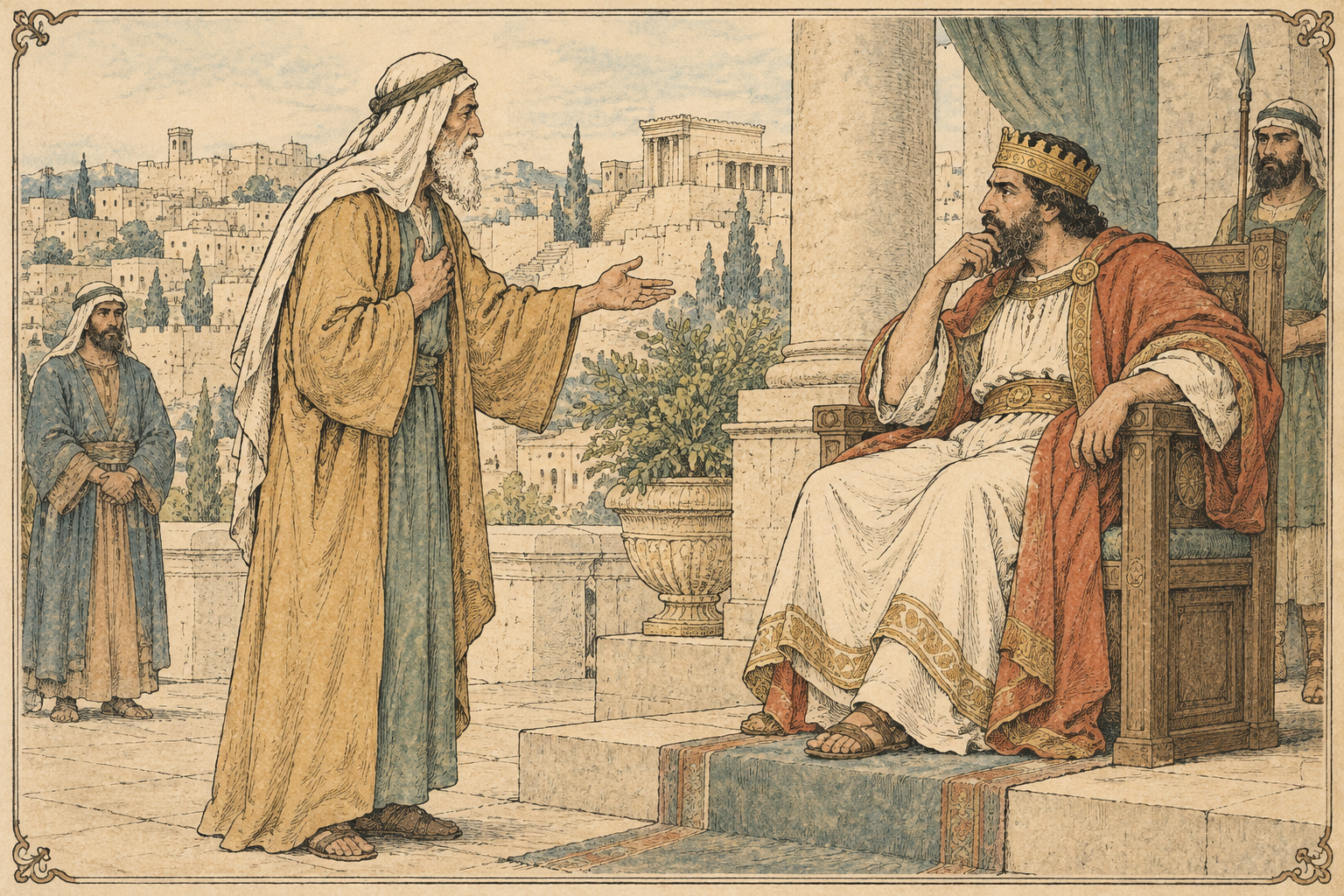
Revelation 21:7 does not stop at "he that overcometh shall inherit all things." It continues: "and I will be his God, and he shall be my son." This second half of the verse is doing more theological work than most readers realize.
Echoes of 2 Samuel 7:14 and the Covenant Formula "I Will Be His God"
"I will be his God, and he shall be my son" is not a new phrase invented for the book of Revelation. It is a direct echo of the covenant God made with David through the prophet Nathan: "I will be his father, and he shall be my son." That promise, recorded in 2 Samuel 7:14, established the line through which Israel's king would rule, and ultimately pointed toward a greater son of David still to come.
Revelation takes that ancient royal promise, once spoken to a single dynasty, and extends it to every overcomer in every church, in every generation, who holds fast in faith. This is not a casual borrowing of pleasant language. It is a deliberate act of theological inheritance, in which the covenant formula once reserved for a king now describes the relationship God Almighty offers to his people. The early Christian teachers who first read this book would have caught the echo instantly. For them, the Davidic covenant was not ancient history. It was the promise their Messiah had come to fulfill and extend.
Inheritance Is Relational, Not Transactional
"Inherit all things" sounds, to modern ears trained by lottery tickets and inheritance disputes on television dramas, like the language of a prize. Something handed over because a contestant met the criteria. But that is not how inheritance worked in the ancient world, and it is not how this text is using the word.
An inheritance in the biblical world belonged to a son because he was a son. It was not earned through a transaction. It flowed out of a relationship that already existed. The father did not hand over the estate because the son completed a checklist. He handed it over because the son belonged to the family. Revelation 21:7 is making exactly this claim about the people of God. The promise is not "perform well enough and you will be awarded a trophy." The promise is "you will be mine, and I will be yours, and everything that belongs to a child in this family belongs to you too."
This reframes the entire passage from a transaction into an invitation into kinship. The overcomer is not a competitor collecting a prize for finishing the race. The overcomer is a child, welcomed home, given everything the family has to give because that is simply what families do for their children. None of this means effort or perseverance are irrelevant. It means the effort flows from belonging rather than earning belonging.
The Setting of Revelation 21:1-5: A New Heavens and New Earth Worth Inheriting
What exactly is being inherited matters as much as the terms of the inheritance. Revelation 21 opens with one of the most striking visions in the entire book: "I saw a new heaven and a new earth, for the first heaven and the first earth were passed away." The holy city descends, not as humanity escaping earth to reach heaven, but as heaven coming down to renew earth. "Behold, the tabernacle of God is with men, and he will dwell with them." God himself wipes away every tear. Death is no more. Sorrow and crying and pain belong to the former things, now passed away.
This is the inheritance. Not a disembodied eternity floating somewhere else, but a renewed creation where God dwells fully and visibly among his people. The biblical writers understood the whole story of Scripture as moving toward exactly this point, heaven and earth joined rather than separated, humanity restored to the garden relationship with God that Eden once pictured. "Inherit all things" is not a vague phrase gesturing at some unspecified bliss. It is a concrete promise rooted in a concrete vision five verses earlier. The son inherits a renewed world, because that is what the Father has been building toward all along.
Revelation 21:8 and the Lake of Fire: Reading the List in Its Actual Order
Having set the promise in its full relational and cosmic context, the text turns, without flinching, to its opposite. "But the fearful, and unbelieving, and the abominable, and murderers, and whoremongers, and sorcerers, and idolaters, and all liars, shall have their part in the lake which burneth with fire and brimstone: which is the second death."
Cowardly and Unbelieving: Why Posture Comes Before Behavior
Here is the detail that nearly every casual reading of this verse skips past. The list does not open with murder, the crime our instincts flag first. It does not open with sexual immorality, the sin most commonly preached from pulpits. It opens with cowardice and unbelief.
This ordering is not accidental in a book this carefully constructed. Revelation names the posture before it names the behavior, because the posture is the root and the behavior is the fruit. Cowardice, in this context, is not an isolated moment of fear under pressure. It describes the settled refusal to stand with Christ when standing costs something, the opposite of the overcoming described one verse earlier. Unbelief is its twin, the refusal to trust that Jesus is who he claimed to be. Put together, these two words describe a fundamental orientation away from God rather than a single bad decision.
This inverts the moral priority most readers bring to the text instinctively. We rank sins by visible damage. Murder seems worse than fear. Sorcery seems worse than doubt. But Revelation is working with a different map entirely, one in which rejection of God himself is the deepest wound, the one from which every other failure eventually grows. The cowardly and unbelieving head the list not because they are the worst offenders in human terms, but because their condition describes everyone else on the list before any specific act is ever committed.
The Rest of the List: Vile, Murderers, Sexually Immoral, Sorcerers, Idolaters, Liars
The remaining categories then unfold as specific expressions of that same root condition. The abominable, often translated "vile" or "detestable," describes practices the biblical world associated with cultic degradation. Murderers take life that belongs to God alone to give. The sexually immoral violate the covenant boundaries God established for intimacy and marriage. Sorcerers, from a Greek word related to pharmaceutical arts and occult practice, seek power and knowledge through channels other than God. Idolaters give worship, the one thing owed exclusively to the Creator, to created things instead. Liars corrupt the trust that holds any community, any covenant, any relationship with God together.
None of these are presented as isolated moral failures unrelated to the opening pair. Each is a different route to the same destination, a life oriented away from the God who offers sonship. The list reads less like a courtroom docket of unrelated offenses and more like a single diagnosis described from several angles.
Lake of Fire Revelation 21:8: Theological Reality, Not Geography
The lake of fire in Revelation 21:8 does not function in the text as a location one could find on a map, the way one might locate ancient Babylon or first-century Ephesus. It functions as a theological claim about final consequence. Throughout Revelation, fire consistently symbolizes purifying and consuming judgment, the complete and final separation of what opposes God from the renewed world described in the opening verses of the same chapter.
This is not a reason to treat the warning lightly. The text intends gravity, not geography. What is being described is the opposite of everything inheritance promises: instead of dwelling with God in a renewed creation, exclusion from that dwelling altogether. The weight of the warning comes precisely from the weight of what is being lost, not from colorful details about flame and sulfur that modern readers tend to fixate on instead.
The Second Death: A Sober Biblical Portrait
The phrase "second death" appears carefully placed across the book rather than introduced once for dramatic effect, and that placement helps us read it rightly.
Tracing the Phrase Through Revelation 2:11, 20:6, and 20:14
The first occurrence comes early, in the letter to Smyrna: "He that overcometh shall not be hurt of the second death." Already the connection to overcoming is established, long before chapter 21 arrives. The second occurrence sits in chapter 20: "Blessed and holy is he that hath part in the first resurrection: on such the second death hath no power." The third defines the term directly: "This is the second death," following the scene of final judgment where death and Hades themselves are cast into the lake of fire.
Taken together, these three verses build a single, consistent picture rather than three disconnected images. The second death is set in direct relationship with overcoming (chapter 2), with resurrection (chapter 20), and with final judgment (chapter 20 again), and Revelation 21:8 simply draws that established thread into its concluding vision.
How the Second Death Differs From the First
Every human being experiences a first death, the separation of body from life that comes to kings and paupers alike, the common inheritance of Adam's descendants. Scripture never treats this death as the final word. It is a passage, however painful, toward resurrection.
The second death is something else entirely. It is tied in the text to final judgment, to the great white throne, to names absent from the book of life. Where the first death is universal and, for those in Christ, temporary, the second death is described as final exclusion from the life God offers, the complete and lasting opposite of the inheritance promised to the overcomer one verse earlier. The first death touches the body. The second death, as the text presents it, touches a person's entire future with God.
Handling a Hard Teaching Without Sensationalism
It would be easy to turn this material into spectacle, and plenty of preaching through the centuries has done exactly that, trading careful exegesis for vivid imagery designed to frighten rather than to clarify. That approach does not honor the text. Revelation itself does not linger on gruesome description. It states the reality plainly and moves on, trusting the weight of the claim to do its own work without embellishment.
The appropriate response to a hard teaching is neither to minimize it into irrelevance nor to weaponize it into a tool of fear. It is to receive it with the same seriousness the original author intended, as a sober warning wrapped inside a larger invitation. That is the only honest way to hold this text.
The Choice Set Before the Reader
Revelation as Invitation, Not Mere Warning
Step back and look at the whole shape of Revelation 21:7-8 again. Every one of the seven letters to the churches in chapters 2 and 3 ends with the same appeal: overcome, and receive what is promised. Revelation 21:7-8 is not a new threat appended to an otherwise comforting vision. It is the same appeal, offered one final time, now set against the backdrop of the renewed creation itself.
This is the frame that should govern how the passage is read. The dominant note is invitation. The warning exists because the invitation is real and the stakes are real, not because the text wants to frighten its readers into compliance. A parent who warns a child about a busy road is not threatening the child. The parent is protecting a relationship already cherished. Revelation 21:8 reads the same way, a warning spoken out of love for people the text has already called sons and daughters.
Can a Believer Lose the Inheritance? Steadfastness and Assurance
This raises an honest pastoral question many readers carry quietly. Can someone who has believed lose this inheritance through failure or struggle. The text answers with neither careless assurance nor constant anxiety.
Overcoming, as traced through the seven letters and through 1 John, is rooted in ongoing faith rather than flawless performance. The believer who stumbles, who doubts, who fails and returns, is not thereby disqualified from the promise, because the promise was never built on flawless performance in the first place. It was built on faith in Jesus as the Son of God, a faith that can be weak, tested, and still genuine. What the text warns against is not failure but final refusal, the settled cowardice and unbelief named first in verse 8, the decision to walk away from the relationship altogether rather than the ordinary struggle of remaining within it. Assurance, rightly understood, rests not on a person's unbroken record but on the character of the God who made the promise in the first place.
Entering the Inheritance: From John 1:12 to Acts 2:38
All of this leaves one final, practical question. How does a person enter this inheritance in the first place?
The Right to Become Children of God (John 1:12)
The opening chapter of John's gospel describes the Word, God himself, entering human history in the person of Jesus. "But as many as received him, to them gave he power to become the sons of God, even to them that believe on his name." This is the mechanism behind the abstract promise of sonship traced throughout Revelation 21:7. Becoming a child of God is not automatic for every person by birth. It is a right given to those who receive Jesus, who believe on his name, the same belief 1 John 5 identifies as the substance of overcoming itself.
Peter's Answer at Pentecost: Repentance and New Birth (Acts 2:38)
When the crowd at Pentecost asked the apostles directly, "what shall we do," Peter's answer was immediate and concrete: "Repent, and be baptized every one of you in the name of Jesus Christ for the remission of sins, and ye shall receive the gift of the Holy Ghost." This is the practical entry point into everything Revelation 21:7 describes. Repentance turns a person away from the cowardice and unbelief named in verse 8. Baptism in the name of Jesus marks the public entry into the family whose covenant formula echoes all the way back to 2 Samuel 7:14. The gift of the Spirit marks the beginning of the ongoing life of faith that Revelation calls overcoming.
Where to Go From Here
Revelation 21:7-8 is not a riddle to be solved once and filed away. It is an invitation that keeps calling readers back to examine where they stand, what they believe, and whether they are walking in the overcoming faith the text describes. For readers who want to keep tracing these questions, more teaching through the full sweep of Revelation and the wider biblical story is available at BabelReport.com, written for exactly this kind of patient, careful walking through Scripture together.
The Revelation 21:7-8 meaning is not ultimately about fear. It is about a Father who has already decided to call overcomers his own sons and daughters, and who has thrown open the door for anyone willing to walk through it. The invitation stands.